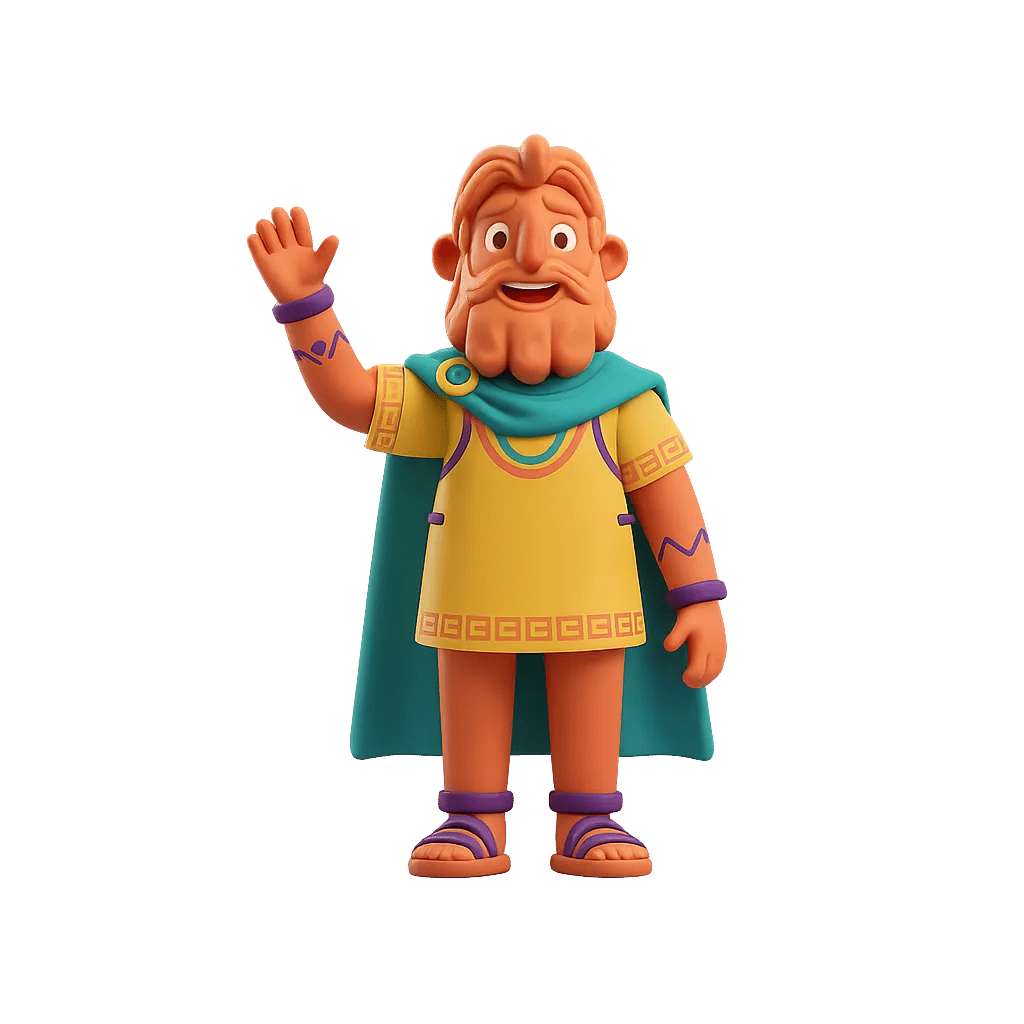
12 Greek Mythology Stories Everyone Should Know


Three thousand years is a long time for a story to stay in circulation. The Greek myths have outlasted the religion that produced them, the language most of them were first told in, and every empire that borrowed them since. They survived because none of them are really about gods. They are about grief, and hubris, and curiosity that will not be talked out of opening the lid. They are about the particular horror of getting exactly what you asked for.
What follows are twelve of them, told as stories rather than summarised as plot points, because that is how they were meant to travel — spoken aloud, in one sitting, to someone who did not yet know the ending. Where the ancient sources disagree, and they disagree constantly, we have said so. Hesiod, Homer, Apollodorus and Ovid were not writing scripture. They were retelling, and arguing, much as we still do.
Prometheus and the Theft of Fire
At Mecone, where gods and mortals were still settling the terms of their relationship, Prometheus was asked to divide an ox. He made two piles. One was bones, dressed in a glistening layer of fat. The other was the good meat, hidden inside the animal's stomach — repellent on the outside. Zeus chose the fat. Whether he was fooled or chose to be fooled, Hesiod leaves deliberately unclear in the Theogony. Either way, Zeus took his revenge by withholding fire from mankind.
So Prometheus stole it. He hid a coal in the pith of a fennel stalk, a plant that smoulders slowly from the inside, and walked it down to earth. Zeus had him chained to a crag in the Caucasus, where an eagle came each day to eat his liver, and each night the liver grew back. Generations later, Heracles shot the eagle.
Prometheus means forethought. His brother, Epimetheus, means afterthought, and that distinction is about to matter enormously.
Pandora and the Jar
Zeus was not finished. He had Hephaestus mould the first woman out of earth and water, and the gods dressed her between them: beauty from Aphrodite, skill at the loom from Athena, and from Hermes a mind full of lies and a persuasive tongue. They named her Pandora, all-gifted, and sent her down to Epimetheus — who had been warned by his brother never to accept a present from Zeus, and who accepted anyway.
She came with a jar. Hesiod's Works and Days does not say she was told not to open it, only that she lifted the lid, and out came every sickness and sorrow and labour that had never troubled humanity before, scattering silently, because Zeus had taken their voices. Pandora got the lid back on with one thing still inside: elpis, hope. Whether hope was being saved for us or kept from us, Hesiod never explains.
It was a storage jar, a pithos. The box is Erasmus's mistranslation in the sixteenth century, and it has outsold the original ever since.
Persephone and the Pomegranate
She was picking flowers in a meadow — a narcissus in particular, one that Gaia had grown as a trap, with a hundred blossoms on a single stem. When Persephone reached for it the ground opened and Hades came up through it at a gallop, and the only witness was Hecate, who heard her cry out but saw nothing.
Her mother Demeter searched for nine days without eating, then stopped searching and simply stopped the harvest. The Homeric Hymn to Demeter is unsparing about what followed: seed lay in the ground and did not rise, oxen dragged ploughs for nothing, and the human race came close enough to extinction that Zeus noticed the gods were losing their sacrifices. He sent Hermes to bring her back.
Hades let her go. But first he gave her something to eat, and she ate, and food from the underworld binds you to it. In the Hymn it is a single pomegranate seed; Ovid makes it seven. She returns to her mother for part of the year, and for the rest the fields go quiet.
Orpheus and Eurydice
Orpheus sang so well that rivers changed course to stay within earshot. When his wife Eurydice died of a snakebite on the day of their wedding, he did the thing no one else had thought to try: he went down to argue.
He sang his case to Hades and Persephone. Virgil, in the fourth Georgic, says the bloodless shades wept, Cerberus held his three mouths open in silence, and Ixion's wheel stopped turning. They gave her back on one condition — that Orpheus walk ahead of her to the upper world and not look behind him until they were both out in the light.
He had almost made it. With the daylight in sight, he turned. Ovid gives the detail that finishes it: she slipped backwards, and though she reached for him she caught only air, and her last word was goodbye, spoken so faintly he could barely hear it.
Both Virgil and Ovid are Roman. The earliest Greek fragments may have let him succeed — the failure, as we tell it, is a late addition, and we have never let it go.
Icarus and Daedalus
Daedalus was the finest craftsman alive and a prisoner of his own résumé. He had built the Labyrinth for King Minos, and Minos was not about to let the only man who knew its layout leave Crete. The sea and the land were watched. Daedalus looked up.
He gathered feathers, graded them by length, bound them with thread and sealed them with wax, and Ovid gives us young Icarus underfoot the whole time, grabbing at feathers as they blew about and softening the wax with his thumb, getting in the way of the work that would kill him. Then the briefing: stay in the middle. Fly low and the sea spray will weigh the feathers down. Fly high and the sun will loosen the wax.
They went. A ploughman looked up and took them for gods. Then Icarus, giddy with it, climbed — the wax ran, bare arms beat at nothing, and the sea that took him is still called the Icarian.
Daedalus was the one who understood the limits. He was also the one who built the wings.
Theseus and the Minotaur
Every nine years, Athens sent seven young men and seven young women to Crete to be fed to a monster. The Minotaur was Minos's shame — his wife Pasiphaë's child by a bull — and he kept it out of sight at the centre of Daedalus's Labyrinth, where the tribute was sent in and never came out.
Theseus volunteered for the third shipment. He told his father Aegeus that if he survived, he would change the ship's black sails for white ones on the return. On Crete, Minos's daughter Ariadne saw him and made a choice against her own house: she gave him a ball of thread and told him to tie one end at the entrance.
He found the Minotaur asleep, killed it with his bare hands in Apollodorus's version, and wound the thread back out through the dark. Then he sailed with Ariadne and abandoned her on Naxos while she slept.
And he forgot the sails. Aegeus, watching from the cliffs, saw black, and threw himself into the sea that now carries his name.
Perseus and Medusa
Perseus was sent to kill Medusa as a joke that got out of hand. King Polydectes wanted Perseus's mother and wanted Perseus gone, so he demanded an impossible gift and named the Gorgon's head.
The gods equipped him, because his father was Zeus. First he had to find the Graeae, three sisters who shared a single eye between them, and he stole it mid-handover and refused to give it back until they told him where the nymphs lived. From the nymphs came winged sandals, a bag to carry the head, and the cap of Hades, which made him invisible. Hermes gave him an adamantine sickle. Athena gave him a polished shield, and the shield was the whole trick: he walked in backwards, watching her reflection, and cut.
From the stump came the winged horse Pegasus. On the way home he found Andromeda chained to a rock and freed her, and at home he used the head one last time on Polydectes, who did not believe him.
Ovid adds the detail Greek sources do not: that Medusa had been beautiful, and was violated in Athena's own temple, and that Athena punished the victim.
Odysseus and the Cyclops
Twelve men walked into a cave that was clearly somebody's home, ate the cheese, and waited to see who lived there. Odysseus admits in Odyssey Book 9 that his crew begged him to take the cheese and go.
Polyphemus came back with his flocks, rolled a boulder across the entrance that twenty wagons could not shift, and ate two of them. In the morning he ate two more and took the sheep out, leaving the rock in place — because killing him in his sleep meant dying slowly in a sealed cave. So Odysseus sharpened an olive-wood stake, hardened the point in the fire, and that evening offered the Cyclops undiluted wine. Asked his name, he said Outis. Nobody.
They drove the stake into his eye. When the other Cyclopes came running, Polyphemus roared that Nobody was killing him, and they went home. At dawn, the blinded giant felt the backs of his sheep as they filed out, and the men went under the bellies.
Safely offshore, Odysseus shouted his real name across the water. It cost him ten years.
The Judgement of Paris
Every god was invited to the wedding of Peleus and Thetis except Eris, goddess of discord, which was an oversight of a very predictable kind. She came anyway and rolled a golden apple into the hall inscribed to the fairest.
Hera, Athena and Aphrodite all claimed it. Zeus, who was married to one of them and fathered another, declined to judge and sent Hermes to fetch a neutral party: a Trojan prince keeping sheep on Mount Ida. None of the three goddesses considered simply letting him look at them. Hera offered Paris rule over all Asia. Athena offered wisdom and victory in every battle. Aphrodite offered him the most beautiful woman in the world.
He chose Aphrodite. The woman was Helen, and she was already married to Menelaus of Sparta.
Homer's Iliad mentions the judgement only once, in the final book, almost in passing — the poem assumes you already know. A thousand ships, ten years of siege, and the deaths of Hector, Achilles and Troy itself all fold back into one man on a hillside being offered a bribe.
Midas and the Golden Touch
Midas found Dionysus's old tutor Silenus drunk and lost in his rose garden, and rather than turn him out, kept him for ten days of hospitality before returning him. Dionysus, grateful, offered any reward. Midas did not think for long.
Ovid tells what happened next as comedy curdling into horror. A twig turns to gold in his hand and he is delighted. A stone, an apple, the doorposts — gold, gold, gold. Then he sits down to dinner. The bread goes stiff and yellow against his teeth. The wine runs down his throat as molten metal. He is the richest man alive and he is going to starve, surrounded by a harvest he cannot eat, praying to be made poor again.
Dionysus sent him to wash in the river Pactolus, and the gold ran out of him into the water — which is why, the Lydians said, the Pactolus ran with gold dust.
The daughter who turns to gold in his arms is not Ovid. She is Nathaniel Hawthorne's, added in 1852, and she has quietly replaced the original ending.
Arachne and the Weaving Contest
Arachne was a dyer's daughter from Lydia with no lineage worth mentioning and hands that everyone came to watch. When people said she must have learned from Athena, she said she had not, and challenged the goddess to prove otherwise.
Athena came disguised as an old woman and advised her to apologise. Arachne told the old woman to mind her own business. The goddess dropped the disguise and the looms went up.
Ovid, who gives us the only full version, makes the contest a political one. Athena wove the gods enthroned in judgement, with mortals being punished in each corner for overreaching. Arachne wove the other side of the story: Zeus as a bull carrying off Europa, as a swan with Leda, as golden rain falling on Danaë — twenty-one scenes of gods deceiving women, worked so finely that Ovid says not even Envy could fault it.
That was the problem. Athena tore the cloth, struck her with the shuttle, and when Arachne hanged herself, sprinkled her with herbs until her body shrank and her fingers became legs. She is still weaving, and we still call her kind arachnids.
Sisyphus and the Stone
Sisyphus was the cleverest man in Greece and he used it entirely on himself. He saw Zeus carrying off the river-god Asopus's daughter and sold the information to her father in exchange for a spring. Zeus sent Death to collect him.
So Sisyphus chained Death up. For as long as Thanatos sat bound in a back room, nobody on earth could die — armies hacked at each other and stood up again — until Ares, whose entire profession had been ruined, came and freed him. Even then Sisyphus had one more move: he told his wife to leave his body unburied, then complained to Persephone about the disrespect and was allowed back up to arrange the funeral. He stayed for years.
Homer shows us the sentence in Odyssey Book 11: heaving a boulder towards the crest of a hill, the whole weight of it turning at the last moment and rolling back down to the plain, and Sisyphus walking down after it, sweating, dust on his head.
Camus, in 1942, read that walk down the hill as the only free moment in the story, and asked us to imagine Sisyphus happy.
Frequently Asked Questions
What is the most famous Greek myth?
The Trojan War cycle is the most famous, and the Judgement of Paris that triggered it is the single best-known episode within it. If you mean the most retold individual story, Icarus and Daedalus and Pandora's jar are the two that turn up most often in modern writing, advertising and film. The Odyssey is the most read as an actual text.
What are the main Greek mythology stories?
They fall into three groups: the creation and succession myths (Prometheus, Pandora, the Titans), the hero quests (Perseus, Theseus, Heracles, Jason), and the Trojan War and its aftermath, covered by Homer's Iliad and Odyssey. Alongside those sit the transformation myths — Arachne, Midas, Orpheus — which come mostly from Ovid's Metamorphoses, a Roman poem written some seven centuries after Homer.
Where should I start with Greek mythology?
Start with the Odyssey, which is an adventure story before it is anything else and works perfectly well without background reading — Emily Wilson's translation is the most readable in English. After that, read Ovid's Metamorphoses for the transformation myths and Hesiod's Theogony for how the world was put together. Retellings by Stephen Fry, Madeline Miller and Natalie Haynes are good company alongside the sources rather than instead of them.
Where to Go Next
If these twelve have left you wanting the map rather than the highlights — who the Olympians are, how the Titans fit in, which monster belongs to which hero — our Greek mythology for beginners guide lays out the whole family tree in one sitting. And if you would rather have the myths read to you, we have gone through the field and picked the ten shows worth your commute in the best Greek mythology podcasts of 2026, from classicist-hosted deep dives to gentler introductions.
These stories were built for the ear, which is the reasoning behind how we publish them. Chunks narrates myths like these as five-minute stories — properly told, with the sources acknowledged where they disagree — and gives you a free one every day, on iOS and Android. Pandora's jar takes about as long as making a coffee.

Founder of Chunks Microlearning. Software engineer with 15 years of experience.
 Download on iOS
 Download on Android