
Who is Perseus?
Hear Perseus's story
Chapter 1 of Medusa and Perseus · the full story is in the app
Perseus was a legendary Greek hero, son of Zeus and the mortal Danae, and founder of the Perseid dynasty, revered alongside Cadmus and Bellerophon as a great monster-slayer before Heracles. Raised on Seriphos, he beheaded the Gorgon Medusa for King Polydectes and rescued Andromeda from the sea monster Cetus, later marrying her. Tradition credits him with founding Mycenae and fulfilling a prophecy by accidentally killing his grandfather Acrisius.
Greek hero, son of Zeus and Danaë, who beheaded the Gorgon Medusa.
Don't stop at the facts — continue Perseus's story in free narrated chapters on Chunks.
See how Chunks works → Download on iOS
 Download on Android
Quick facts
- Role
- Hero of Greek myth
Perseus: key facts
- Perseus was the son of Zeus and the mortal princess Danae, conceived after Zeus came to her as a shower of gold while she was imprisoned by her father, King Acrisius of Argos.
- He was raised on the island of Seriphos by the fisherman Dictys after he and his mother washed ashore there in a wooden chest.
- To satisfy King Polydectes of Seriphos, Perseus beheaded the Gorgon Medusa, using a reflective shield lent by Athena and a harpe sword and winged sandals lent by Hermes, along with Hades's helm of invisibility.
- From Medusa's severed neck sprang the winged horse Pegasus and the giant Chrysaor, both children of Medusa and Poseidon.
- Perseus rescued the Aethiopian princess Andromeda from the sea monster Cetus and subsequently married her, with the couple having seven sons and two daughters.
- An oracle's prophecy that Perseus would kill his grandfather Acrisius was fulfilled when Perseus accidentally struck him fatally with a discus during athletic games.
- Greek tradition credits Perseus with founding the city of Mycenae, and he and Andromeda's descendants, the Perseid dynasty, eventually included the hero Heracles.
A Child Born of a Golden Shower
Perseus belongs to the oldest layer of Greek heroic legend, predating even Heracles, to whom he was both half-brother and great-grandfather through their shared father, Zeus. His mother was Danaë, the only child of King Acrisius of Argos. Because Acrisius had no son, he consulted the Oracle at Delphi, which warned him that he would one day be killed by his own grandson. To prevent any child from being born to Danaë, Acrisius locked her away in a bronze chamber within his palace courtyard.
The imprisonment failed to stop the prophecy from moving forward. Zeus came to Danaë in the form of a shower of gold, and she bore a son, Perseus, sometimes called Chrysopatros, meaning gold-fathered. Afraid of the gods' anger if he killed the boy outright, but equally unwilling to let him live nearby, Acrisius sealed mother and child inside a wooden chest and cast them into the sea. The chest drifted to the island of Seriphos, where a fisherman named Dictys took them in. Dictys raised Perseus to adulthood, while his brother Polydectes ruled the island as king.
Polydectes' Trap
As Perseus grew into manhood, Polydectes developed a desire for Danaë and came to see her son as an obstacle. Perseus, suspicious of the king's intentions, shielded his mother from him. Polydectes responded by staging an elaborate banquet at which every guest was expected to bring a gift, ostensibly to help him court Hippodamia, daughter of Oenomaus. When asked what gift he thought fitting, Perseus rashly declared he would bring the head of Medusa, the Gorgon whose gaze turned onlookers to stone. In another version of events, Perseus had already offered to fetch Polydectes any gift he named, however difficult.
When the other guests arrived with horses and Perseus had nothing comparable to offer, Polydectes rejected his gift and held him to his boast, sending him off to retrieve Medusa's head, a task seemingly designed to get rid of him for good.
The Hunt for the Gorgon
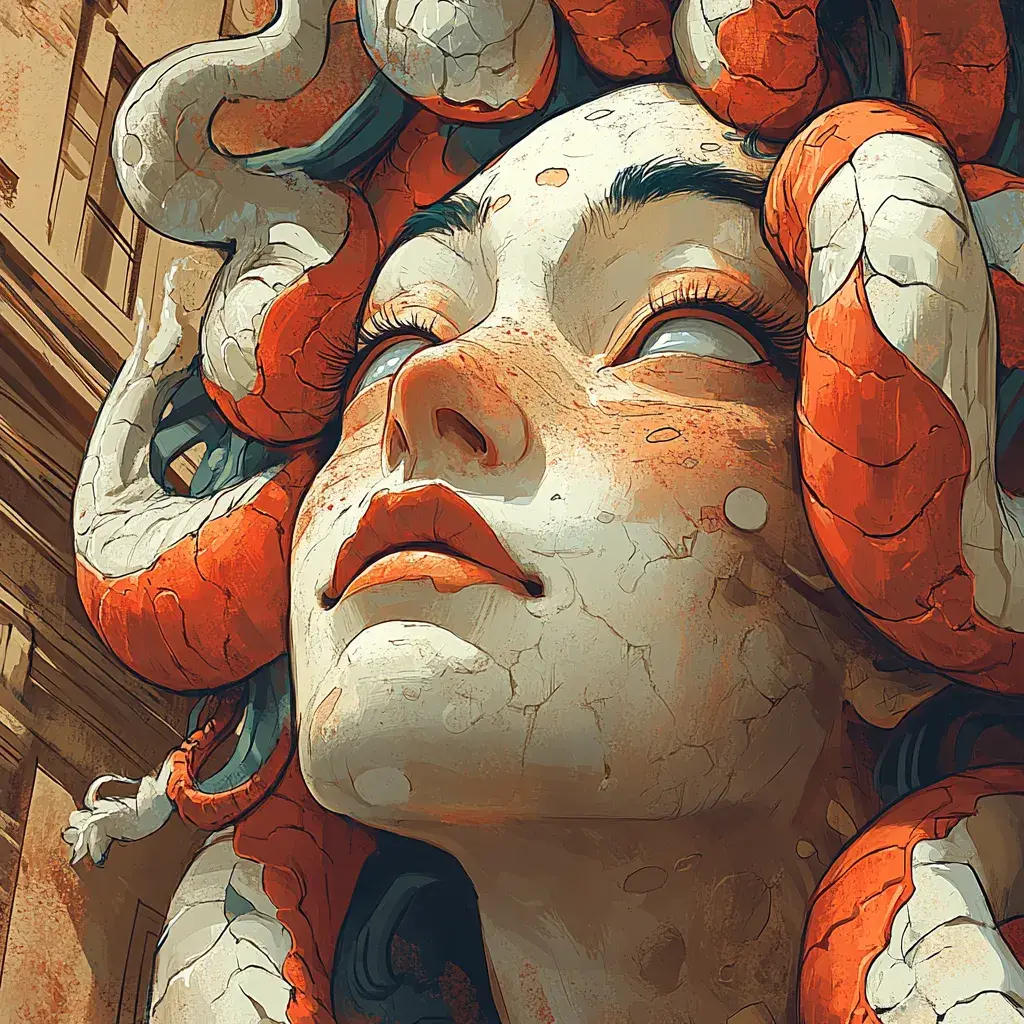
Medusa was one of three Gorgon sisters, monstrous women with snakes for hair, golden wings, sharp claws, and a stare that turned any living thing to stone. Unlike her sisters Stheno and Euryale, she was mortal. Before Perseus set out, he prayed to the gods, and Zeus sent two of his other children to equip his son for the task. Hermes lent Perseus winged sandals and the curved sword known as the harpe, while Hades contributed his helm of invisibility. Athena gave Perseus a polished shield, so he could track Medusa by her reflection rather than look at her directly, along with a special pouch, the kibisis, to carry the severed head safely, since it retained its petrifying power even after death.
Athena directed Perseus first to the Graeae, three elderly sisters who shared a single eye and tooth between them. Perseus seized the eye as they were passing it from one to another and refused to return it until they told him where to find the Gorgons. With that information, he traveled to the island of Sarpedon, where he found the Gorgons asleep. Walking backward and guiding himself by the shield's reflection, he approached Medusa and beheaded her with Athena steadying his aim. From her severed neck sprang Pegasus and Chrysaor, her children by Poseidon. Stheno and Euryale woke and pursued him, but the helm of invisibility let him escape. On his way home he also turned King Atlas to stone with the Gorgon's head after being refused hospitality, an act later connected to the origin of the Atlas mountains.
Andromeda and the Return to Seriphos
Flying homeward, Perseus passed through the kingdom of Aethiopia, ruled by Cepheus and Cassiopeia. Cassiopeia had boasted that her daughter Andromeda surpassed the Nereids in beauty, provoking Poseidon to send a flood and a sea monster, Cetus, to ravage the land. An oracle declared that the only remedy was to sacrifice Andromeda to the creature, so she was chained to a rock on the shore. Perseus arrived in time to kill the monster, either with the harpe or by turning it to stone with Medusa's head, and claimed Andromeda as his wife, overriding her previous betrothal to Phineus, who was later petrified when he challenged the marriage.
Returning at last to Seriphos, Perseus found that his mother had been forced to seek refuge from Polydectes' unwanted advances. He confronted the king and used Medusa's head to turn him to stone, then installed Dictys, the fisherman who had raised him, as the island's new ruler. Having no further need of the weapons lent to him, Perseus returned them and gave Medusa's head to Athena, who mounted it on her aegis.
Fulfilling the Prophecy and Founding Mycenae
Accounts differ on how Acrisius eventually died, but all agree the oracle's warning came true. In one version, Perseus never returned to Argos at all; instead he traveled to Larissa to compete in athletic games, where he had just introduced the discus throw. Acrisius, visiting the games, was struck and killed by Perseus's throw, fulfilling the prophecy without any direct confrontation between them. Another account has Acrisius fleeing to Thessaly on hearing of his grandson's approach, only to be killed there in the same accidental manner during funeral games. Either way, Perseus did not kill his grandfather deliberately.
Perseus, now heir to the Argive throne, chose not to rule Argos directly, reportedly out of discomfort at having gained the kingdom through his grandfather's death. He traded kingdoms with Megapenthes, taking Tiryns for himself while Megapenthes took Argos. Greek tradition credited Perseus with founding Mycenae, and later writers pointed to a shrine and sacred spring associated with him there. Through his marriage to Andromeda, Perseus fathered several sons and daughters, and their descendants, the Perseids, ruled Mycenae for generations, eventually including Heracles among their line.
Perseus: timeline
- BirthBorn to Danaë after Zeus visited her as a shower of gold while King Acrisius kept her locked in a bronze tower.
- InfancyAcrisius sealed Perseus and Danaë in a wooden chest and set them adrift at sea; they washed ashore on Seriphos and were raised by the fisherman Dictys.
- YouthKing Polydectes of Seriphos desired Danaë, and Perseus rashly promised to bring him the head of the Gorgon Medusa as a gift.
- Quest preparationHermes and Athena armed Perseus with winged sandals, a sword, Hades's helm of invisibility, and a reflective shield to aid his hunt for Medusa.
- Quest for MedusaPerseus tricked the Graeae into revealing the Gorgons' location by seizing their shared eye and tooth.
- Slaying of MedusaUsing the shield's reflection to avoid her petrifying gaze, Perseus beheaded the sleeping Medusa, from whose neck sprang Pegasus and Chrysaor.
- Journey homePerseus petrified King Atlas with Medusa's head after being refused hospitality, an act later said to explain the Atlas mountains.
- Rescue of AndromedaIn Aethiopia, Perseus killed the sea monster Cetus to save Andromeda, who had been chained to a rock as a sacrifice, and later married her.
- Return to SeriphosPerseus found his mother threatened by Polydectes, killed him with Medusa's head, and placed Dictys on the throne instead.
- Fulfillment of the prophecyWhile competing in discus at funeral games, Perseus accidentally struck and killed his grandfather Acrisius, fulfilling the oracle's warning.
- KingshipAshamed of killing his grandfather, Perseus traded his claim to Argos for Tiryns and is credited with founding Mycenae.
- DeathAccording to the Suda, an aged and nearly blind Perseus accidentally turned Medusa's head on himself and died; his son Merros later burned the head.
Listen: stories featuring Perseus
Narrated chapters from the Chunks Microlearning app. Read a preview here, or listen to the full story in the app.
Continue Perseus's story
You've read the summary — hear the myth of Perseus as narrated 5-minute chapters on Chunks, alongside 200+ figures and events from history, myth, philosophy and science. Free to start on iOS and Android.