
Sisyphus was the founder and first king of Ephyra, the city later known as Corinth. From his citadel, he witnessed something he was not meant to see: Zeus, king of the gods, abducting the nymph Aegina. Soon after, Aegina’s father, the river god Asopus, came looking for her. Sisyphus saw an opportunity. He offered to reveal what he knew, but for a price. In exchange for the secret, Asopus would grant his city a permanent source of water. The deal was struck, and the Peirene spring began to flow on the acropolis. But Sisyphus's cleverness came at a cost. Enraged by the betrayal, Zeus ordered Thanatos, the personification of Death, to seize the mortal king and chain him in the Underworld.
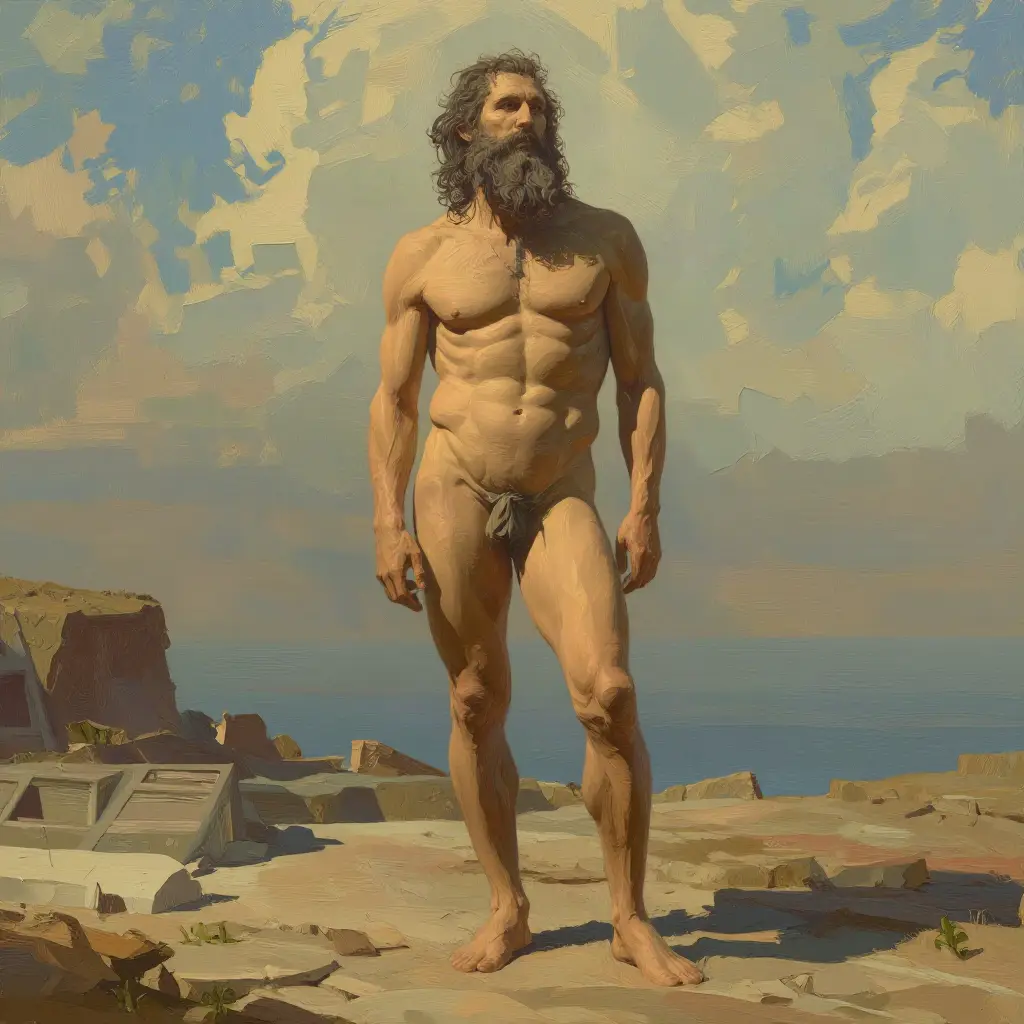
Sisyphus
The myth of the king who cheated death twice and the punishment of the boulder, re-examined by philosopher Albert Camus in 1942.
Chapter 1
The King's Secret
0:49
Frequently Asked Questions
Why was Sisyphus punished by the gods?
Sisyphus was a king who betrayed a secret of Zeus, the king of the gods. He then outwitted death twice, first by trapping the god Thanatos in his own chains, and second by tricking the rulers of the Underworld into letting him return to life. His eternal punishment was for this repeated defiance.
What is a 'Sisyphean task'?
A 'Sisyphean task' is a term derived from Sisyphus's punishment. It describes a job or activity that is endless, laborious, and ultimately futile. The term refers to his condemnation to forever roll a massive boulder up a hill, only for it to roll back down each time he nears the top.
Why did Albert Camus think Sisyphus was happy?
Albert Camus argued that happiness comes from embracing the struggle of life itself. He believed that when Sisyphus acknowledges the futility of his task and chooses to continue anyway, he becomes the master of his own fate. The struggle to reach the summit is enough to fill his heart, so one must imagine him happy.
Learn more
To continue the story, download the Chunks Microlearning app
Or get it straight away:
 Download on iOS
 Download on Android