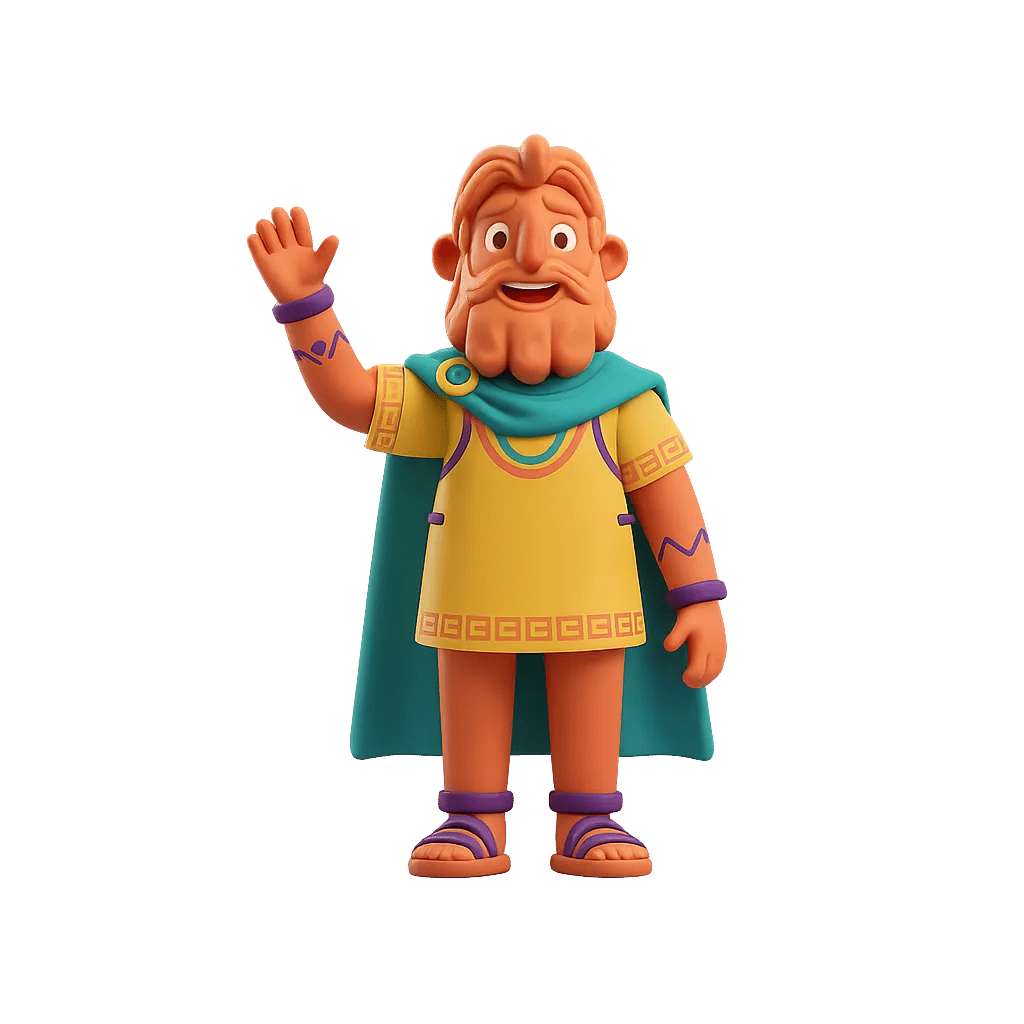
Ares, the Greek God of War: The Olympian His Own People Distrusted


Ares was the Greek god of war — specifically of battle itself, the noise and butchery of the killing field rather than the campaign that led to it. He was one of the twelve Olympians, the son of Zeus and Hera, and he appears across the surviving literature as an enormous, armoured, bellowing presence who turns up where men are dying and leaves when they stop.
He is also, almost uniquely among the major Greek gods, a figure his own worshippers were suspicious of. In Book 5 of the Iliad, Ares has just been wounded and comes to Olympus to complain to his father. Zeus does not comfort him. He tells his son that he is the most hateful to him of all the gods who hold Olympus, because quarrelling and wars and battles are forever dear to his heart. It is one of the bluntest lines in Homer, and it is aimed by the king of the gods at his own son. That hostility is not a quirk of one poem. It runs through Greek literature, Greek cult practice, and the way the Greeks divided up the idea of war itself — and it is the single most useful thing to understand about Ares.
Who was Ares?
In the standard genealogy, given by Hesiod in the Theogony, Ares is the son of Zeus and Hera, full brother to Hebe and Eileithyia. Ovid offers a competing Roman version in the Fasti, in which Juno, annoyed that Jupiter had produced Minerva from his own head, is made pregnant with Mars by a magic flower supplied by the goddess Flora, with no father involved at all. The two accounts are not reconcilable, and there is no need to reconcile them; they come from different cultures roughly seven centuries apart.
What Ares governed is narrower than "war" as we now use the word. The Greeks had several terms for the domain, and Ares sits at the violent end of it. He is associated with phonos (slaughter), with the rout, with the confusion of the melee. Homer's epithets for him are consistent: he is "bane of mortals", "insatiate of war", "manslaughtering". His name is used as a common noun in Greek poetry to mean the fighting itself, in the way an English poet might write "the sword" to mean combat.
He is not a god of victory, of strategy, or of the defence of a city. He does not reliably favour one side. In the Iliad he switches allegiance — he begins fighting for the Trojans after promising Hera and Athena he would support the Greeks — and Zeus describes him with the word for a turncoat. He represents the part of war that no one controls, which is precisely why the Greeks were uneasy about him. A culture that built its self-image on the disciplined hoplite line had good reason to be wary of a deity who personified the moment the line breaks.
Ares versus Athena: two ideas of war
The clearest way to see what the Greeks thought about Ares is to set him beside Athena, who also had war in her portfolio and was enormously popular. Athena was the patron deity of Athens, received one of the largest temples in the Greek world, and appears throughout the literature as a protector of heroes. Ares had comparatively few temples and no great civic festival.
The division between them is not power but kind. Athena's war is the war of planning, tactics, discipline and craft — the shield wall that holds, the stratagem that wins the siege, the armour that is made well. Ares' war is the war that happens when all of that stops working. The Greeks did not think one was an inferior version of the other; they thought they were different things, and they honoured one and feared the other.
Homer makes the point with results on the page. In Iliad 5, Athena mounts Diomedes' chariot, takes the reins herself, and guides the mortal's spear into Ares' body. In Iliad 15, when Ares wants to charge back into the fighting to avenge his dead son Ascalaphus, Athena physically strips the helmet from his head and the spear from his hand and talks him out of it. In Iliad 21, during the battle of the gods, Ares attacks her directly and she picks up a boundary stone from the plain and knocks him flat with it, and Homer notes with some relish that his body covered seven pelethra of ground as he fell. She then does the same to Aphrodite when Aphrodite tries to help him up.
Athena wins every one of these encounters, and Homer never treats the outcome as surprising. If you want the Greek view of war as strategy against war as fury, that pattern is it.
The myths of Ares
The affair with Aphrodite and Hephaestus's net
The most famous Ares story is sung by the bard Demodocus in Book 8 of the Odyssey. Ares and Aphrodite are lovers; Aphrodite is married to the smith-god Hephaestus. The Sun sees them together and tells Hephaestus, who forges a net of chains so fine as to be invisible, fixes it above the bed, and pretends to leave for Lemnos. The pair are caught in it, naked and immobilised, and Hephaestus calls the other gods in to look. The goddesses stay away out of modesty; the male gods come and laugh, and Apollo and Hermes exchange a joke about whether the humiliation would be worth it. Poseidon eventually stands surety for the compensation Hephaestus demands. When the net is lifted, Ares goes to Thrace and Aphrodite to Paphos on Cyprus.
Ovid retells the episode in the Metamorphoses and again in the Ars Amatoria, with the emphasis shifted towards the lovers. The Homeric version is worth reading first, because the structure of the scene — a war god trapped, exposed, and laughed at by the other gods — is precisely the treatment Ares tends to get.
The killing of Halirrhothius and the first trial
Apollodorus records that Halirrhothius, a son of Poseidon, raped Ares' daughter Alcippe, and that Ares killed him for it. Poseidon demanded justice, and Ares was tried by the other gods on a hill below the Acropolis in Athens. He was acquitted. The hill took its name from the case: the Areopagus, the hill of Ares, which became the seat of the ancient Athenian homicide court.
This is worth flagging carefully, because it is one of the few myths in which Ares is sympathetic. It is also not the only account of how the Areopagus got its name — Aeschylus, in the Eumenides, derives it instead from the Amazons, who camped and sacrificed there — and ancient sources preserved both. The Halirrhothius version, however, is the one that gave Athens its founding story for trial by jury in a murder case, with a god in the dock.
Wounded by a mortal in the Iliad
In Iliad 5, Athena makes Diomedes able to see the gods and drives his chariot against Ares. The spear goes in at the belly. Ares roars, Homer says, as loudly as nine or ten thousand men shouting in battle, and both armies shake with fear. He then leaves the field, flies up to Olympus wrapped in cloud, shows Zeus the wound, and is told he is the most hateful god on the mountain. The healer Paeon treats him and he recovers quickly, but the scene is unambiguous: a mortal with divine help has put a spear into the god of war, and the god's own father tells him he deserved it.
Thirteen months in a bronze jar
Also in Book 5, Dione tells a short story to console the wounded Aphrodite: the Aloadae, the giant brothers Otus and Ephialtes, once bound Ares and shut him in a bronze jar for thirteen months. He was near death when their stepmother Eeriboea told Hermes, who stole him out. Homer gives it in a few lines and moves on, which is itself telling — the imprisonment of the god of war by two adolescents is offered as a passing anecdote rather than a scandal.
Ares in Rome: why Mars was a different god
Roman Mars is routinely given as the Latin name for Ares, and that equation does real damage to both. The identification happened, and Roman poets writing in Greek modes leaned into it, but the underlying god the Romans actually worshipped was not the same figure.
Mars was second only to Jupiter in Roman state religion. He had his own priest, the flamen Martialis, one of the three senior flamens. He had the Salii, a college of priests who danced through the city in archaic armour in March and October. The month of March is named after him, as is the Campus Martius, the field outside the city walls where the citizen army mustered. There was nothing marginal about him.
He was also, in the older Italic layer, a god of agriculture and of the boundary of the settled land. The clearest evidence is the prayer that Cato the Elder preserves in De Agri Cultura, written in the second century BC, which accompanies the suovetaurilia — the sacrifice of a pig, a sheep and a bull — performed to purify a farm. The prayer addresses "Mars pater", Father Mars, and asks him to keep away disease, barrenness, ruin and bad weather from the fields, the household and the livestock. That is not a bloodlust deity. It is a protector of what lies inside the boundary.
And Mars was the father of Rome itself. In the standard foundation story, given by Livy among others, Mars fathered Romulus and Remus on the Vestal Virgin Rhea Silvia. Romans could and did claim descent from him. No Greek city claimed descent from Ares in that way, and the difference in civic attitude follows directly.
Flattening the two into one entry in a table of equivalents loses the Greek unease about Ares and loses the Roman respect for Mars at the same time.
Symbols, children and cult
Ares' attributes in art and poetry are the spear, the helmet, the shield and the burning torch. The dog and the vulture are the animals most consistently associated with him — both scavengers of the battlefield, which is not accidental. Roman Mars additionally took the wolf and the woodpecker, animals tied to the Romulus story and to Italic augury.
His children map the domain neatly. By Aphrodite, Hesiod gives him Phobos and Deimos — Fear and Terror or Panic — who yoke his horses and go with him into battle, and Harmonia, whose name means concord and who became the wife of Cadmus, founder of Thebes. Elsewhere he fathers Diomedes of Thrace, owner of the man-eating mares, and in several traditions the Amazons descend from him. Cycnus, a son who challenged travellers and was killed by Heracles, is another.
Cult sites are genuinely sparse by Olympian standards, and that scarcity is part of the argument. The Greeks placed his homeland in Thrace, to the north — Homer sends him there after the net episode, and Herodotus reports that the Thracians worshipped only Ares, Dionysus and Artemis. Placing your most alarming god on the edge of the Greek world is a statement of attitude. Sparta is the notable exception: Spartan youths sacrificed to him under the title Enyalios, and Pausanias describes an old wooden image of Enyalios at Sparta kept in fetters, on the reasoning that a bound war god could never desert the city. Athens did eventually have a temple of Ares in the Agora, but it was physically relocated there from Acharnae in the Augustan period rather than built for him in the classical city.
Frequently asked questions
Who is Ares the god of war?
Ares is the Greek Olympian god of war, specifically of battle, slaughter and the chaos of combat. He is the son of Zeus and Hera in Hesiod's account, the lover of Aphrodite, and the father of Phobos and Deimos. The Romans identified him with Mars, though Mars was worshipped very differently.
Why did the Greeks dislike Ares?
Because he personified the uncontrolled part of war rather than its purpose or its discipline, and the Greeks valued the disciplined line above individual fury. Homer has Zeus tell him directly that he is the most hateful of all the Olympians, and Ares is defeated, wounded or humiliated in almost every episode in which he appears. His cult sites were correspondingly few, and Greek writers tended to place his homeland in Thrace, outside the Greek world.
Who is stronger, Ares or Athena?
In the surviving literature, Athena consistently beats Ares. She guides Diomedes' spear into him in Iliad 5, disarms him in Book 15, and knocks him to the ground with a boundary stone in Book 21. The point Homer is making is not that Athena is physically mightier but that war fought with intelligence defeats war fought on rage.
What are Ares' symbols?
The spear, helmet, shield and torch, with the dog and the vulture as his animals. Chariots drawn by his sons Phobos and Deimos appear in poetry. Roman Mars added the wolf and the woodpecker, tied to the founding myth of Rome.
Where to go next
Ares repays reading in the primary sources more than almost any other Olympian, because the gap between how he is described and how he actually performs is where the interesting material sits. Iliad Books 5, 15 and 21 and Odyssey Book 8 will take an evening between them and contain most of what matters.
If you are building a broader foundation first, our guide to Greek mythology for beginners covers the Olympians, the Titans and the major hero cycles in order. For listening, we have also reviewed the best Greek mythology podcasts of 2026, several of which are hosted by classicists who are careful about which ancient source a given version comes from.
Chunks publishes a free five-minute narrated story every day, covering history, science, philosophy and mythology, on iOS and Android.

Founder of Chunks Microlearning. Software engineer with 15 years of experience.
 Download on iOS
 Download on Android