
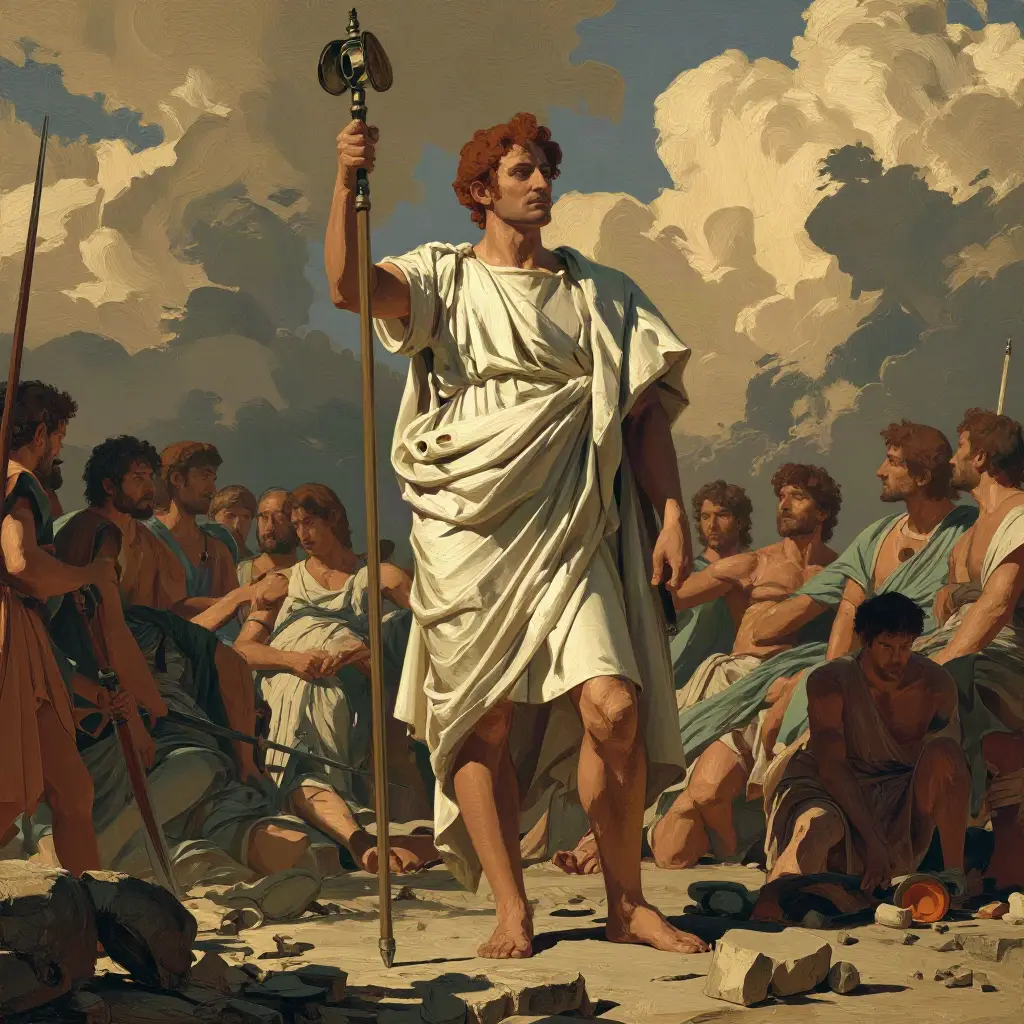
The Iliad begins not with the start of the Trojan War, but in its tenth year, with a divine rage. The very first word of its 15,693 lines is menis, a superhuman anger. A plague sent by the god Apollo is ravaging the Greek army, punishment for their commander Agamemnon refusing to return the daughter of a priest of the god. Forced to return her, Agamemnon seizes the captive woman Briseis from Achilles, the Greeks’ greatest warrior. For Achilles, this is an unbearable public insult to his honor. Enraged, he draws his sword, only to be stopped by the goddess Athena herself. He does not kill his king. Instead, he withdraws himself and his soldiers from the war entirely, retreating to his ships to watch his comrades suffer.
Homer's Iliad
Homer's Iliad, the Greek epic of Achilles' rage in the tenth year of the Trojan War, from his quarrel with Agamemnon to the death and burial of Hector.
Chapter 1
The Rage of Achilles
0:52
Part of
Frequently Asked Questions
Does the Iliad cover the entire ten-year Trojan War?
No, the poem's narrative covers a period of about 51 to 52 days in the tenth and final year of the war. It focuses on the consequences of a single event: the rage of Achilles.
Did Homer really write the Iliad?
The poem is attributed to a single poet named Homer, but its origins are in a long tradition of oral performance by wandering bards called rhapsodes. The text we have today was likely composed in the late 8th century BCE.
Is the story of the Trojan Horse in the Iliad?
No. The famous trick of the Trojan Horse and the subsequent fall of the city are not part of the Iliad's narrative. Those events are described in other works, most notably Virgil's Aeneid.
Learn more
To continue the story, download the Chunks Microlearning app
Or get it straight away:
 Download on iOS
 Download on Android