
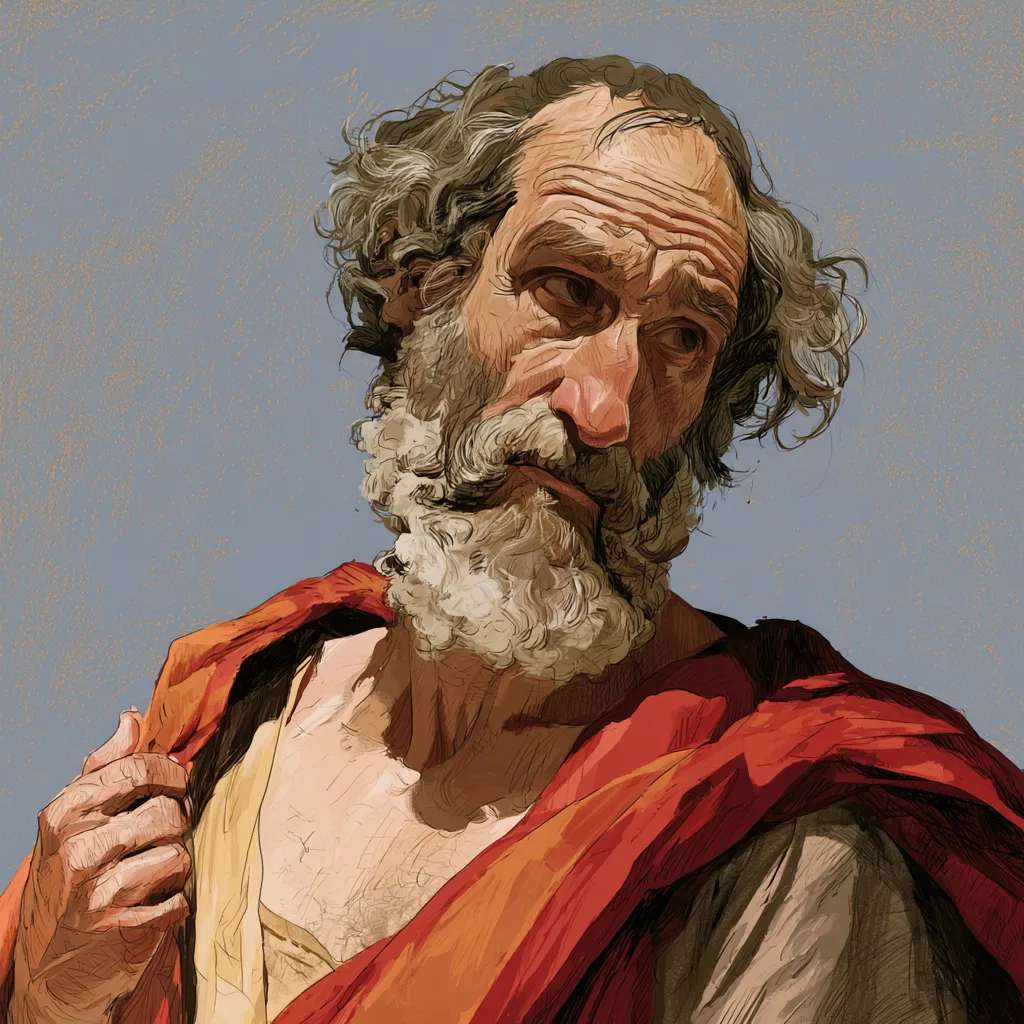
Who was Homer?
Homer was an ancient Greek poet traditionally credited with composing the Iliad and the Odyssey, foundational epics of Greek literature likely composed in the late eighth or early seventh century BC. Ancient traditions describe him as a blind Ionian bard, though his true identity remains debated among scholars. Most accounts place his death on the island of Ios. His works profoundly shaped Greek culture, education, and literary history.
Ancient Greek poet traditionally credited with composing the Iliad and the Odyssey. His epic works about the Trojan War have shaped Western literature for nearly three thousand years.
Don't stop at the facts — continue Homer's story in free narrated chapters on Chunks.
Or get it straight away:
 Download on iOS
 Download on Android
Quick facts
- Born
- 9th century BC
- Died
- 8th century BC
- Place of death
- Ios
- Nationality
- Ionian League
- Occupation
- Poet, author, writer
Homer: key facts
- Homer is traditionally credited as the author of the Iliad and the Odyssey, two foundational epic poems of ancient Greek literature.
- The Iliad focuses on a quarrel between King Agamemnon and the warrior Achilles during the final year of the Trojan War.
- The Odyssey follows the ten-year journey of Odysseus, king of Ithaca, as he tries to return home after the fall of Troy.
- Ancient sources most often describe Homer as a blind bard associated with Ionia, including the islands of Chios and Samos.
- Ancient tradition places Homer's death and burial on the island of Ios, commemorated in epigrams by the poet Alcaeus of Messene.
- The Homeric epics are composed in Homeric Greek, a literary language blending Ionic and Aeolic dialect features with a predominant Ionic influence.
- Plato praised Homer's cultural influence, stating that he had educated Greece.
A Poet Known Mostly Through Legend
No reliable biographical record of Homer survives, and most scholars today treat the ancient idea of a single identifiable author behind the Iliad and the Odyssey as a story rather than history. During antiquity, as genuine facts about him remained unknown, biographers filled the gap with increasingly elaborate and often contradictory legends, generally assuming he had lived sometime after the Trojan War.
The most widespread ancient tradition described Homer as a blind bard from Ionia, the Greek-settled region on the central western coast of Anatolia, with the islands of Chios and Samos also frequently named as his home. Other accounts gave him different origins entirely: the historian Ephorus claimed he was born in Cyme and trained under a bard named Phemius, while the writer Philochorus placed his birthplace in Argos, and still other writers named Pylos or Athens. No single version of his origins ever became universally accepted.
Ancient sources also invented family trees for him, claiming descent from a Muse, from Apollo, or from figures such as Orpheus and Telemachus, son of Odysseus. One tradition dating to the reign of the Roman emperor Hadrian even named Telemachus and Epicaste, a daughter of Nestor, as his parents. The two best-known ancient biographies, the Life of Homer attributed to Pseudo-Herodotus and the Contest of Homer and Hesiod, are themselves products of this legend-making rather than trustworthy history.
Most accounts agree that Homer died on the small island of Ios, a tradition commemorated in two epigrams by the poet Alcaeus of Messene, which praise both Homer's undying fame and the honor his burial brought to the modest island. The earliest surviving hints that Homer was already a recognized figure come from seventh-century BC poets Archilochus, Alcman, Tyrtaeus, and Callinus, who allude to him without offering any biographical detail.
The Iliad and the Odyssey
The Iliad follows a quarrel between King Agamemnon and the warrior Achilles during the final year of the Trojan War, while the Odyssey tells of the ten-year journey home of Odysseus, king of Ithaca, after Troy's fall. Both poems dwell on human struggle against divine punishment and fate, though the Odyssey especially emphasizes Odysseus's endurance. Despite their largely serious and tragic tone, both works also contain moments of comedy and laughter.
The poems are composed in Homeric Greek, sometimes called Epic Greek, an artificial literary language that blends features of the Ionic and Aeolic dialects from different periods, with Ionic forms predominating. This language was used only for epic hexameter poetry and was never anyone's everyday spoken tongue. Both poems open with an invocation to the Muse, asking her to sing of Achilles's anger in the Iliad and of the wandering man in the Odyssey, an opening later echoed by Virgil in the Aeneid.
Beyond these two epics, antiquity attributed a large number of other works to Homer, including the Homeric Hymns, the Contest of Homer and Hesiod, various epigrams, the Little Iliad, the Nostoi, the Thebaid, the Cypria, the Epigoni, the comic Batrachomyomachia (the Frog-Mouse War), the Margites, the Capture of Oechalia, and the Phocais. None of these attributions are accepted as genuine today, and even in ancient times they were not universally believed. Their persistence mainly shows how central Homer had become to Greek cultural identity.
The Homeric Question
Scholars have long debated who actually composed the Iliad and the Odyssey, when, where, and under what circumstances. Most researchers now believe the poems arose from a wider oral tradition of Greek epic song rather than springing fully formed from one poet's imagination, and they generally treat the Iliad and the Odyssey as the work of two different authors, based on differences in narrative style, theology, ethics, vocabulary, and geography. Nearly all scholars nonetheless agree that each poem shows a coherent overall design, suggesting each was largely shaped by a single composer working from older oral material.
Dating the poems remains contested. Some ancient scholars imagined Homer as an eyewitness to the Trojan War itself, while others thought he lived as much as five hundred years afterward. Modern researchers generally place the poems' composition in the late eighth or early seventh century BC. Richard Janko has argued for an eighth-century date for both works based on linguistic evidence, Barry Powell places their composition between roughly 800 and 750 BC partly on the strength of a statement by Herodotus that Homer lived four hundred years before him, and Martin West has argued the Iliad shows awareness of seventh-century Near Eastern events and could not predate about 660 to 650 BC, with the Odyssey composed a generation or so later.
A long history of oral transmission complicates any precise dating. The poems were likely passed down through spoken performance for generations before being written down sometime between the eighth and sixth centuries BC, and ancient tradition held that they were collected and organized in Athens under the ruler Pisistratus in the late sixth century BC. Some later poets and scribes may have continued revising the text even after it began to be written, meaning the works readers encounter today are the product of a long collaborative tradition rather than a single act of authorship.
The very name Homer is of uncertain origin. One ancient theory linked it to the Greek word for hostage or surety. Modern scholars' proposed explanations tend to reflect their broader views on the Homeric Question: the scholar Gregory Nagy interprets the name as meaning 'he who fits the song together,' while Martin West has proposed both Greek and Phoenician possible roots.
Homer's Place in Greek Education and Later Culture
The Iliad and the Odyssey served as the foundation of Greek and later Hellenistic education, functioning as the first literary texts taught to students throughout the ancient world. The Iliad, particularly its opening books, received even more intensive study than the Odyssey during the Hellenistic and Roman periods. This central educational role shaped how ancient thinkers viewed Homer: Plato credited him simply with having 'educated Greece,' and many authors came to regard him as an almost prototypical philosopher whose verses concealed deep wisdom.
This reputation endured well beyond antiquity. In Dante Alighieri's Divine Comedy, the character Virgil calls Homer the 'Poet sovereign,' ruler among poets, and Alexander Pope, in the preface to his translation of the Iliad, acknowledged that Homer had long been regarded as the greatest of all poets. Renaissance scholars revived the ancient habit of reading Homer allegorically, treating him as a wise figure whose poems hid deeper truths, though in much of Western Europe at the time Virgil was actually read more widely than Homer, with Homer often viewed through a Virgilian lens.
Extensive scholarly commentary on Homer developed early, driven partly by the difficulty later Greek readers had understanding the poems' archaic language and customs. Byzantine scholars such as Eustathius of Thessalonica and John Tzetzes produced particularly massive twelfth-century commentaries, with Eustathius's notes on the Iliad alone stretching to roughly four thousand pages in modern printed editions. The first printed edition of Homer's works was produced by the Greek scholar Demetrios Chalkokondyles, published in 1488 in Italy, marking the poems' transition into the age of print and setting the stage for centuries of further editing and debate among modern scholars.
Homer: timeline
- c. late 8th – early 7th century BCThe Iliad and the Odyssey are composed, most likely drawing on centuries of earlier oral tradition.
- 7th century BCThe earliest implicit references to Homer appear in the poetry of Archilochus, Alcman, Tyrtaeus, and Callinus.
- 4th century BCPlato praises Homer as the poet who "educated Greece."
- Hellenistic periodScholars at the Library of Alexandria, including Zenodotus of Ephesus, Aristophanes of Byzantium, and Aristarchus of Samothrace, work to establish a canonical text of the Homeric poems.
- 1st century BCThe Roman orator Cicero repeats the tradition that Pisistratus collected and organized the Homeric poems in Athens.
- 12th centuryByzantine scholars Eustathius of Thessalonica and John Tzetzes compile extensive commentaries and scholia on the Iliad and Odyssey.
- 1488Demetrios Chalkokondyles publishes the editio princeps of Homer's poems in Florence, the first printed edition of his works.
- 1664François Hédelin, abbé d'Aubignac attacks the Homeric poems as incoherent and immoral, arguing that Homer never existed.
- 1795Friedrich August Wolf's Prolegomena ad Homerum argues the epics grew from short oral songs later assembled by literate editors, founding the Analyst school of Homeric scholarship.
- 1928Milman Parry, later joined by Albert Lord, begins developing the Oral-Formulaic Theory after studying living oral bards in the Balkans.
Listen: stories featuring Homer
Narrated chapters from the Chunks Microlearning app. Read a preview here, or listen to the full story in the app.
Frequently asked questions about Homer
What did Homer write?
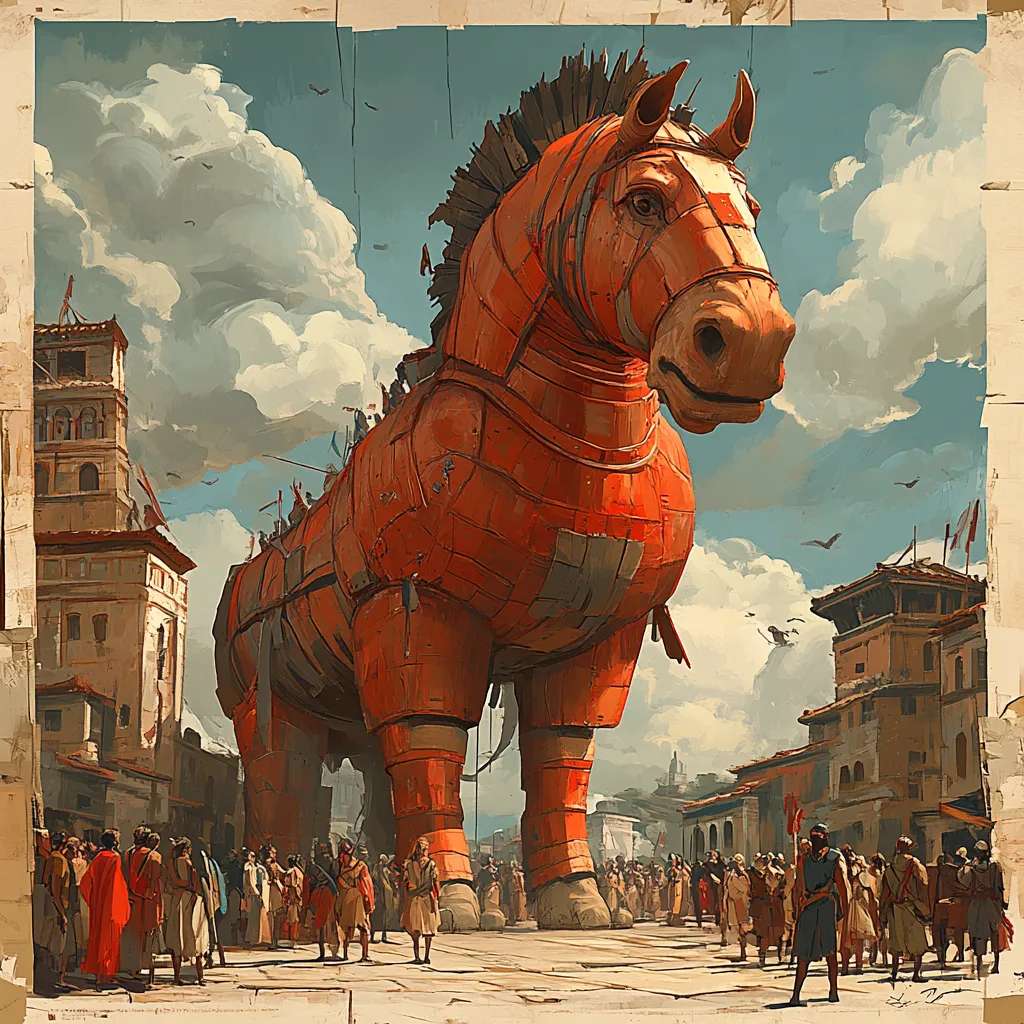
Homer is credited with composing the Iliad and the Odyssey, two foundational epic poems of ancient Greek literature. The Iliad recounts events of the Trojan War.
Why is Homer significant to the Trojan War story?
Homer's Iliad is the most famous account of the Trojan War, immortalizing its heroes and themes. His work has shaped how the war is remembered for millennia.
Is Homer a historical or legendary figure?
Little is known for certain about Homer's life, and some scholars debate whether he was a single author. He is nonetheless traditionally regarded as the author of two of the greatest works in Western literature.
Continue Homer's story
You've read the summary — hear the full story as narrated 5-minute chapters on Chunks, alongside 200+ figures and events from history, philosophy and science. Free to start on iOS and Android.