
Bosham, on the Sussex coast, 1064. Edward the Confessor, King of the English, was ageing and had no son to follow him. He had spent much of his own life in exile in Normandy, and he favored his Norman kin, among them his first cousin once removed, Duke William. Now he called for Harold Godwinson, Earl of Wessex, brother of his own queen, Edith, and sent him across the Channel. Why remains disputed to this day. Norman writers later claimed Harold carried a promise, that he went to confirm the English throne to William. English sources instead suggest a quieter errand, that he sailed to free family members held hostage in Normandy for years. The Bayeux Tapestry itself shows the mission but never explains it, only a man boarding a ship. Harold left from his own manor at Bosham, and the ship that carried him out into open water was heading toward a shore that would not let him leave easily.
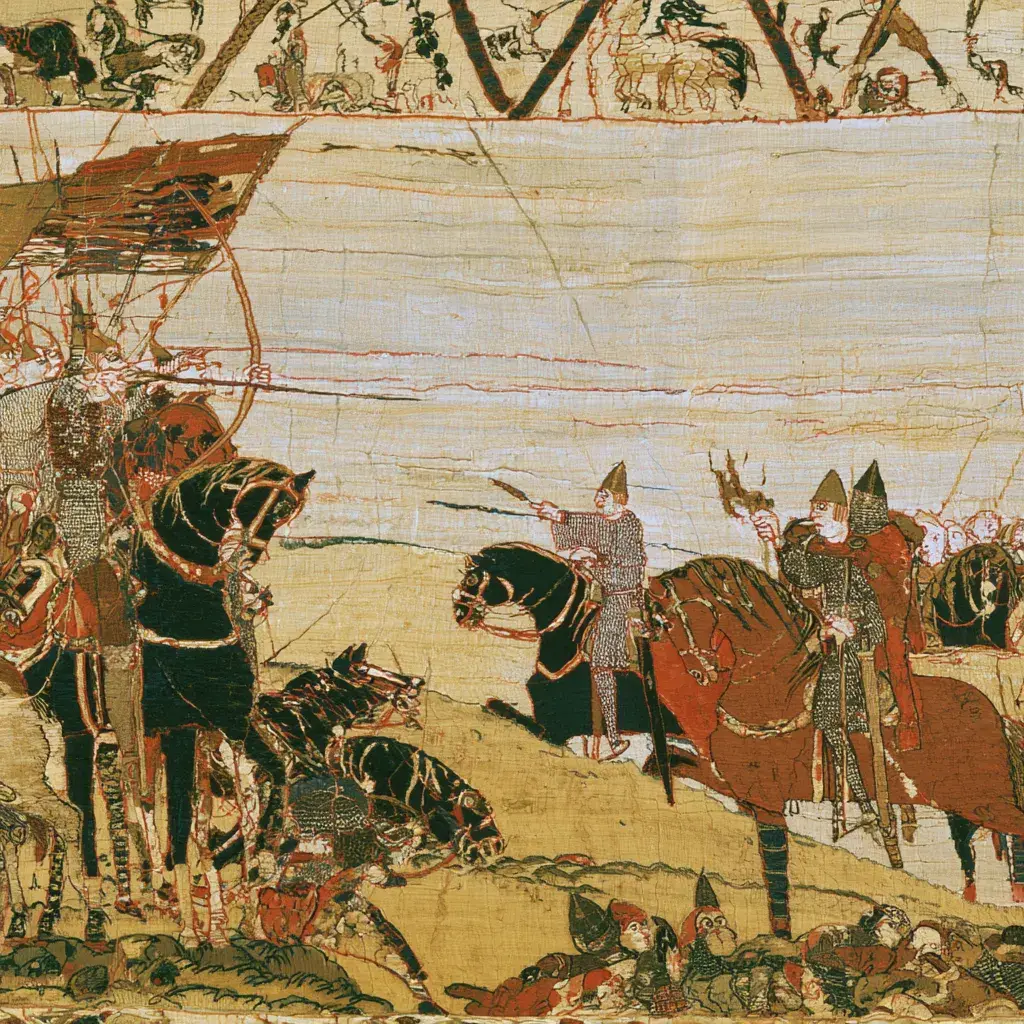
The Bayeux Tapestry
Nearly 70m of 1070s embroidery stitches Hastings, a comet omen, and Harold's broken oath into 58 scenes.
A Mission Across the Channel
Frequently Asked Questions
Why did Edward the Confessor send Harold Godwinson to Normandy in 1064?
The reason is disputed. Norman chroniclers claimed Harold went to confirm the English throne to Duke William, while English sources suggest he sailed to free family members held hostage in Normandy. The Bayeux Tapestry shows the journey but gives no explanation for it.
What actually happened to Harold at the Battle of Hastings?
Harold died on 14 October 1066 along with his brothers Gyrth and Leofwine, named together in the Tapestry's Latin caption. The Tapestry shows a figure struck in the eye by an arrow beside another falling to a sword, but the arrow detail is a later addition and historians are unsure which figure, if either, depicts Harold's actual death.
Who made the Bayeux Tapestry and why has it survived nearly 1,000 years?
Most historians believe Bishop Odo of Bayeux, William the Conqueror's half-brother, commissioned it from English embroiderers, likely in Kent, for his cathedral's 1077 consecration. It survived a near-destruction during the French Revolution, display under Napoleon in 1803, and seizure by Nazi occupiers in the Second World War, when a fragment was cut away before being recovered decades later.
To continue the story, download the Chunks Microlearning app
Or get it straight away:
 Download on iOS
 Download on Android