
Who was William the Conqueror?
Hear William the Conqueror's story
Chapter 1 of The Bayeux Tapestry · the full story is in the app
William the Conqueror (c. 1028 - 9 September 1087) was Duke of Normandy and the first Norman king of England, reigning from 1066 until his death. He defeated Harold Godwinson at the Battle of Hastings in October 1066, was crowned king that Christmas, and spent subsequent years suppressing English revolts while ruling both Normandy and England. He died in Rouen during a military campaign in northern France and was buried in Caen.
Duke of Normandy who won the Battle of Hastings in 1066 and became the first Norman king of England.
Don't stop at the facts — continue William the Conqueror's story in free narrated chapters on Chunks.
See how Chunks works → Download on iOS
 Download on Android
Quick facts
- Born
- 8 November 1028
- Birthplace
- Falaise
- Died
- 9 September 1087
- Place of death
- Rouen
- Occupation
- Monarch
William the Conqueror: key facts
- William the Conqueror was born around 1028 in Falaise, Duchy of Normandy, the illegitimate son of Duke Robert I and his mistress Herleva.
- He became Duke of Normandy in 1035 as a child of seven or eight and did not fully secure control of the duchy until about 1060.
- William defeated King Harold Godwinson at the Battle of Hastings on 14 October 1066, after which Harold was killed.
- He was crowned King of England at Westminster Abbey on Christmas Day, 25 December 1066.
- In 1086 he ordered the compilation of the Domesday Book, a survey recording landholdings and their value across England.
- William died on 9 September 1087 in Rouen after being injured during a campaign at Mantes, and was buried at the Abbaye-aux-Hommes in Caen.
- Upon his death his lands were divided: his son Robert Curthose inherited Normandy while his son William Rufus became King of England.
An Illegitimate Son Inherits a Duchy
William was born on 8 November 1028 in Falaise, in the Duchy of Normandy, the only son of Duke Robert I and his mistress Herleva, daughter of a man named Fulbert of Falaise who may have worked as a tanner or embalmer. Because his parents never married, William grew up known in some quarters as William the Bastard, a label that shadowed him even after he became a powerful ruler. His mother later married Herluin de Conteville, and the sons she had with him, Odo and Robert, would become important figures in William's later career.
Robert I had no legitimate heir, and before leaving on a pilgrimage to Jerusalem in 1035, he persuaded the Norman nobility to swear loyalty to young William as his successor. Robert died on the journey home, leaving William, only seven or eight years old, as duke of a territory riddled with rival factions. His great-uncle, Archbishop Robert, initially protected him, but the archbishop's death in 1037 plunged Normandy into years of violence as noble families fought for control of the child and for their own advantage.
William's childhood guardians were killed one after another. Alan of Brittany held custody until his death around 1040, after which Gilbert of Brionne took over, only to be murdered within months. Another guardian, Turchetil, died around the same time, and a third, Osbern, was killed in William's own bedchamber while the duke slept. Stories later circulated that William's uncle Walter sometimes hid the boy in peasant houses to keep him safe from assassination.
Fighting for Control of Normandy
Rebellion against William's rule came to a head in 1046, led by Guy of Burgundy with support from two powerful viscounts. William escaped an attempt to seize him and fled to the French king, Henry I, who still backed him. The two returned with an army in 1047 and defeated the rebels at the Battle of Val-es-Dunes near Caen. Afterward William issued the Truce of God throughout the duchy, limiting the days on which fighting was permitted, but this victory did not end the struggle for dominance; near-constant warfare continued for several more years.
Through the 1050s William steadily extended his authority, besieging and exiling Guy of Burgundy, contesting the ambitious Count of Anjou over the county of Maine, and securing the strategically placed Bellême family strongholds of Alencon and Domfront for himself. His former ally King Henry turned against him in 1052 out of fear that William was becoming too powerful, launching invasions in 1054 and 1057, both of which William defeated, at Mortemer and Varaville respectively. The deaths of Henry and the Count of Anjou in 1060 removed William's two greatest rivals and left him the dominant power in northern France.
Sometime in the early 1050s William married Matilda of Flanders, daughter of Count Baldwin V, despite Pope Leo IX having initially forbidden the match. The marriage strengthened William's position by linking him to one of the more powerful territories in France, and the couple went on to have at least nine children. William also placed his own supporters into senior positions in the Norman church, including his half-brother Odo as Bishop of Bayeux, binding ecclesiastical power to his own household.
A Disputed Crown and the Invasion of England
William's claim to the English throne rested on his kinship to Edward the Confessor, a childless king and William's first cousin once removed, who seems to have indicated as early as 1051 that William might succeed him. The claim was complicated by Harold Godwinson, head of England's most powerful noble family, whom Edward reportedly named as his successor on his deathbed in January 1066. Norman writers later claimed Harold had earlier sworn an oath to support William's claim, a story impossible to verify but one William used to justify his invasion.
Harold was crowned king in January 1066 and spent the summer guarding the English coast against William's anticipated invasion, only to disband his forces in September when the harvest season arrived. At almost the same moment, Harold's exiled brother Tostig joined the Norwegian king Harald Hardrada in an invasion of northern England. Harold marched north and crushed them at the Battle of Stamford Bridge on 25 September, killing both men, only to learn that William's fleet had landed at Pevensey two days later.
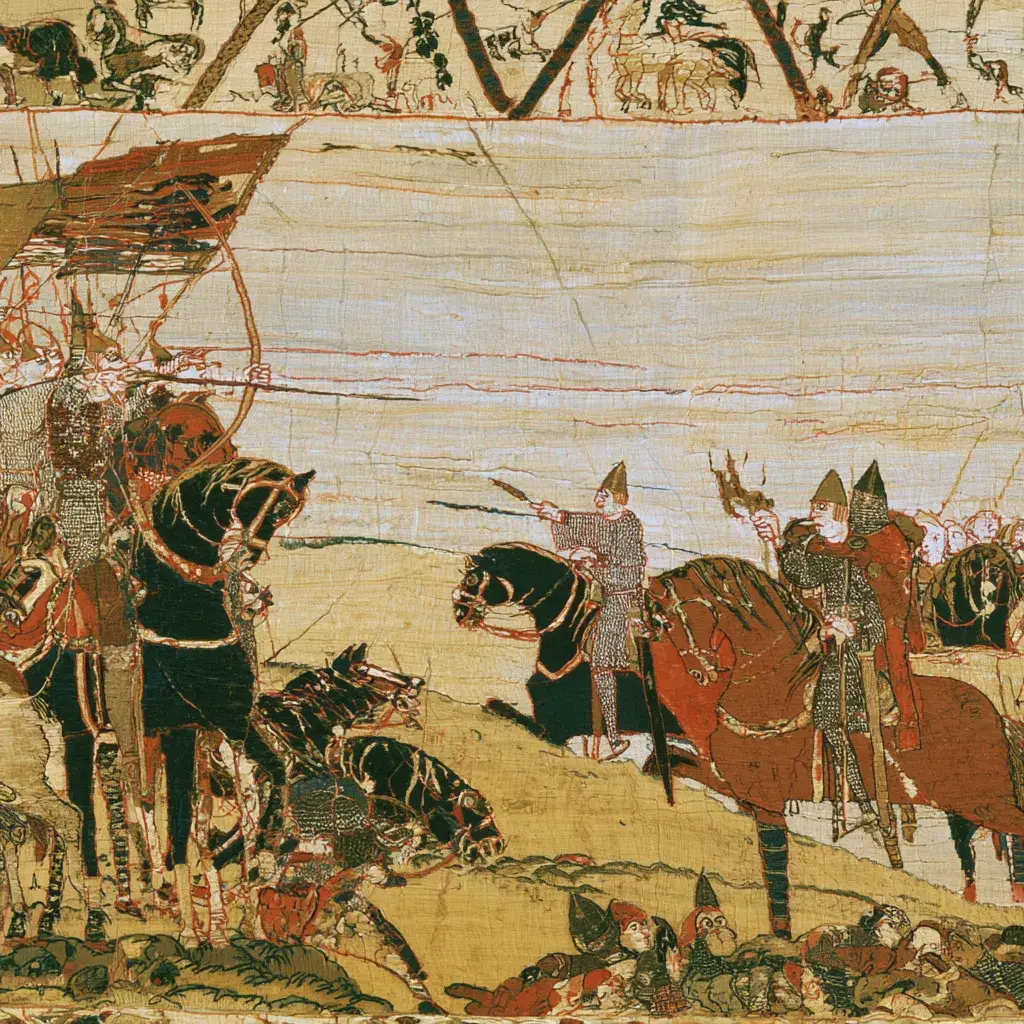
Harold rushed his exhausted army south to meet the new threat. On 14 October 1066 the two forces met at Senlac Hill near Hastings. William's combined cavalry and archers eventually broke the English shield wall after Harold was killed late in the battle, though accounts differ on exactly how he died. The English nobility briefly rallied around Edgar the Aetheling, a distant claimant, but William secured Dover, Canterbury, and Winchester, then marched on London, receiving the submission of the remaining English leaders before being crowned king at Westminster Abbey on Christmas Day 1066.
Holding Down a Conquered Kingdom
William's early years as king were spent reconciling, then crushing, English resistance. He initially confirmed English earls in their lands and left native sheriffs in place, but revolts broke out repeatedly, including risings by Edwin and Morcar, an invasion by Edgar the Aetheling allied with the Danish king, and resistance centered on Exeter and the Isle of Ely under Hereward the Wake. William answered with a brutal campaign across northern England known as the Harrying of the North, burning the countryside between 1069 and 1070, and he built castles, including the Tower of London, across the kingdom to garrison his new territory.
William never merged England and Normandy into a single state, administering them as separate realms with their own courts, coinage, and legal customs, and he crossed the Channel at least nineteen times to manage both. He also reorganized the English church, replacing nearly all native bishops and abbots with continental appointees, most notably installing Lanfranc as Archbishop of Canterbury in 1070. His later years were further disrupted by a prolonged, bitter conflict with his eldest son Robert, who at one point unhorsed William himself during a siege, and by the death of his wife Matilda in 1083.
In 1085, facing the threat of a Danish invasion, William ordered a comprehensive survey of landholding across England, organized by county and recording ownership, value, and resources. Completed by August 1086 and later called the Domesday Book, it stands as one of the most detailed administrative records of medieval Europe and reveals how thoroughly Norman lords had replaced the Anglo-Saxon aristocracy in the two decades since the conquest.
Death in Normandy and a Divided Inheritance
William's final campaign took him back to the continent, where conflict with the French king over the Vexin region led him to attack and seize the town of Mantes in July 1087. During the campaign he was injured, by illness or by his saddle, and was carried to the priory of Saint Gervase at Rouen, where he died on 9 September 1087. On his deathbed he divided his territories, leaving Normandy to his rebellious son Robert and England to his second surviving son, also named William, while his youngest son Henry received a payment of money.
William's funeral at Caen was marred by disruption: a local man interrupted the service to claim the church had been built on land stolen from his family, a complaint that was verified and settled on the spot, and the king's body, too large for its stone coffin, burst open during burial. His tomb was disturbed repeatedly in later centuries, and today only a single thigh bone is believed to remain of his remains, under a marker dating from the early nineteenth century.
The conquest reshaped England permanently, replacing most of its aristocracy with Norman landholders, remaking its church hierarchy, and tying its politics closely to France for centuries afterward. William's death triggered a long contest between his sons for control of Normandy and England that was not resolved until his youngest son Henry defeated Robert at the Battle of Tinchebray in 1106. Historians have long disagreed about how radical the Norman Conquest truly was, but its mark on England's language, institutions, and ruling class is still visible in the historical record.
William the Conqueror: timeline
- 1028Born at Falaise, the illegitimate son of Duke Robert I of Normandy and Herleva.
- 1035Became Duke of Normandy as a child after his father died returning from a pilgrimage to Jerusalem.
- 1047Crushed a rebellion of Norman nobles at the Battle of Val-es-Dunes, beginning to assert real control over the duchy.
- 1050sMarried Matilda of Flanders, gaining a powerful ally and strengthening his political standing.
- 1051Was apparently named by the childless King Edward the Confessor of England as his intended successor.
- 1060Secured control of the county of Maine, completing the consolidation of his power in Normandy.
- 1066Defeated and killed King Harold Godwinson at the Battle of Hastings after invading England.
- 1066Was crowned King of England at Westminster Abbey.
- 1069-70Suppressed northern uprisings by devastating the countryside in a campaign later known as the Harrying of the North.
- 1086Ordered the compilation of the Domesday Book, a detailed survey of landholdings across England.
- 1087Died at Rouen after being injured during a campaign near Mantes, and was buried in Caen.
Listen: stories featuring William the Conqueror
Narrated chapters from the Chunks Microlearning app. Read a preview here, or listen to the full story in the app.
Continue William the Conqueror's story
You've read the summary — hear the full story as narrated 5-minute chapters on Chunks, alongside 200+ figures and events from history, philosophy and science. Free to start on iOS and Android.