

Who was Socrates?
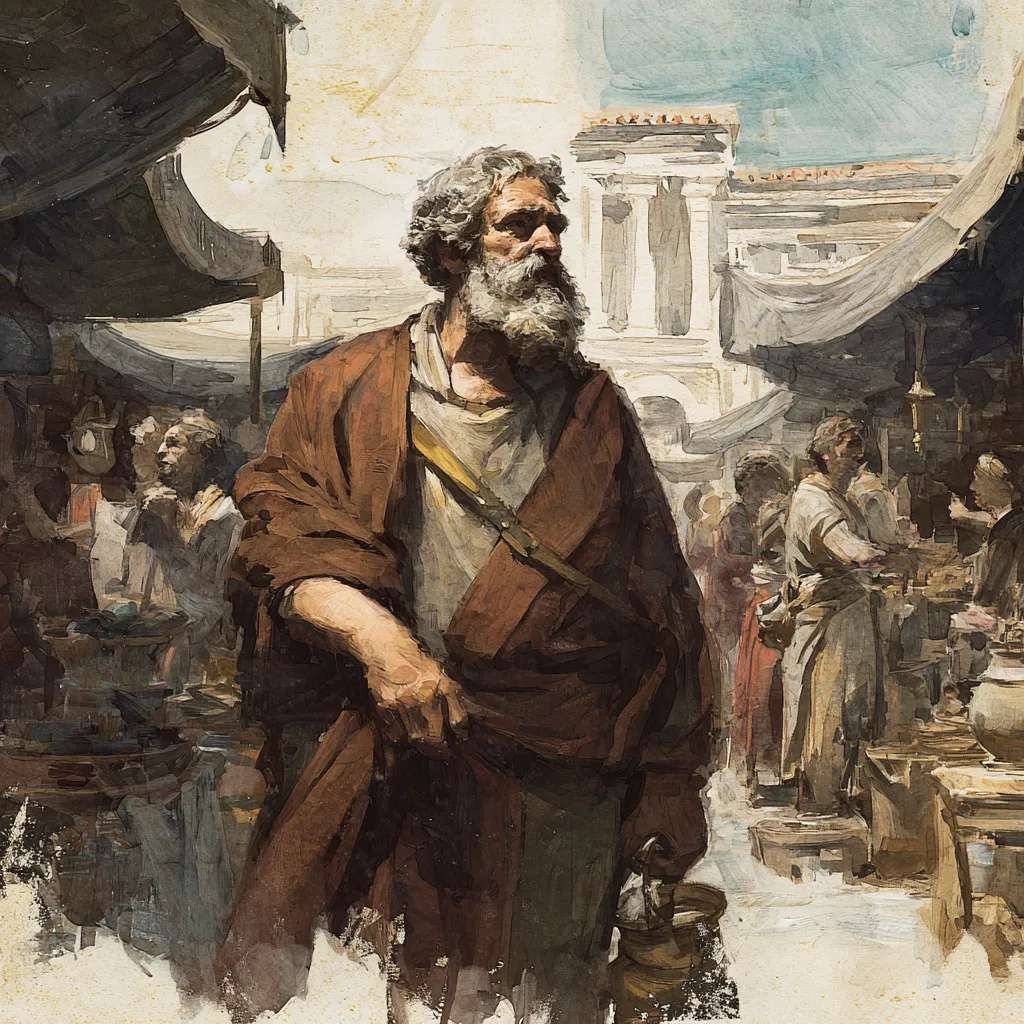
Socrates (c. 470–399 BC) was an ancient Greek philosopher from Athens, widely regarded as a foundational figure in Western moral philosophy. He wrote nothing himself and is known mainly through the accounts of his students Plato and Xenophon. His method of probing questions and answers, called elenchus, shaped the Socratic dialogue tradition. He was tried for impiety and corrupting youth, then executed by poison hemlock.
Ancient Greek philosopher considered the founder of Western philosophy, known for his method of questioning (Socratic method) and his famous declaration that 'the unexamined life is not worth living.' Though he wrote nothing himself, his teachings were preserved through his student Plato.
Don't stop at the facts — continue Socrates's story in free narrated chapters on Chunks.
 Download on iOS
 Download on Android
Quick facts
- Born
- 470 BC
- Birthplace
- Alopeke
- Died
- 399 BC
- Place of death
- Athens
- Nationality
- Classical Athens
- Occupation
- Philosopher, teacher, writer
Socrates: key facts
- Socrates was born around 470 BC in the Athenian deme of Alopece to Sophroniscus, a stoneworker, and Phaenarete, a midwife.
- Socrates wrote nothing himself and is known almost entirely through the posthumous accounts of others, particularly his students Plato and Xenophon.
- The Socratic method, known as elenchus, involves a structured dialogue of questions and answers that exposes contradictions in an interlocutor's beliefs and was most prominently recorded in Plato's early dialogues.
- In 399 BC, Socrates was tried in Athens on charges of impiety and corrupting the youth, found guilty by a jury of hundreds of male Athenian citizens, and sentenced to death.
- Socrates died in Athens in 399 BC after drinking poison hemlock, having refused offers from allies to help him escape from prison.
- Socrates frequently proclaimed his own ignorance, a stance encapsulated in the idea that acknowledging one's lack of knowledge is the first step toward wisdom.
- Socrates influenced nearly every major philosophical school that followed him, including Plato's Academy, Aristotle's Lyceum, the Cynics, and the Stoics.
A Stoneworker's Son Who Reshaped Greek Thought
Socrates was born around 470 BC in the Athenian deme of Alopece, the son of Sophroniscus, a stoneworker, and Phaenarete, a midwife. As an Athenian citizen born to relatively affluent parents, he received the standard education of a young man from a comfortable household: basic reading and writing, alongside additional instruction in gymnastics, poetry, and music. He inherited part of his father's estate, which left him reasonably free from financial pressure throughout his life.
The man who became Athens's most celebrated talker was notoriously indifferent to the impression he made. Contemporaries described him as physically striking in an unflattering way — flat turned-up nose, bulging eyes, a large belly — and his friends joked openly about his appearance. He rarely bathed, walked barefoot, and wore a single ragged coat. He ate and drank moderately, resisted material comforts, and showed little interest in wealth or social status. He served in the military during the Peloponnesian War and, according to Plato, distinguished himself in three campaigns.
Teaching Through Questions: The Socratic Method
Socrates left no writings of any kind. Everything known about his ideas comes from accounts written by others, chiefly his students Plato and Xenophon, and the comic playwright Aristophanes. This dependence on secondhand sources creates a persistent difficulty — known as the Socratic problem — in separating what Socrates actually believed from what his biographers invented or embellished. The two principal accounts already contradict each other: Xenophon's Socrates is duller and more conventional, while Plato's is ironic, intellectually restless, and philosophically richer.
The technique most closely associated with Socrates is the elenchus, or method of refutation. He would approach someone regarded as an expert — on courage, justice, piety, or another virtue — and ask them to define the concept. Through a sequence of short questions and answers, he would draw out contradictions in the expert's position until the supposed expert was forced to admit they did not understand the very thing they claimed to know. Socrates did not then supply the correct answer; he frequently insisted that he too was ignorant. The process placed doubt on received opinion and was, to many Athenians, profoundly unsettling.
Ethics, Knowledge, and the Pursuit of the Good Life
At the centre of Socratic philosophy was the conviction that virtue and knowledge are inseparable. Socrates held that all virtues are ultimately a form of knowledge, and that if a person truly understood what was good they would act accordingly. This position leads to one of his most distinctive and counterintuitive claims: that no one errs willingly. Bad behaviour, in his view, is always the result of ignorance rather than a deliberate choice to do wrong. The mind's failure to grasp what is genuinely good, not some irrational impulse, produces every moral failure.
Socrates linked this view to the pursuit of eudaimonia, a Greek term often translated as happiness or flourishing. He considered money and prestige far less valuable than most Athenians assumed, and argued that self-examination was the essential human activity. His religious views were equally unconventional: he questioned the value of sacrifices offered to gods in expectation of reward, and argued that goodness exists independently of the gods themselves — a position captured in the famous dilemma he poses in Plato's Euthyphro, asking whether an act is pious because the gods approve of it, or whether the gods approve of it because it is already pious.
The Trial and Death of Socrates in 399 BC
In 399 BC, Socrates was formally charged with impiety — specifically, failing to worship the gods of Athens and introducing new divine entities — and with corrupting the youth of the city. The political atmosphere was tense: Athens had recently suffered a catastrophic military defeat at the hands of Sparta, endured the brutal rule of the Thirty Tyrants, and was struggling to restore its democratic government. The charges were brought by a poet named Meletus, along with Anytus and Lycon, and the trial likely took place over a single day before a jury of hundreds of male Athenian citizens.
Plato's account of the trial, the Apology, shows Socrates refusing to soften his behaviour or beg for mercy. When found guilty and invited to propose his own punishment, he suggested, apparently in earnest, that the city provide him with free meals as a reward for his services — an offer the jury declined before sentencing him to death. Friends and allies offered to help him escape from prison, but he refused, arguing that to flee would be to defy the laws he had always accepted. He spent his last day in prison in conversation with friends and died, in accordance with his sentence, by drinking poison hemlock.
An Influence That Outlasted the Ancient World
With the exception of the Epicureans and the Pyrrhonists, nearly every major philosophical school after Socrates claimed some connection to him — Plato's Academy, Aristotle's Lyceum, the Cynics, and the Stoics all traced intellectual roots back to his example. His immediate followers drew sharply different lessons from the same teacher: Antisthenes developed a philosophy centred on the rejection of material goods, a line of thought carried forward by Diogenes and the Cynics, while Aristippus returned to his home city of Cyrene and founded a school grounded in pleasure and hedonism.
In the medieval Islamic world, Socrates was translated into Arabic and admired by scholars who saw in his commitment to combining ethics with daily life a quality worth emulating. During the Italian Renaissance, humanists such as Leonardo Bruni translated Plato's dialogues and presented Socrates as a civic model aligned with republican values. In the modern era, philosophers as different as Søren Kierkegaard — who considered Socrates his primary teacher and modelled his own philosophical task on the Socratic example — and Friedrich Nietzsche, who blamed Socrates for what he saw as Western culture's excessive rationalism, continued to argue about what Socrates meant and whether his influence had been beneficial.
Socrates: timeline
- c. 470 BCBorn in the Athenian deme of Alopece to Sophroniscus, a stoneworker, and Phaenarete, a midwife.
- c. 450s BCBy around age 45, Socrates had already captured widespread attention in Athens as a philosopher, as evidenced by Aristophanes taking notice of him.
- c. 430s–410s BCServed in the Peloponnesian War and distinguished himself in three military campaigns, fulfilling his duty as an Athenian citizen.
- 404 BCRefused an order from the oligarchic Thirty Tyrants to arrest Leon the Salaminian for execution, choosing to risk their retribution rather than participate in what he considered a crime.
- 399 BCFormally accused by Meletus, Anytus, and Lycon of impiety and corrupting the youth of Athens; defended himself at trial but was found guilty by a jury of hundreds of male Athenian citizens.
- 399 BCSentenced to death and, after refusing offers from allies to help him escape, died in an Athenian prison by drinking poison hemlock.
Listen: stories featuring Socrates
Narrated chapters from the Chunks Microlearning app. Read a preview here, or listen to the full story in the app.
Continue Socrates's story
You've read the summary — hear the full story as narrated 5-minute chapters on Chunks, alongside 200+ figures and events from history, philosophy and science. Free to start on iOS and Android.