
In the shadowy depths of a cave, a group of people have been chained since birth. Their ankles and necks are bound so they cannot turn their heads and must face a blank wall in front of them. Behind these prisoners burns a fire. Between the fire and the prisoners, people carry countless objects; figures of men and women, animals, and plants. These objects cast shifting shadows onto the wall before the captives. The prisoners, never allowed to see anything else, come to know only the shapes and movements on the wall. To them, those shadows are the entirety of reality. They do not know there is a fire behind them, or people moving with objects, or the world outside the cave at all. The everyday sights and sounds of the cave are their whole universe, a universe made only of shadows, flickers, and echoes.
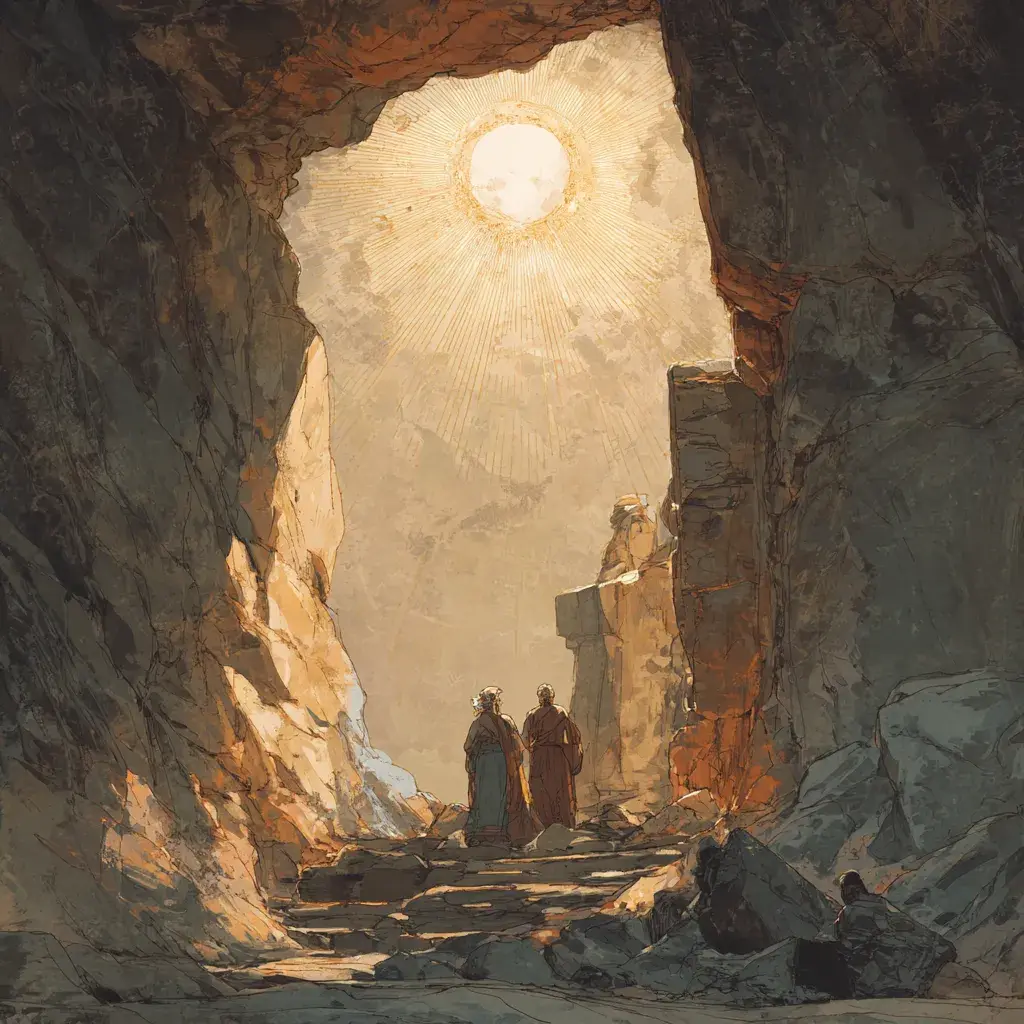
Plato’s Allegory of the Cave
A journey from ignorance to enlightenment in Plato’s timeless cave allegory.
Summary
Plato's Allegory of the Cave, told in Book VII of the Republic (c. 380 BC), is the most famous single image in Western philosophy. Prisoners chained from birth in a cave see only shadows cast on a wall and take the shadows for reality. The story dramatises Plato's view that ordinary sensory experience is a kind of imprisonment, that philosophical education is an awakening to a deeper reality (the Forms), and that the philosopher who has seen the real world has an obligation to return and free the others. The image has shaped 2,400 years of debate about knowledge, education, politics, and the relationship between appearance and reality.
Key Facts
- Written by Plato (c. 428–347 BC) in Republic Book VII
- The prisoners represent ordinary people who mistake sensory experience for reality
- Turning toward the fire and exiting the cave represents philosophical education
- The sun outside the cave represents the Form of the Good — the highest truth in Plato's metaphysics
- The philosopher's return to the cave is the obligation to teach those who remain in ignorance
- Influenced subsequent philosophy from Augustine and medieval Christian thought to modern epistemology
The Prisoners
Frequently Asked Questions
What is Plato's Allegory of the Cave and what does it represent?
Plato's Allegory of the Cave is a philosophical story from his work 'The Republic' that illustrates the journey from ignorance to knowledge. In the allegory, prisoners chained in a cave mistake shadows on the wall for reality until one escapes and discovers the true world outside. The cave represents ignorance and illusion, while the outside world symbolizes enlightenment and philosophical truth.
Why are the prisoners in Plato's cave unable to see reality at first?
The prisoners are physically chained in place since childhood, facing only a wall where shadows are cast by objects behind them. They have never seen the actual objects or the fire that creates the shadows, so they believe the shadows are the only reality that exists. Their physical restraints represent the limitations of human perception and the difficulty of questioning accepted beliefs.
What happens when the freed prisoner returns to tell the others about the outside world?
When the escaped prisoner returns to share his discovery of the true world, the other prisoners reject his message and become hostile toward him. They prefer their familiar shadow-world and view his claims about a brighter reality as nonsense or lies. This represents how people often resist new knowledge that challenges their existing worldview, and how those who seek to enlighten others may face ridicule or persecution.
Learn more
To continue the story, download the Chunks Microlearning app
Or get it straight away:
 Download on iOS
 Download on Android