

Who was Plato?
Plato (c. 428–347 BC) was an ancient Greek philosopher from Athens who studied under Socrates and became one of the most influential thinkers in Western history. He founded the Academy in Athens and developed the Theory of Forms. His philosophical dialogues, which explore ethics, politics, knowledge, and the soul, are still widely read and studied today.
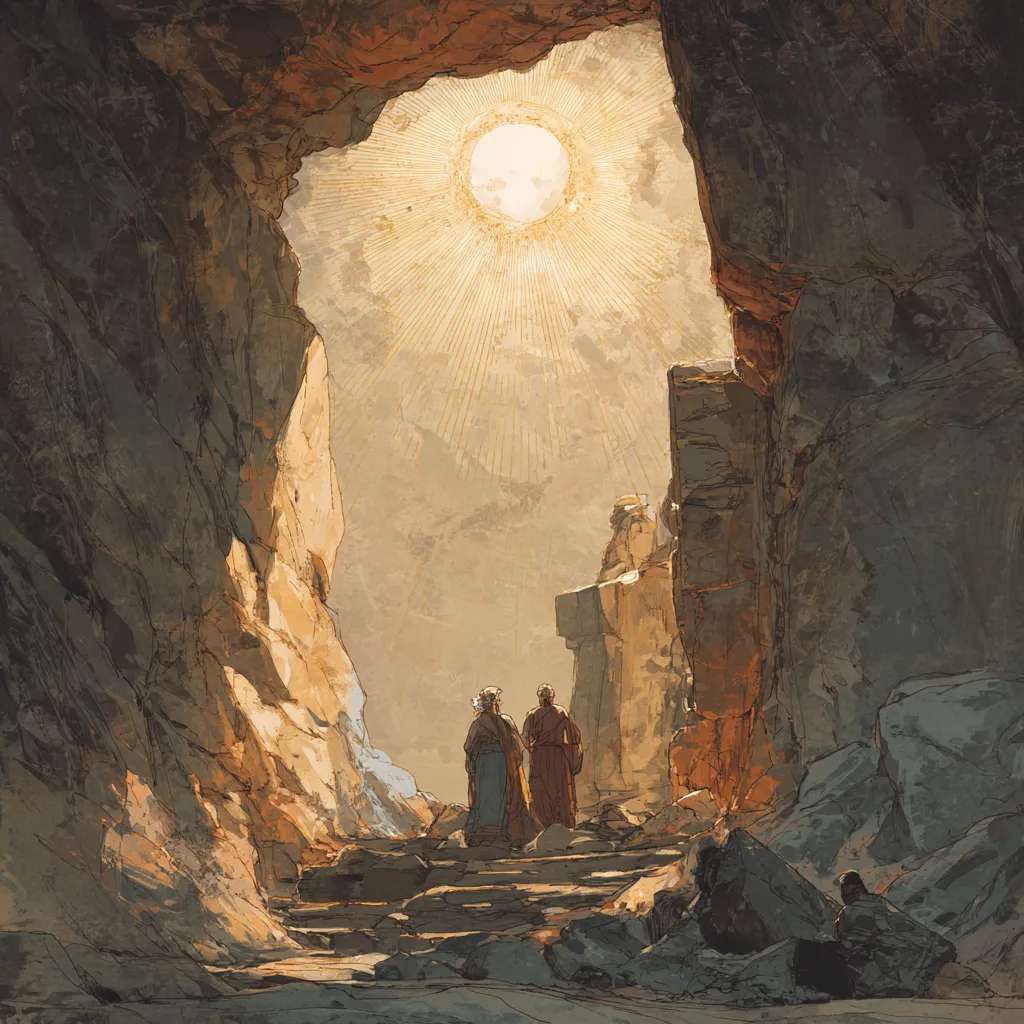
Ancient Greek philosopher and student of Socrates who founded the Academy in Athens and wrote philosophical dialogues that remain influential today. His allegory of the cave is one of philosophy's most famous metaphors for the journey from ignorance to knowledge.
Don't stop at the facts — continue Plato's story in free narrated chapters on Chunks.
 Download on iOS
 Download on Android
Quick facts
- Born
- 420s BC
- Birthplace
- Athens
- Died
- 340s BC
- Place of death
- Athens
- Nationality
- Classical Athens
- Occupation
- Philosopher, epigrammatist, poet
Plato: key facts
- Plato was born around 428 BC in Athens into an aristocratic family and died there in 348/347 BC, spending most of his life in the city where he both studied and taught philosophy.
- Plato founded the Academy in Athens around 383 BC, one of the earliest institutions of higher learning in the Western world, where he taught until his death.
- Plato's most famous contribution to philosophy is his Theory of Forms, which argues that the material world perceived by the senses is merely a copy of a higher, unchanging reality grasped by reason.
- Every one of Plato's dialogues except the Laws features Socrates as a character, though Plato himself never appears as a speaker in any of them.
- Plato was a student of Socrates and later the teacher of Aristotle, making him the central link in the three most influential figures of ancient Greek philosophy.
- Alfred North Whitehead described the European philosophical tradition as consisting of 'a series of footnotes to Plato', reflecting how foundational Plato's ideas have been to Western thought.
- Before turning to philosophy, Plato reportedly wrote poetry including dithyrambs and tragedies, but abandoned and burned his earlier work after meeting Socrates.
Aristocratic Origins and Education in Wartime Athens
Plato was born around 428 BC into one of Athens's most prominent aristocratic families. Through his mother Perictione, he was descended from Solon, the statesman credited with laying the foundations of Athenian democracy. He had two brothers, Glaucon and Adeimantus, both of whom appear as characters in his later philosophical work the Republic, as well as a sister, Potone, and a half-brother, Antiphon. The name 'Plato' was reportedly a nickname alluding to his robust physique, though modern scholars widely regard this story as false.
Plato grew up during the Peloponnesian War, in which Athens was locked in a prolonged and ultimately losing conflict with Sparta. Like other male citizens of Athens, he received a traditional education in gymnastics and music. Ancient writers report that he devoted his early years to poetry, composing dithyrambs, lyric poems, and even a tragedy, before abandoning these pursuits entirely when he encountered Socrates and turned his attention to philosophy.
The Defining Influence of Socrates and a Broken Path to Politics
Plato first encountered Socrates in his youth, initially in the company of other Athenian boys, and eventually became part of Socrates's inner circle. Socrates had redirected Greek philosophical inquiry away from questions about the natural world toward ethics and politics, challenging received ideas through a rigorous method of questioning. This approach left a permanent mark on Plato, who would go on to feature Socrates as the central speaker in nearly all of his philosophical dialogues.
As Plato came of age, he imagined a life in public affairs. Those ambitions were complicated by the political upheavals following Athens's defeat by Sparta in 404 BC, which brought to power the brutal oligarchy known as the Thirty Tyrants. Two of Plato's own relatives, Critias and Charmides, were among the Thirty. Plato was invited to join the administration but declined, repelled by the group's atrocities, including their attempt to implicate Socrates in the unlawful seizure of the democratic general Leon of Salamis. The prosecution of Socrates by Anytus, which followed the restoration of democracy, ended whatever remained of Plato's political ambitions.
Travels, Mathematics, and the Road to the Academy
After the death of Socrates, Plato remained in Athens for roughly three years before embarking on a period of intensive intellectual travel. He studied in Megara with Euclid of Megara, founder of the Megarian school of philosophy. Back in Athens around 394 BC, he studied mathematics alongside figures including Archytas of Tarentum, Theaetetus, and Leodamas of Thasos in the grove of Hecademus, northwest of the city. He also traveled to southern Italy to study with Archytas and other Pythagoreans, an encounter that left a significant impression on his thinking about the relationship between mathematics, abstract reasoning, and the nature of the soul.
Around 385 BC, Plato visited Syracuse, then ruled by the tyrant Dionysius. During this trip, Dionysius's brother-in-law, Dion of Syracuse, became one of Plato's disciples, though the tyrant himself turned against Plato. After returning to Athens, Plato founded his philosophical school, the Academy, near the sacred olive grove of Hecademus, in roughly 383 BC. The school began modestly, with a house and garden, but grew into an open area dedicated to the study of philosophy and mathematics. Aristotle of Stagira arrived there in 367 BC, shortly before Plato departed for his second visit to Syracuse.
The Theory of Forms and the Architecture of Plato's Philosophy
Plato's most celebrated philosophical contribution is the Theory of Forms, first introduced in the dialogue known as the Phaedo. The theory holds that the material world perceived through the senses is not the most real world — it is merely an image or copy of an unchanging realm of Forms, which are grasped by reason alone. Where individual objects like tables or acts of justice exist in the shifting physical world, there are perfect, eternal counterparts — 'tableness,' 'justice,' 'beauty' — that constitute true reality. One of Plato's most cited illustrations of this idea was the eternal truths of geometry, such as the Pythagorean theorem, which hold regardless of any physical triangle drawn in the dirt.
Alongside the Theory of Forms, Plato developed a rich account of the soul, which he believed to be immortal and subject to reincarnation. In the Republic, he divided the soul into three parts — reason, spirit, and appetite — located in different regions of the body, and used this structure to map out an analogous three-part division in society: governing philosopher-kings corresponding to reason, warrior-guardians to spirit, and productive workers to appetite. Plato's ethics centered on the idea that knowledge of what is truly good necessarily leads to good action, and that the highest object of knowledge is the Form of the Good, which he described as existing even beyond being itself.
Final Years, Death, and an Enduring Philosophical Tradition
Plato made two further visits to Syracuse, in 366 BC and 361 BC, both connected to the hope of guiding the new ruler Dionysius II toward philosopher-kingship at the urging of Dion. Neither visit succeeded. On the third trip, Dionysius kept Plato against his will, and Plato had to appeal to his friend Archytas to secure his release. After returning to Athens for the last time around 360 BC, Plato devoted his remaining years to writing, producing or revising works including the Timaeus, Sophist, Statesman, Philebus, and the Laws, his longest work, which was still unfinished at his death and was edited by a student at the Academy, Philip of Opus.
Plato died in 348 or 347 BC and was buried in the garden of the Academy. He was succeeded as head of the school by his nephew Speusippus. His complete works are believed to have survived — an extraordinary circumstance given that the writings of nearly all his contemporaries were lost. The philosopher Alfred North Whitehead captured the scale of his influence by remarking that the entire European philosophical tradition could be characterized as a series of footnotes to Plato, a judgment that reflects how thoroughly Plato's questions about knowledge, reality, justice, and the soul have shaped every subsequent generation of thinkers.
Plato: timeline
- c. 428 BCBorn in Athens into an aristocratic family; through his mother Perictione, he was a descendant of the statesman Solon.
- 404 BCSparta defeated Athens at the end of the Peloponnesian War, leading to the rule of the Thirty Tyrants, which included Plato's relatives Critias and Charmides; Plato was invited to join but declined.
- 403 BCDemocracy was restored in Athens after the Battle of Munychia, where both Critias and Charmides were killed; Plato had become disillusioned with political life.
- c. 396 BCLeft Athens to study in Megara with Euclid of Megara, founder of the Megarian school of philosophy.
- c. 394 BCReturned to Athens and spent time studying mathematics with Archytas of Tarentum and others in the grove of Hecademus, where he would later found the Academy.
- c. 385 BCVisited Syracuse for the first time during the rule of Dionysius, where Dion of Syracuse became one of his disciples.
- c. 383 BCFounded the Academy near the sacred olive grove of Hecademus in Athens, establishing it as a school for philosophy and mathematics.
- 367 BCReturned to Syracuse at Dion's request to tutor Dionysius II, hoping to guide him as a philosopher king; the attempt ultimately failed and Plato returned to Athens.
- 361 BCMade a third trip to Syracuse, was kept against his will by Dionysius II, and had to appeal to his friend Archytas to secure his release and return to Athens.
- 348/347 BCDied in Athens and was buried in his garden at the Academy; he was succeeded as head of the Academy by his nephew Speusippus.
Listen: stories featuring Plato
Narrated chapters from the Chunks Microlearning app. Read a preview here, or listen to the full story in the app.
Continue Plato's story
You've read the summary — hear the full story as narrated 5-minute chapters on Chunks, alongside 200+ figures and events from history, philosophy and science. Free to start on iOS and Android.