
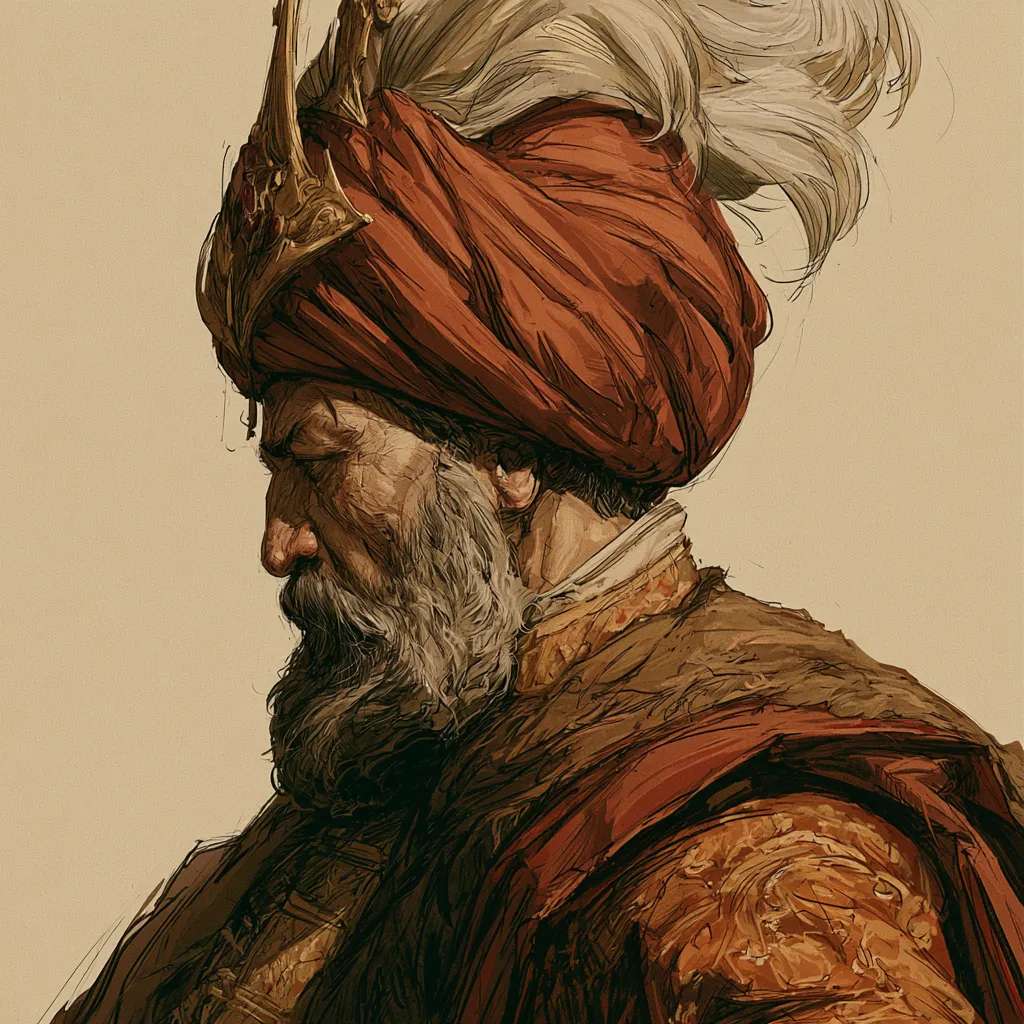
Who was Mehmed II?
Mehmed II (30 March 1432 – 3 May 1481) was an Ottoman sultan who conquered Constantinople in 1453 at age 21, ending the Byzantine Empire and earning the title 'the Conqueror.' He ruled twice, claimed the title Caesar of Rome, reunified Anatolia, and expanded Ottoman power into the Balkans, transforming Constantinople into a thriving imperial capital.
Ottoman Sultan known as 'the Conqueror' who captured Constantinople in 1453, ending the Byzantine Empire. His victory transformed the Ottoman Empire into a major European power and changed the course of world history.
Don't stop at the facts — continue Mehmed II's story in free narrated chapters on Chunks.
Or get it straight away:
 Download on iOS
 Download on Android
Quick facts
- Born
- 30 March 1432
- Birthplace
- Edirne
- Died
- 3 May 1481
- Place of death
- Gebze
- Occupation
- Monarch, poet, sultan
Mehmed II: key facts
- Mehmed II was born on 30 March 1432 in Edirne, then the capital of the Ottoman Empire, and died on 3 May 1481 at the age of forty-nine.
- At age 21, Mehmed II conquered Constantinople on 29 May 1453 after a 57-day siege, ending the Byzantine Empire and moving the Ottoman capital there from Adrianople.
- Following the conquest of Constantinople, Mehmed claimed the title Caesar of Rome (Qaysar-i Rūm), a claim recognized by the Eastern Orthodox Church but rejected by most European monarchs.
- Mehmed II served as Ottoman sultan twice: first from August 1444 to September 1446, and again from February 1451 until his death in May 1481.
- Beyond Constantinople, Mehmed conquered the Despotate of Morea (1460), the Empire of Trebizond (1461), Bosnia (1463), and parts of Albania, significantly expanding Ottoman territory.
- Mehmed II was a patron of arts and learning who commissioned portraits from Venetian painter Gentile Bellini, built the Fatih Mosque and Topkapı Palace, and assembled a multilingual library of over 8,000 manuscripts.
- Writing poetry under the pen name 'Avni,' Mehmed II was the first Ottoman sultan to codify criminal and constitutional law through a formal kanunname issued during 1477–1481.
From Edirne to the Throne: A Prince Trained for Power
Mehmed II was born on 30 March 1432 in Edirne, then the capital of the Ottoman Empire. His father was Sultan Murad II, and his mother Hüma Hatun, a slave of uncertain origin. At the age of eleven, following established Ottoman custom, Mehmed was sent to Amasya to serve as a provincial governor and gain practical experience of rule, accompanied by advisors and teachers appointed by his father.
The religious and intellectual education Mehmed received during these years left a deep mark on him. His mentor Molla Gürâni shaped his approach to Islamic learning, while Akshamsaddin became a dominant influence, instilling in Mehmed a conviction that conquering Constantinople was a sacred duty. When Murad II made peace with Hungary in June 1444 and abdicated in favor of his twelve-year-old son, Mehmed's first reign began almost immediately under the pressure of a Hungarian-led crusade that violated the Treaties of Edirne and Szeged. Murad was eventually persuaded to return and lead the Ottoman forces, winning the Battle of Varna on 10 November 1444. By 1446 Murad had formally returned to the throne, and Mehmed governed Manisa as a prince until his father's death in 1451 gave him the sultanate for the second time.
The Siege That Ended an Empire: Constantinople, 1453
From the moment he regained the throne, Mehmed devoted himself to preparations for the assault on Constantinople. He strengthened the Ottoman navy and built the fortress of Rumelihisarı on the European side of the Bosphorus, complementing the existing Anadoluhisarı on the Asian side, giving him complete control of the strait. Ships that ignored Ottoman signals were sunk, and their surviving sailors executed, making clear the seriousness of his intent.
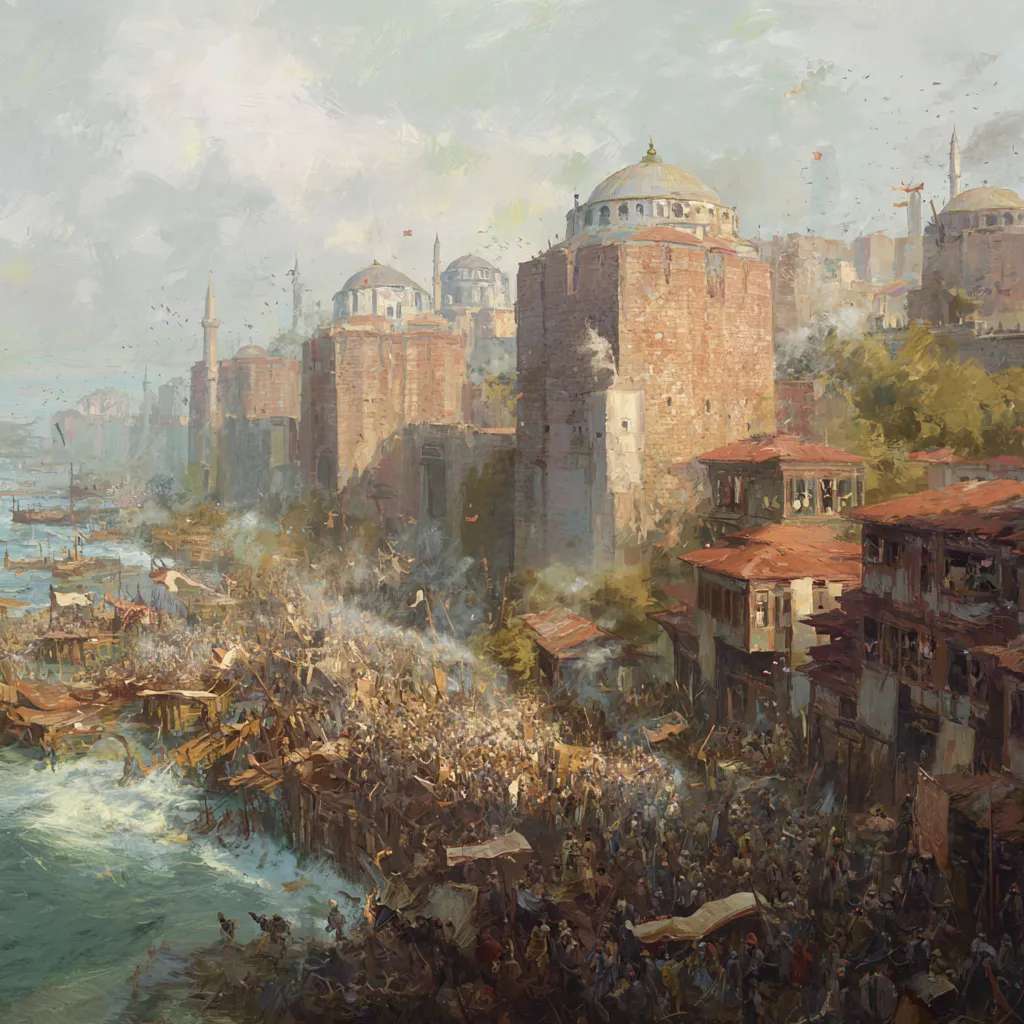
In 1453, at the age of twenty-one, Mehmed launched the siege with an army estimated between 80,000 and 200,000 troops, more than seventy large artillery pieces, and a fleet of 320 vessels. The city's defenders held out for weeks, aided by a chain blocking the Golden Horn harbor. Mehmed broke the deadlock on 22 April by hauling around eighty lighter warships overland, bypassing the Genoese colony of Galata, and launching them into the Golden Horn from the north. Constantinople fell on 29 May 1453, after a fifty-seven-day siege. The last Byzantine emperor, Constantine XI Palaiologos, died in the fighting without an heir.
Following the conquest, Mehmed claimed the title of caesar of Rome, arguing that Constantinople had served as the seat of the Roman Empire since 330 AD and that its ruler was therefore the legitimate Roman successor. The Eastern Orthodox Patriarchate recognized the claim; most European monarchs did not. Mehmed moved the Ottoman capital from Adrianople to Constantinople and immediately began rebuilding the shattered city, ordering repairs to the walls and the construction of new mosques, a palace, and commercial installations.
Decades of Conquest: The Balkans, Anatolia, and Beyond
Mehmed never regarded Constantinople as a final destination. Within years of the city's fall he had taken the Despotate of Morea in the Peloponnese in campaigns of 1458 and 1460, and the Empire of Trebizond on the Black Sea coast in 1461, erasing the last remnants of Byzantine rule. Serbia was progressively absorbed through a series of campaigns between 1454 and 1459, ending with the capture of the Serbian capital Smederevo in June 1459. Bosnia fell in 1463, when Mehmed personally led an army into the country, executed its king Stephen Tomašević, and made Bosnia the westernmost province of the Ottoman Empire.
In Anatolia, Mehmed reunified the Turkish principalities that had fragmented after the disastrous Ottoman defeat at the Battle of Ankara in 1402. His most significant eastern confrontation came against Uzun Hasan of the Aq Qoyunlu confederation, whose alliances with Venice and the Karamanids made him a genuine strategic threat. The two forces met at the Battle of Otlukbeli in 1473, where Mehmed won a decisive victory that secured Ottoman dominance across the region. Along the Adriatic coast, Mehmed fought a protracted war against Venice from 1463 to 1479, ultimately capturing Negroponte in 1470 and forcing the Venetians to cede Shkodra and pay an annual tribute in the Treaty of Constantinople that ended the war.
In 1480, an Ottoman army under Gedik Ahmed Pasha landed in southern Italy and captured the city of Otranto. The attack caused genuine alarm in Rome, and Pope Sixtus IV called for a crusade. Plans were made to evacuate the city. Mehmed died before he could consolidate the Italian foothold, and Otranto was eventually retaken in 1481 after negotiations allowed the Ottoman garrison to withdraw to Albania.
Rebuilding Constantinople and Governing a Diverse Empire
Mehmed transformed Constantinople from a depopulated, damaged city into a functioning imperial capital within a single generation. He issued orders throughout the empire for Muslims, Christians, and Jews to resettle there, and returned confiscated houses to Greeks and Genoese who had fled in order to draw them back. According to a survey conducted in 1478, Constantinople and the neighboring district of Galata together contained 16,324 households, 3,927 shops, and a population of roughly 80,000, of whom approximately 60 percent were Muslim, 20 percent Christian, and 10 percent Jewish.
He restored the Ecumenical Orthodox Patriarchate in January 1454 and appointed the monk Gennadios as patriarch, granting the Orthodox community a degree of legal and religious autonomy within the empire. He also appointed a grand rabbi for the Jewish community. After conquering Bosnia in 1463, Mehmed issued a formal document to Bosnian Franciscans guaranteeing their freedom of movement, worship, and protection from persecution. His standing army, however, was recruited partly through the devshirme system, which took Christian boys between the ages of roughly eight and twenty, converted them to Islam, and trained them for military or administrative roles.
Mehmed reorganized Ottoman government by issuing a kanunname between 1477 and 1481 that codified the roles, salaries, and responsibilities of state officials for the first time. He deliberately appointed officials of devshirme background rather than hereditary aristocrats, ensuring personal loyalty to the sultan. Power was increasingly concentrated at the center, and Mehmed withdrew from public accessibility, conducting government through viziers who commanded armies and received foreign ambassadors on his behalf. He is recognized as the first Ottoman sultan to codify both criminal and constitutional law.
Scholar, Poet, and Collector: Mehmed's Intellectual World
Mehmed was reputedly fluent in Turkish, Arabic, Persian, Greek, Latin, and Serbian. He assembled Islamic scholars for theological debates at his court, and during his reign mathematics, astronomy, and theology reached heights not previously seen in the Ottoman world. He invited the Muslim astronomer Ali Qushji to Constantinople and built a university alongside the Fatih Mosque. He also wrote poetry under the pen name Avni and left behind a collection of classical diwan verse.
His interest in Western culture was equally serious. From early in his reign he sought to commission Italian Renaissance artists, and both Costanzo da Ferrara and Gentile Bellini were eventually invited to the Ottoman court. Bellini came from Venice to paint Mehmed's portrait. Mehmed built a multilingual library containing more than 8,000 manuscripts in Persian, Ottoman Turkish, Arabic, Latin, and Greek. His Greek scriptorium held copies of works including the Anabasis of Alexander the Great and Homer's Iliad. He also patronized the Greek writer Kritiboulos of Imbros, who wrote a Greek-language history of Mehmed's reign.
Mehmed also accumulated a collection of Christian relics acquired after the conquest of Constantinople, including objects associated with John the Baptist. Contemporary accounts describe him as deeply attached to these relics; when Venice reportedly offered 30,000 ducats for one of them, he refused to sell at any price. He died on 3 May 1481, near Maltepe, while preparing what would have been yet another military campaign, at the age of forty-nine. The news of his death was celebrated across Europe with church bells and public festivities.
Mehmed II: timeline
- 1432Born in Edirne, then the capital of the Ottoman Empire, to Sultan Murad II and Hüma Hatun, a slave of uncertain origin.
- 1444At age twelve, ascended the Ottoman throne for the first time after his father Murad II abdicated in his favour.
- 1444His father Murad II, recalled to lead the Ottoman army, defeated the crusade led by John Hunyadi at the Battle of Varna.
- 1446Murad II returned to the throne; Mehmed retained the title of sultan but served effectively as governor of Manisa.
- 1451Following the death of Murad II, Mehmed ascended the Ottoman throne for the second time and began strengthening the navy and preparing to attack Constantinople.
- 1453At age twenty-one, conquered Constantinople after a fifty-seven-day siege, ending the Byzantine Empire and claiming the title Caesar of Rome.
- 1454–1459Conducted a series of campaigns against the Serbian Despotate, ultimately capturing Smederevo in 1459 and formally annexing Serbian lands into the Ottoman Empire.
- 1460Captured Mistra, completing the conquest of the Despotate of Morea and absorbing the last major remnant of Byzantine rule in Greece.
- 1461Led an army that besieged and captured Trebizond, bringing the final vestige of Byzantine rule into the Ottoman Empire.
- 1463Invaded Bosnia, executed King Stephen Tomašević, and made Bosnia the westernmost province of the Ottoman Empire.
- 1473Decisively defeated Uzun Hasan and the Aq Qoyunlu at the Battle of Otlukbeli, reunifying Anatolia under Ottoman control.
- 1481Died at age forty-nine while on campaign, and was buried in his türbe near the Fatih Mosque complex in Constantinople.
Listen: stories featuring Mehmed II
Narrated chapters from the Chunks Microlearning app. Read a preview here, or listen to the full story in the app.
Continue Mehmed II's story
You've read the summary — hear the full story as narrated 5-minute chapters on Chunks, alongside 200+ figures and events from history, philosophy and science. Free to start on iOS and Android.