
In the late 13th century, in the rugged frontiers of Anatolia, a small principality was about to shape the course of history. Osman I, the ambitious leader of the Ottoman tribe, led his people through uncertainty and opportunity. The weakening of the Byzantine Empire and the fragmentation of Seljuk rule left power vacuums. Osman, inspired by dreams of conquest and guided by a vision of unity, began expanding his territory. His followers, known as ghazis, were warriors committed to spreading their faith and defending their lands. The early Ottomans thrived on mobility, skilled horsemanship, and strategic alliances. Through shrewd diplomacy and determined warfare, they captured the Byzantine town of Bursa in 1326, marking a turning point. With Bursa as their capital, the Ottomans gained both prestige and a foothold into the complex world of Anatolian politics. Osman's son, Orhan, would soon expand their power even further. The seeds of empire were sown, and a dynasty was born—one that would eventually span three continents and last over six centuries.
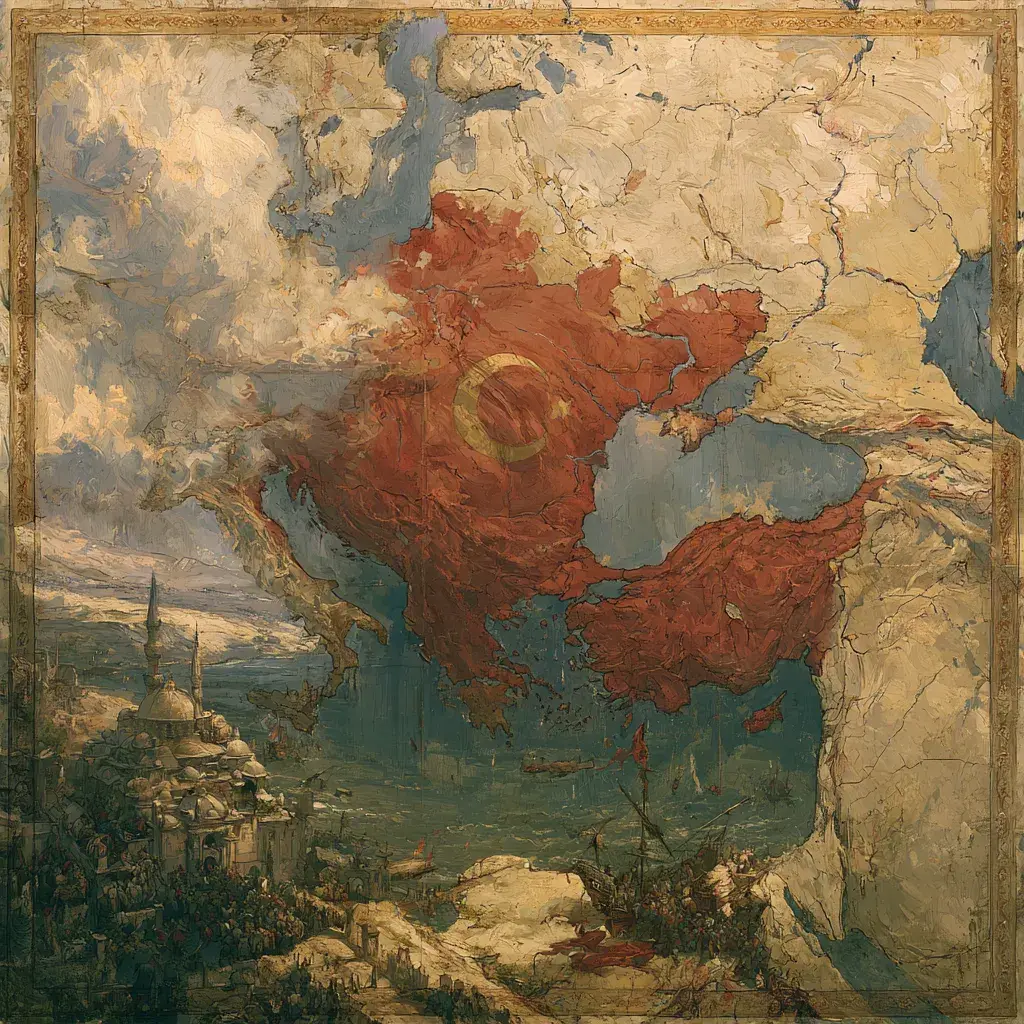
The Ottoman Empire
A captivating journey through the rise, glory, and legacy of the Ottoman Empire across seven chapters.
Origins: The Birth of an Empire
Frequently Asked Questions
How did the Ottoman Empire begin and who founded it?
The Ottoman Empire was founded by Osman I in the late 13th century in northwestern Anatolia. Starting as a small beylik (principality), it gradually expanded by conquering Byzantine territories and other Turkish beyliks. The empire grew from these humble beginnings to eventually span three continents.
What was the significance of the Ottoman conquest of Constantinople in 1453?
The fall of Constantinople in 1453 marked the end of the Byzantine Empire and established the city as the new Ottoman capital, renamed Istanbul. This conquest gave the Ottomans control of the strategic Bosphorus strait connecting Europe and Asia. It symbolized the empire's emergence as a major world power and the center of Islamic civilization.
Who was Suleiman the Magnificent and why is he considered the greatest Ottoman sultan?
Suleiman the Magnificent ruled the Ottoman Empire from 1520 to 1566 during its golden age. He expanded the empire to its greatest territorial extent, reaching the gates of Vienna and controlling much of southeastern Europe, western Asia, and North Africa. Under his rule, the empire experienced unprecedented military success, legal reforms, and cultural flourishing.
Learn more
To continue the story, download the Chunks Microlearning app
Or get it straight away:
 Download on iOS
 Download on Android