
In the spring of 1453, Constantinople stood as the proud, ancient capital of the Byzantine Empire. Once, its golden domes and strong, triple-layered walls had protected the crossroad of Europe and Asia for centuries. But now, the city was a shadow of its former glory. Its population had dwindled, and the empire’s lands had shrunk to little more than the city itself and a handful of outposts. Emperor Constantine XI Palaiologos ruled over the besieged metropolis, aware that his realm was the last remnant of Rome’s eastern heritage. Beyond the city’s thick Theodosian Walls, a new threat had emerged. Sultan Mehmed II, just twenty-one years old but determined and ambitious, led a formidable Ottoman army. He dreamed of conquest and believed that Constantinople, with its riches and strategic location, was the key to uniting his empire and making history. As the Ottomans encircled the city, the citizens of Constantinople prepared for the siege. Hope mingled with fear, prayers echoed through Hagia Sophia, and everyone wondered if help would come in time. The fate of an empire—and perhaps the world—hung in the balance.
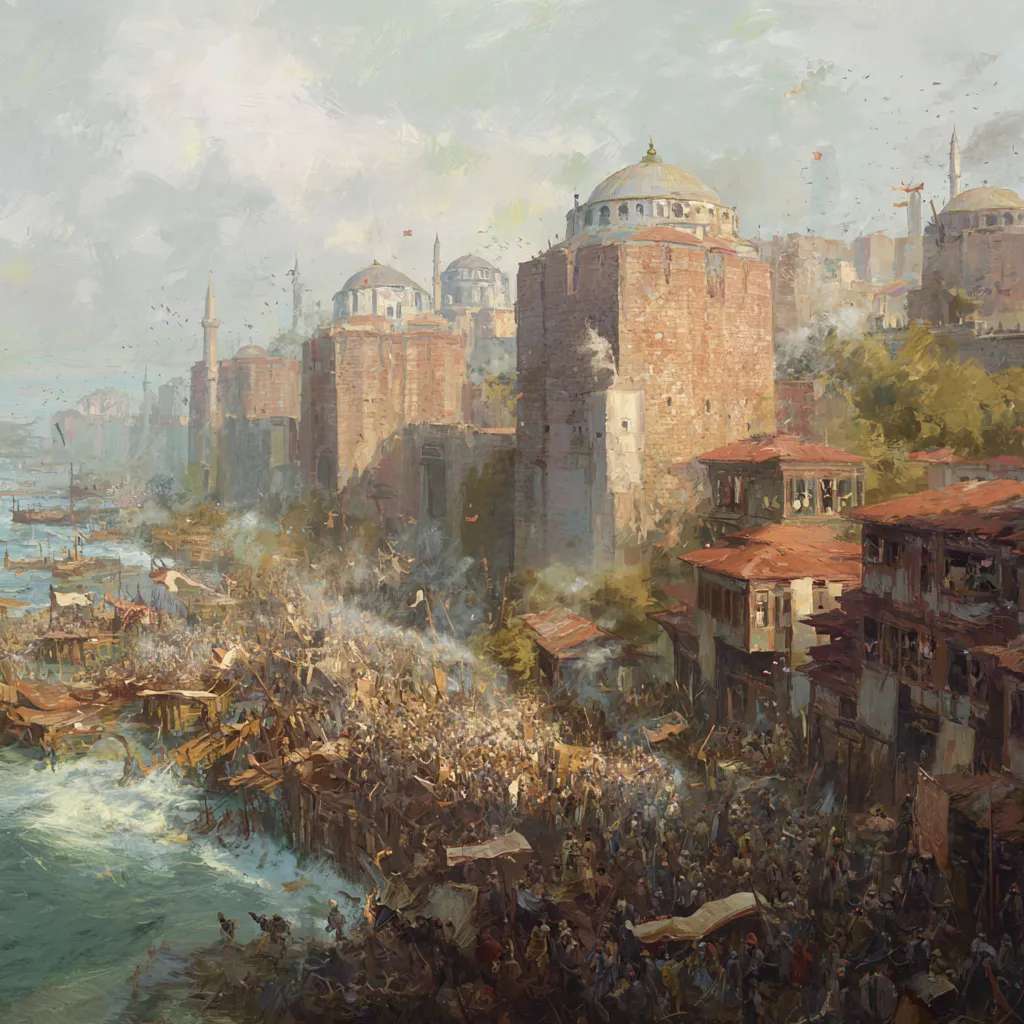
The Fall of Constantinople
A dramatic retelling of the final days of Byzantium and the conquest that changed world history forever.
The Last Bastion of Byzantium
Frequently Asked Questions
What happened during the Fall of Constantinople in 1453?
The Ottoman Empire under Sultan Mehmed II successfully conquered Constantinople after a 53-day siege, ending the Byzantine Empire that had lasted over 1,000 years. The city's massive walls were breached using advanced cannon technology, and Emperor Constantine XI died defending his capital. This conquest gave the Ottomans control of the strategic Bosphorus strait and marked the end of the last remnant of the Roman Empire.
Why was the Fall of Constantinople so significant to world history?
The conquest fundamentally altered European and Middle Eastern politics by establishing Ottoman dominance in the region and cutting off traditional trade routes to Asia. It prompted European explorers to seek new sea routes to the East, contributing to the Age of Exploration and the discovery of the Americas. The fall also triggered a migration of Byzantine scholars to Western Europe, helping fuel the Renaissance.
How did Sultan Mehmed II manage to capture the seemingly impregnable city?
Mehmed II employed massive cannons designed by Hungarian engineer Orban that could breach Constantinople's legendary walls, which had protected the city for over 1,000 years. He also transported ships overland into the Golden Horn to bypass the city's naval defenses and surround it completely. The Ottomans used superior numbers, advanced siege technology, and relentless attacks to overwhelm the outnumbered Byzantine defenders.
Learn more
To continue the story, download the Chunks Microlearning app
 Download on iOS
 Download on Android