
In the fifth year of Pharaoh Merneptah, around 1208 BC, the Libyan chief Meryey led a coalition west of the Nile Delta that included Ekwesh, Teresh, Lukka, Sherden and Shekelesh fighters. They came calling themselves the northerners coming from all lands, a phrase later carved into the Great Karnak Inscription alongside the Athribis Stele and the Merneptah Stele. What set Meryey's march apart from a raid was what came with it: women, children, household goods and building tools, carried as if the coalition meant to settle the Delta rather than plunder it and leave. Word reached Merneptah's court, and the pharaoh's response was not immediate battle but ritual. He prayed and fasted before mustering his forces, a detail the Egyptian scribes thought worth recording alongside the muster itself. Meanwhile Meryey's coalition kept advancing, pushing as far as the main branch of the Nile in the western Delta before any Egyptian force engaged them. For a moment it looked as though the invaders might simply walk into Egypt's richest farmland and stay. Behind Meryey came families expecting new fields, new homes, a new country. Ahead of him, an Egyptian army was finally forming after days of fasting. Neither side yet knew how quickly it would be over, but the stakes were plain: this was not a border skirmish, it was an attempted resettlement of the Delta itself.
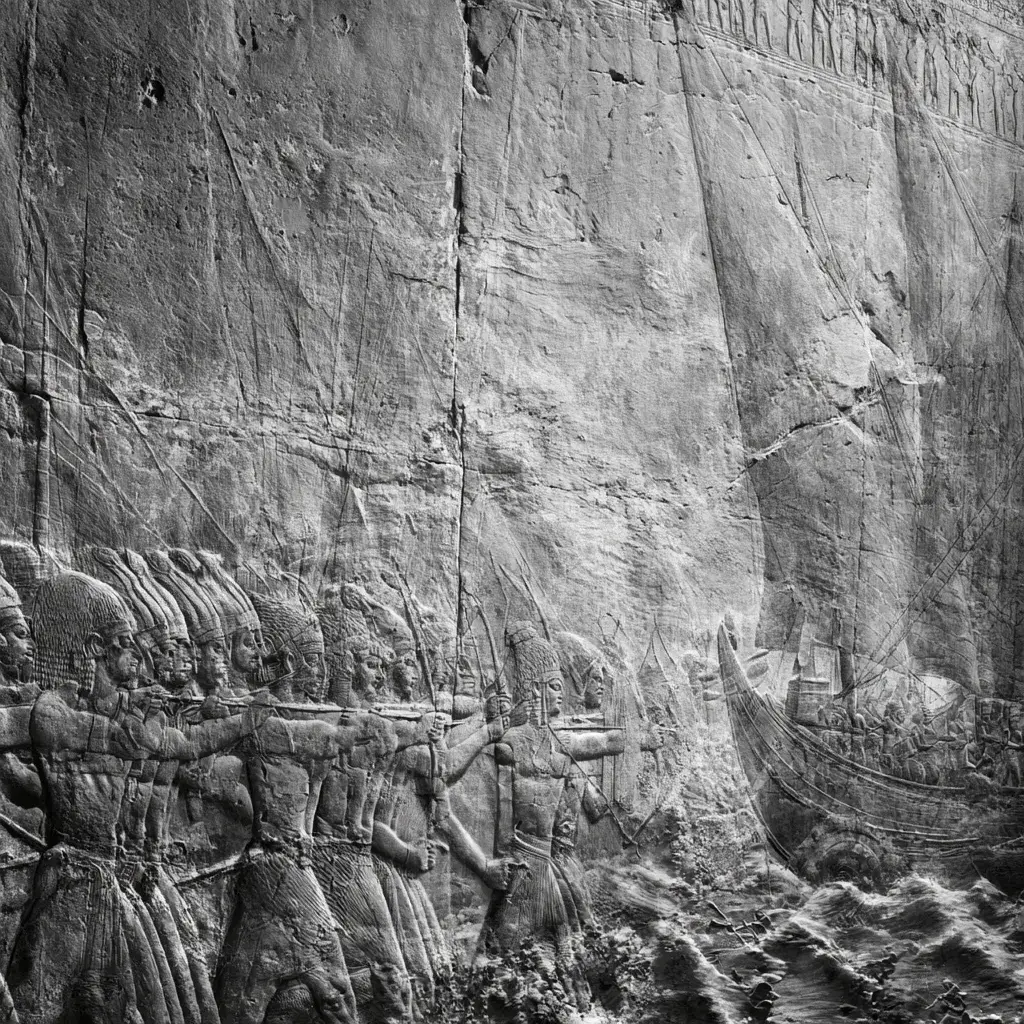
The Mystery of the Sea Peoples
They helped topple the Bronze Age world, then vanished from history. Egypt wrote down little more than their names.
The Chief Who Brought His Family
Frequently Asked Questions
Did the ancient Egyptians ever call their enemies the Sea Peoples?
No. That phrase never appears in any Bronze Age Egyptian, Hittite or Levantine text. It was coined in 1855 by the French Egyptologist Emmanuel de Rouge while describing photographs of the Medinet Habu reliefs, and later built into a migration theory by his successor Gaston Maspero around 1881.
What actually destroyed the Hittite Empire?
Tree-ring evidence from central Turkey shows a severe three-year drought struck in 1198, 1197 and 1196 BC. Hittite Anatolia had no coastal ports for emergency grain shipments like Egypt did, and Hattusa's buildings were found emptied of valuables, suggesting the capital was deliberately abandoned rather than sacked.
What happened to the Sea Peoples groups that Egypt turned away?
Groups including the Peleset settled the southern Canaanite coast within a generation of their defeat, founding what became the Philistine Pentapolis cities of Ashdod, Ashkelon, Ekron, Gath and Gaza. At Ashdod a destroyed fortress was replaced by a shrine and a workshop producing Mycenaean-style pottery, the ancestor of later Philistine bichrome ware.
Learn more
To continue the story, download the Chunks Microlearning app
Or get it straight away:
 Download on iOS
 Download on Android