
Who was Ramesses III?
Hear Ramesses III's story
Chapter 1 of The Mystery of the Sea Peoples · the full story is in the app
Ramesses III (c. 1217-1155 BC) was the second pharaoh of Egypt's Twentieth Dynasty, considered the last New Kingdom ruler to wield substantial power. He repelled invasions by the Sea Peoples and Libyans, built the mortuary temple of Medinet Habu, and was assassinated in a harem conspiracy led by his wife Tiye, a plot that triggered a succession crisis hastening Egypt's decline.
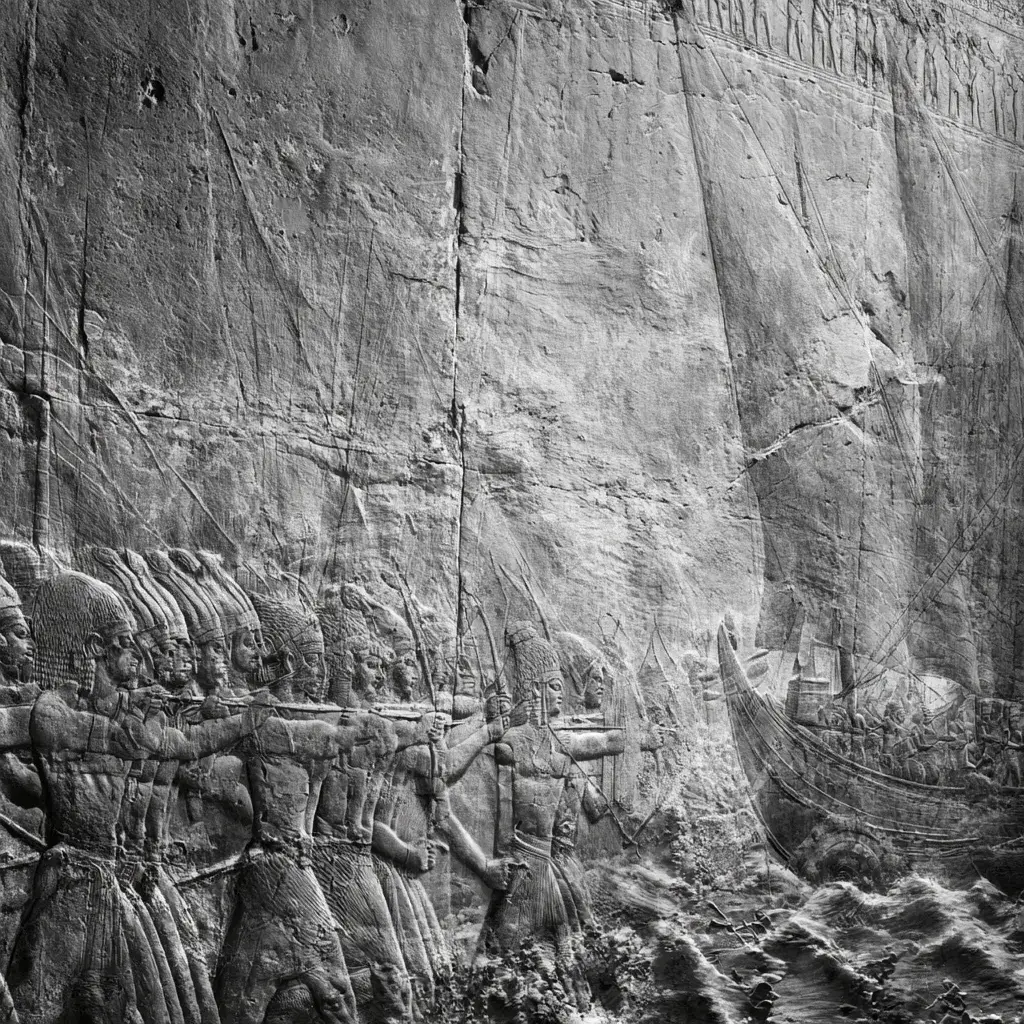
Egyptian pharaoh who recorded his victory over the Sea Peoples on the walls of his temple at Medinet Habu.
Don't stop at the facts — continue Ramesses III's story in free narrated chapters on Chunks.
See how Chunks works → Download on iOS
 Download on Android
Quick facts
- Born
- 1217 BC
- Birthplace
- Thebes
- Died
- 1155 BC
- Nationality
- Ancient Egypt
- Occupation
- Sovereign
Ramesses III: key facts
- Ramesses III reigned as the second pharaoh of Egypt's Twentieth Dynasty, with his rule commonly dated from 1185 to 1154 BC.
- He was the son of Setnakhte and Queen Tiy-Merenese, and is regarded as the last New Kingdom pharaoh to wield substantial power.
- In Year 8 of his reign he defeated the Sea Peoples in the Battle of Djahy and the Battle of the Delta, repelling invasions by land and sea.
- He also fought off Libyan invasions of Egypt's Western Delta in Year 5 and Year 11 of his reign.
- He built the vast fortified mortuary temple complex of Medinet Habu at western Thebes, decorated with scenes of his military victories.
- Ramesses III was assassinated around 1155 BC in a harem conspiracy led by his secondary wife Tiye and her son Pentawere, and CT scans later confirmed his throat had been cut.
- He was succeeded by his designated heir, Ramesses IV, despite the conspirators' efforts to install Pentawere on the throne.
Origins and Rise to the Throne
Ramesses III was born around 1217 BC in Thebes, the son of Setnakhte and Tiy-Merenese. His father's exact origins are unknown, and Setnakhte appears to have seized the throne during a period of crisis and political unrest, likely taking power from Twosret. Ramesses III was not closely related to the earlier kings Ramesses I or Ramesses II, though he was presumably a minor descendant of Ramesses II through a different family line than that of Seti II, Siptah, and Twosret.
He became the second pharaoh of Egypt's Twentieth Dynasty, with his reign estimated to have run from March 1185 BC to April 1154 BC, a span of roughly 31 years. His accession date is recorded as I Shemu day 26, and a description of his coronation from his temple at Medinet Habu describes four doves being released to the four corners of the horizon to announce that Horus, in the person of Ramesses III, still held the throne and that order prevailed over the land.
War Against the Sea Peoples and Libyan Invaders
Ramesses III ruled during the Late Bronze Age collapse, a period when the eastern Mediterranean world was being overrun by instability, invasion, and the migrations of groups known collectively as the Sea Peoples. In Year 8 of his reign, a coalition including the Peleset, Denyen, Shardana, Meshwesh, and Tjekker attacked Egypt by both land and sea. Ramesses met them first at the Battle of Djahy, on the empire's eastern frontier in what is now southern Lebanon, and defeated them there.
The second confrontation, the Battle of the Delta, saw Ramesses lure the invading fleet into the mouths of the Nile, where he had secretly positioned his own ships. Egyptian archers lined the riverbanks and poured arrows into the enemy vessels as they tried to land, while the Egyptian navy closed in with grappling hooks to drag the ships ashore for brutal hand-to-hand fighting. The Egyptians, despite a reputation as poor sailors, won decisively. Surviving members of the Sea Peoples were settled by Ramesses as subject populations in southern Canaan, a resettlement that may have contributed to the later rise of new states such as Philistia.
Beyond this, Ramesses fought Libyan tribesmen in two major campaigns in Egypt's Western Delta, in Year 5 and Year 11. Egyptian inscriptions from his reign have turned up as far afield as Byblos, southern Jordan, and northern Saudi Arabia, suggesting military or trading expeditions reached deep into the Levant and Arabian Peninsula. In 2025, a hieroglyphic inscription bearing his royal cartouche was identified in the Wadi Rum Reserve in Jordan, offering fresh physical evidence of this reach.
Strain on the Treasury and the First Recorded Strike
The cost of sustained warfare steadily drained Egypt's treasury and weakened its hold over its Asian territories. By Year 29 of his reign, the state could no longer reliably provision the elite tomb-builders and artisans of Deir el-Medina with their food rations, leading to what is considered the first known labor strike in recorded history. Some researchers connect this hardship to a period of reduced sunlight and arrested tree growth lasting nearly two decades, possibly caused by the Hekla 3 volcanic eruption in Iceland, which may have disrupted harvests and driven up grain prices in the years following his reign.
None of this difficulty appears on Ramesses III's official monuments, which were designed to project stability and continuity in the manner of his revered predecessor Ramesses II. He expanded the temples at Luxor and Karnak and built his mortuary and administrative complex at Medinet Habu, one of the largest and best-preserved temples in Egypt. Yet the massive fortifications enclosing Medinet Habu, unprecedented for a temple in the Egyptian heartland, quietly reveal just how insecure his later years actually were.
The Harem Conspiracy and a Violent Death
Papyrus trial records show that a plot against Ramesses III's life was organized within his own royal harem, coming to a head during a festival at Medinet Habu in 1155 BC. The scheme was led by his secondary wife Tiye, who wanted her son Pentawere to inherit the throne instead of Ramesses IV, the king's officially designated heir. Ramesses III had failed to make the succession clear and had not honored birth order among his sons, a miscalculation that may have encouraged Tiye to believe her son could also leapfrog his older half-brothers.
The conspiracy implicated a wide circle of palace officials, including the chief of the chamber, royal butlers, treasury overseers, army standard-bearers, scribes, and a herald. Three separate trials were held, and thirty-eight people were ultimately condemned to death, some permitted to take their own lives rather than face execution. The tombs of Tiye and Pentawere were later robbed and their names deliberately erased in an attempt to deny them an afterlife.
For years it was believed Ramesses III's mummy showed no sign of violence, but a 2011 forensic study found heavy bandaging around his throat, and a subsequent CT scan led by Egyptian radiologists revealed a deep knife wound cutting through his trachea, esophagus, and blood vessels down to the vertebrae, a wound described as unsurvivable. A separate scan also found his left big toe had been amputated by a sharp, heavy object shortly before death, with no sign of healing, and that embalmers had fitted a linen prosthetic toe along with protective amulets, pointing to an assassination carried out by more than one attacker using different weapons. Despite the plot, the throne passed as intended to Ramesses IV.
Monuments, Mummy, and Modern Genetic Study
The Great Harris Papyrus, commissioned by Ramesses IV in his father's memory, records Ramesses III's extensive gifts of land, gold statues, and construction work to temples across Egypt and Nubia, along with a trading expedition to the Land of Punt and copper mining operations at Timna in southern Canaan. His temple at Medinet Habu, completed around Year 12, remains decorated with scenes of his naval and land battles against the Sea Peoples and stands as one of the best-preserved temples of the New Kingdom.
His mummy was discovered by antiquarians in 1886 and has become something of a stock image of the Egyptian mummy in popular film. Genetic analysis led by Albert Zink compared his remains with an unidentified young man known as Unknown Man E, found in the same tomb cache, and found matching Y-chromosomal and autosomal markers consistent with a father-son relationship, along with an unusual mummification method on the younger man suggestive of punishment, making him a strong candidate for Pentawere. In April 2021, Ramesses III's mummy was relocated from the Museum of Egyptian Antiquities to the National Museum of Egyptian Civilization as part of the Pharaohs' Golden Parade, alongside the remains of seventeen other kings and four queens.
Ramesses III: timeline
- 1217 BCBorn in Thebes, son of Setnakhte and Tiy-Merenese.
- 1185 BCAscended the throne of Egypt as the second pharaoh of the Twentieth Dynasty.
- Year 5 (c. 1180 BC)Fought off an invasion of Libyan tribesmen in Egypt's Western Delta.
- Year 8 (c. 1178 BC)Defeated the Sea Peoples at the Battle of Djahy and then destroyed their fleet at the Battle of the Delta.
- Year 11 (c. 1175 BC)Repelled a second major Libyan incursion into the Western Delta.
- Year 12 (c. 1174 BC)Completed construction of his mortuary temple complex at Medinet Habu, decorated with scenes of his battles against the Sea Peoples.
- Year 29 (c. 1156 BC)Economic strain left royal tomb-workers at Deir el-Medina unpaid, triggering history's first recorded labour strike.
- 1155 BCSurvived an assassination attempt until wounded in a harem conspiracy organized by his wife Tiye and her son Pentawere, who sought the throne for Pentawere.
- 1154 BCDied in his 32nd regnal year from a fatal knife wound to the throat, succeeded by his designated heir Ramesses IV.
- 1886His mummy was discovered by antiquarians, later becoming an iconic image of the Egyptian mummy in popular culture.
- 2012A CT scan study led by Egyptian and Italian researchers confirmed his throat had been cut, proving he was murdered.
- 2021His mummy was relocated from the Museum of Egyptian Antiquities to the National Museum of Egyptian Civilization during the Pharaohs' Golden Parade.
Listen: stories featuring Ramesses III
Narrated chapters from the Chunks Microlearning app. Read a preview here, or listen to the full story in the app.
Continue Ramesses III's story
You've read the summary — hear the full story as narrated 5-minute chapters on Chunks, alongside 200+ figures and events from history, philosophy and science. Free to start on iOS and Android.