
In 1591, in the halls of King Seonjo's court at Hanseong, an envoy from Japan delivered a message from Toyotomi Hideyoshi, the regent who had just finished unifying Japan after a century of civil war among daimyo. Hideyoshi's demand was blunt: let his armies pass through Korea to strike Ming China, or face conquest themselves. His words, recorded at the time, warned that if Korea would not join him against Ming, 'I shall conquer that country first.' Seonjo's court did not take the threat lightly at first. In 1591 scouts were sent across the strait to Japan to judge the man's intentions, and they returned with conflicting reports, one warning of real danger, another dismissing it as bluster. Seonjo chose to believe the milder assessment. No mobilization followed, no forts were strengthened, no grain was stockpiled against siege. Hideyoshi's ambitions, meanwhile, reached beyond Korea entirely. He spoke of Korea only as a road, a corridor his armies would cross on their way to conquering Ming China itself, the vastly larger empire beyond. The refusal that Seonjo's court gave was quiet, almost bureaucratic, a matter of court correspondence rather than declared war. But it was the trigger. By the spring of the following year, Hideyoshi's transport ships were already being loaded at the southern Japanese ports, and Korea's coastline had never been defended for anything like what was coming.
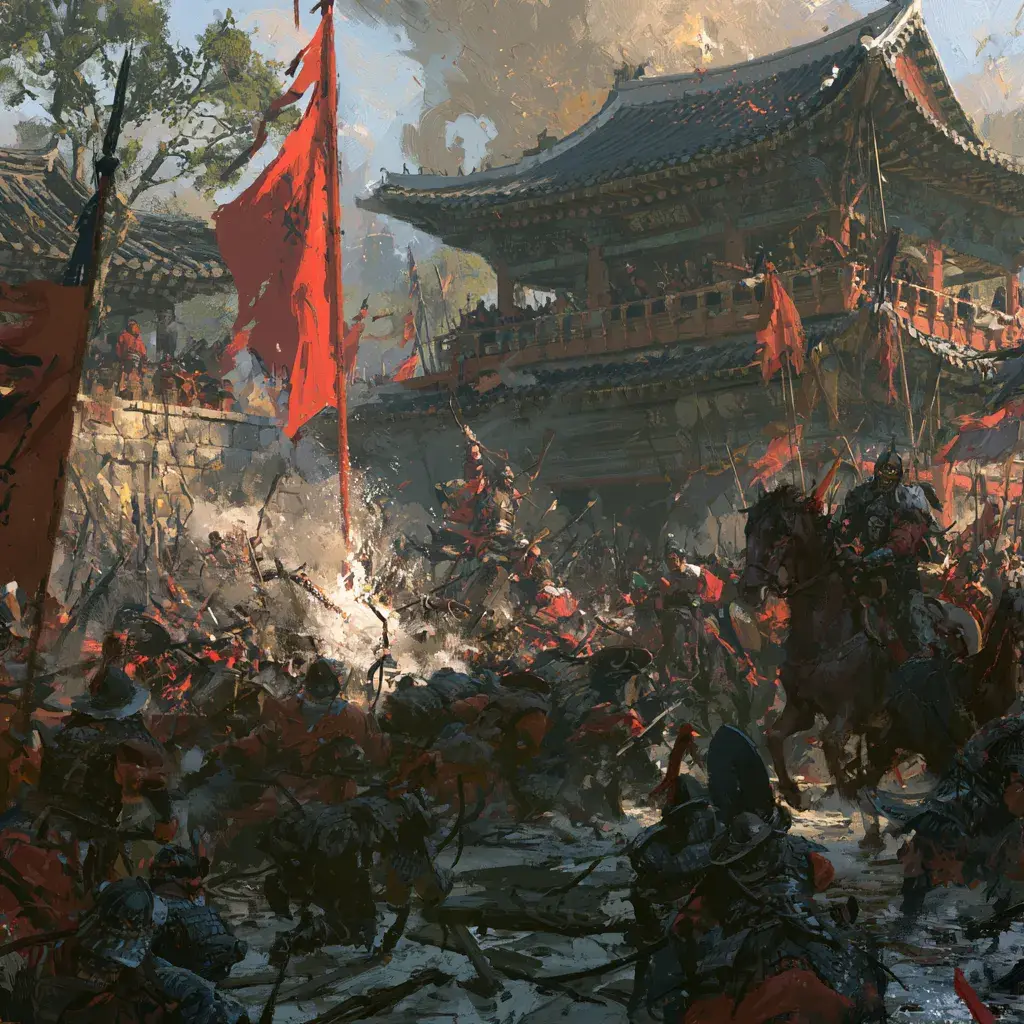
The Imjin War
Hideyoshi warned Korea 'I shall conquer that country first,' then invaded in 1592.
The Envoy's Warning
Frequently Asked Questions
Why did Japan invade Korea in 1592?
Toyotomi Hideyoshi, having unified Japan, demanded Korea let his armies pass through to attack Ming China. King Seonjo's court refused to cooperate, and Hideyoshi launched an invasion in 1592 with Korea as the intended corridor.
Who was Admiral Yi Sun-sin and why does he matter?
Yi Sun-sin commanded the Joseon navy and won decisive victories at Hansan Island in 1592 and Myeongnyang in 1597, at one point defeating a fleet of roughly 133 warships with only 13 ships. He died at the final Battle of Noryang in 1598, ordering his death be hidden until the fighting ended.
How did the Imjin War end?
Toyotomi Hideyoshi died on 18 September 1598 and Japan's Council of Five Elders ordered a withdrawal. After the climactic Battle of Noryang, surviving Japanese forces fled to Busan and left for Japan, and diplomatic relations between Joseon and Japan were formally restored in 1607.
Learn more
To continue the story, download the Chunks Microlearning app
Or get it straight away:
 Download on iOS
 Download on Android