
Who was Toyotomi Hideyoshi?
Hear Toyotomi Hideyoshi's story
Chapter 1 of The Imjin War · the full story is in the app
Toyotomi Hideyoshi (March 17, 1537 - September 18, 1598) was a Japanese samurai and daimyo who rose from a peasant background as a foot soldier to become Japan's second Great Unifier. Serving under Oda Nobunaga before succeeding him, he gained the titles of kampaku and daijo-daijin, completed the unification of Japan by 1591, and later launched costly invasions of Korea that stalled before his death at Fushimi Castle.
Samurai who unified Japan and then launched the invasions of Korea in 1592.
Don't stop at the facts — continue Toyotomi Hideyoshi's story in free narrated chapters on Chunks.
See how Chunks works → Download on iOS
 Download on Android
Quick facts
- Born
- 17 March 1537
- Birthplace
- Nakamura-ku
- Died
- 18 September 1598
- Place of death
- Fushimi Castle
- Nationality
- Japan
- Occupation
- Politician, military commander, ashigaru
Toyotomi Hideyoshi: key facts
- Toyotomi Hideyoshi was born on March 17, 1537, in Nakamura, Owari Province, present-day Nakamura Ward, Nagoya, to an ashigaru foot soldier named Kinoshita Yaemon.
- He rose from a peasant background to serve the Oda clan, becoming a trusted general under Oda Nobunaga and eventually taking the name Hashiba Hideyoshi.
- After Nobunaga was killed in the Honno-ji incident in 1582, Hideyoshi defeated his assassin Akechi Mitsuhide at the Battle of Yamazaki and became his successor.
- In 1585 he became Imperial Regent, or kampaku, the first person of base-born origin to hold that office, and was later given the clan name Toyotomi by the Imperial Court.
- Hideyoshi completed the unification of Japan by conquering Shikoku in 1585, Kyushu in 1587, winning the Siege of Odawara in 1590, and crushing the Kunohe rebellion in 1591.
- In 1592 he launched the Japanese invasions of Korea, aiming eventually to conquer Ming China, but the campaigns ended in military stalemate.
- Toyotomi Hideyoshi died at Fushimi Castle on September 18, 1598, leaving his young son Hideyori as successor under a Council of Five Elders.
A Peasant's Son in a Collapsing Order
Toyotomi Hideyoshi was born on March 17, 1537, in Nakamura, in Owari Province, an area that is now part of Nagoya. Japan at the time had no functioning central government; the Ashikaga shogunate had effectively collapsed, and regional warlords fought constantly for territory during what is known as the Sengoku period. Hideyoshi's father, Kinoshita Yaemon, was an ashigaru, a peasant foot soldier with no samurai rank, and the family had no traceable samurai lineage at all. As a child Hideyoshi was known as Hiyoshimaru. His father died in 1543, when he was seven years old, and contemporary accounts from the period describe the family's poverty as severe enough that Hideyoshi reportedly had to beg in the streets.
Popular legend holds that he was sent to a temple to study and ran off in search of adventure instead; whether or not that detail is accurate, he did eventually take the name Kinoshita Tokichiro and entered service with the Imagawa clan as a retainer to a local ruler named Matsushita Yukitsuna. This was the first step in a career that had no precedent in Japanese history: a man born with no samurai blood climbing, step by step, into the highest ranks of national power.
Sandal-Bearer to General Under Oda Nobunaga
In 1558 Hideyoshi joined the Oda clan as an ashigaru under Oda Nobunaga, the ambitious lord then consolidating control over Owari Province. He started as Nobunaga's sandal-bearer, a post that carried more status than the title suggests, and is credited by biographers with overseeing repairs at Kiyosu Castle and managing kitchen affairs, though some of these details are considered embellished by later storytellers. In 1561 he married One, the adopted daughter of Asano Nagakatsu. He later helped repair Sunomata Castle in hostile territory, and legend credits him with building a fort there overnight and finding a secret route into Mount Inaba that induced the local garrison to surrender.
His value to Nobunaga went beyond construction work. In 1564 he proved himself as a negotiator, persuading several Mino warlords, including the Saito clan's own strategist Takenaka Shigeharu, to defect through generous bribery, which helped secure Nobunaga's victory at the Siege of Inabayama Castle in 1567. By 1568 Hideyoshi had become one of Nobunaga's leading generals and adopted the name Hashiba Hideyoshi, combining characters borrowed from two of Nobunaga's other senior retainers along with two rival commanders. Over the following decade he commanded or took part in a long string of campaigns, including the retreat from Kanegasaki in 1570, the Battle of Anegawa the same year, sieges against the Azai and Asakura clans, the Battle of Nagashino in 1575, and a lengthy effort from 1577 onward to conquer the Chugoku region from the Mori clan, culminating in the Siege of Takamatsu in 1582. Along the way Nobunaga rewarded him with territory in northern Omi Province, where he built up the town of Nagahama and expanded a firearms factory at Kunitomo.
Avenging Nobunaga and Seizing the Realm
On June 21, 1582, while Hideyoshi was besieging Takamatsu, Nobunaga and his heir Nobutada were killed by the retainer Akechi Mitsuhide in the Honno-ji incident. Hideyoshi quickly made peace with the Mori clan he had been fighting and marched to confront Mitsuhide, defeating him thirteen days later at the Battle of Yamazaki. This victory positioned him as Nobunaga's effective successor. He began building Osaka Castle that same year on the site of a temple Nobunaga had destroyed, a project not completed until 1597, and it would later serve as the Toyotomi clan's last stronghold.
Succession to Nobunaga's authority was not automatic. At a meeting of daimyo at Kiyosu Castle, Hideyoshi backed Nobunaga's infant grandson Hidenobu as heir rather than either of Nobunaga's surviving adult sons, a choice that provoked Shibata Katsuie into open rebellion alongside Oda Nobutaka. Hideyoshi crushed Katsuie's forces at the Battle of Shizugatake in 1583, leaving him in control of roughly thirty provinces. A further challenge came from Nobunaga's son Nobukatsu, who allied with Tokugawa Ieyasu; their forces fought to an inconclusive standstill at Komaki and Nagakute in 1584. Hideyoshi and Ieyasu never met in direct battle, and after both sides lost key commanders they withdrew. Hideyoshi eventually made peace with Nobukatsu, and after the 1586 Tensho earthquake forced him to abandon further plans against Ieyasu, he sent his own sister and mother to Ieyasu's side as hostages, after which Ieyasu agreed to submit to him.
Rather than pursue the title of shogun, Hideyoshi arranged adoption into the noble Konoe family and secured the courtly offices of daijo-daijin, or Chancellor, and in 1585 the position of kampaku, Imperial Regent, becoming the first person of base birth ever to hold it. That same year the imperial court granted him the new clan name Toyotomi. He built the lavish Jurakudai palace in 1587 and hosted Emperor Go-Yozei there the following year.
Completing the Unification of Japan
With court authority secured, Hideyoshi spent the later 1580s extending military control across the whole archipelago. In 1585 his forces subdued Kii Province in the Siege of Negoro-ji, burning the temple complex and its warrior monks, and the same year a Toyotomi army of some 113,000 men overwhelmed Chosokabe Motochika's roughly 40,000 defenders to take Shikoku. In 1586 Hideyoshi and his half-brother Toyotomi Hidenaga led a combined force of 200,000 against the Shimazu clan's 30,000 men in Kyushu, besieging their stronghold at Kagoshima Castle until the Shimazu surrendered.
In 1588 Hideyoshi ordered a sword hunt, banning ordinary peasants from owning weapons and melting confiscated arms down for use in building a great statue of the Buddha in Kyoto. The policy cut off a major source of peasant unrest and locked in a rigid separation between the warrior class and everyone else. In 1590 he turned against the Later Hojo clan at Odawara, deploying an unusually theatrical siege featuring entertainers and musicians alongside troops, and during the campaign he persuaded Ieyasu to trade his five provinces for eight Hojo-held provinces in the Kanto region. The following year, 1591, Hideyoshi's forces put down the Kunohe rebellion in Mutsu Province, a conflict that began as a succession dispute within the Nanbu clan; its suppression in September 1591 marked the final military action needed to complete the unification of Japan under his rule.
Taiko, the Korean Invasions, and Death
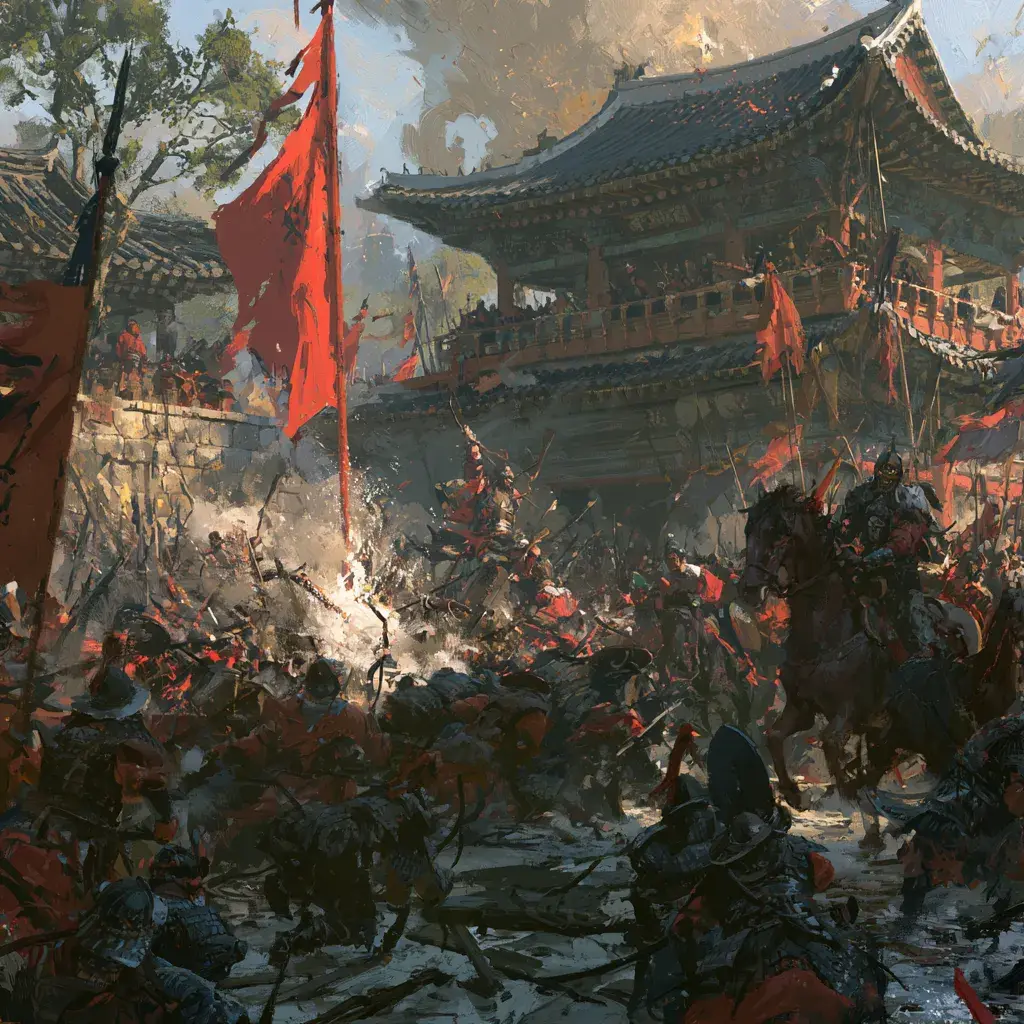
In 1591 Hideyoshi's three-year-old son Tsurumatsu died, followed by the death of his half-brother Hidenaga from illness. He responded by adopting his nephew Hidetsugu as heir in January 1592 and stepping down from the kampaku title to become taiko, a retired regent who retained real power. That same year he launched the invasion of Korea, intending eventual conquest of Ming China and openly describing ambitions that extended toward India and the Philippines. Japanese forces under commanders including Ukita Hideie, Konishi Yukinaga, and Kato Kiyomasa took Seoul within weeks and pushed deep into the peninsula, but Ming China intervened on Korea's behalf in 1593, and the destruction of the Japanese navy by Admiral Yi Sun-sin cut off supply lines and stalled the campaign.
The birth of a second son, Hideyori, in 1593 complicated the succession Hideyoshi had just arranged. Suspicion fell on Hidetsugu, who was stripped of his titles in 1595, exiled, and ordered to commit suicide, after which his family members were executed in Kyoto. Hideyoshi then secured blood-signed loyalty oaths from major daimyo, including Ieyasu, to protect Hideyori's position. A second invasion of Korea launched under Kobayakawa Hideaki in the mid-1590s made little headway and left Japanese troops pinned down, even as individual battles such as Sacheon in 1598 went in Japan's favor.
Hideyoshi died at Fushimi Castle on September 18, 1598, reportedly telling his assembled generals that he depended on them for everything and had nothing else to leave behind. His death was concealed at first by the Council of Five Elders so that Japanese forces could be withdrawn from Korea without panic. He had tried to secure Hideyori's future by urging an alliance with Ieyasu, but the council could not restrain Ieyasu's ambitions, and Ieyasu's victory at the Battle of Sekigahara in 1600 set the stage for the Tokugawa shogunate. The Toyotomi line was finally destroyed when Ieyasu besieged Osaka Castle in 1614 and 1615, forcing Hideyori and his mother to take their own lives. Historians now regard the loss of Hideyoshi's adult heirs, leaving only the young Hideyori behind, as the central reason the Toyotomi regime could not survive his death.
Toyotomi Hideyoshi: timeline
- 1537Born in Nakamura, Owari Province, to a peasant family with no samurai lineage.
- 1558Joined the Oda clan as an ashigaru foot soldier, beginning service under Oda Nobunaga.
- 1561Married One (Nene), adopted daughter of Asano Nagakatsu.
- 1573After campaigns against the Azai and Asakura clans, was made daimyo over districts in northern Omi Province.
- 1582Oda Nobunaga was killed in the Honno-ji incident; Hideyoshi then defeated the assassin Akechi Mitsuhide at the Battle of Yamazaki.
- 1583Crushed rival Shibata Katsuie at the Battle of Shizugatake, consolidating control over roughly thirty provinces.
- 1585Secured the title of Imperial Regent (kampaku) and received the new clan name Toyotomi from the Imperial Court.
- 1586Conquered Kyushu, forcing the surrender of the Shimazu clan after besieging Kagoshima Castle.
- 1590Won the Siege of Odawara against the Later Hojo clan, extending control over the Kanto region.
- 1591Suppressed the Kunohe rebellion in Mutsu Province, completing the unification of Japan.
- 1592Resigned as kampaku to become taiko and launched the Japanese invasion of Korea aiming eventually at Ming China.
- 1598Died at Fushimi Castle, leaving his young son Hideyori as heir under a council of regents.
Listen: stories featuring Toyotomi Hideyoshi
Narrated chapters from the Chunks Microlearning app. Read a preview here, or listen to the full story in the app.
Continue Toyotomi Hideyoshi's story
You've read the summary — hear the full story as narrated 5-minute chapters on Chunks, alongside 200+ figures and events from history, philosophy and science. Free to start on iOS and Android.