
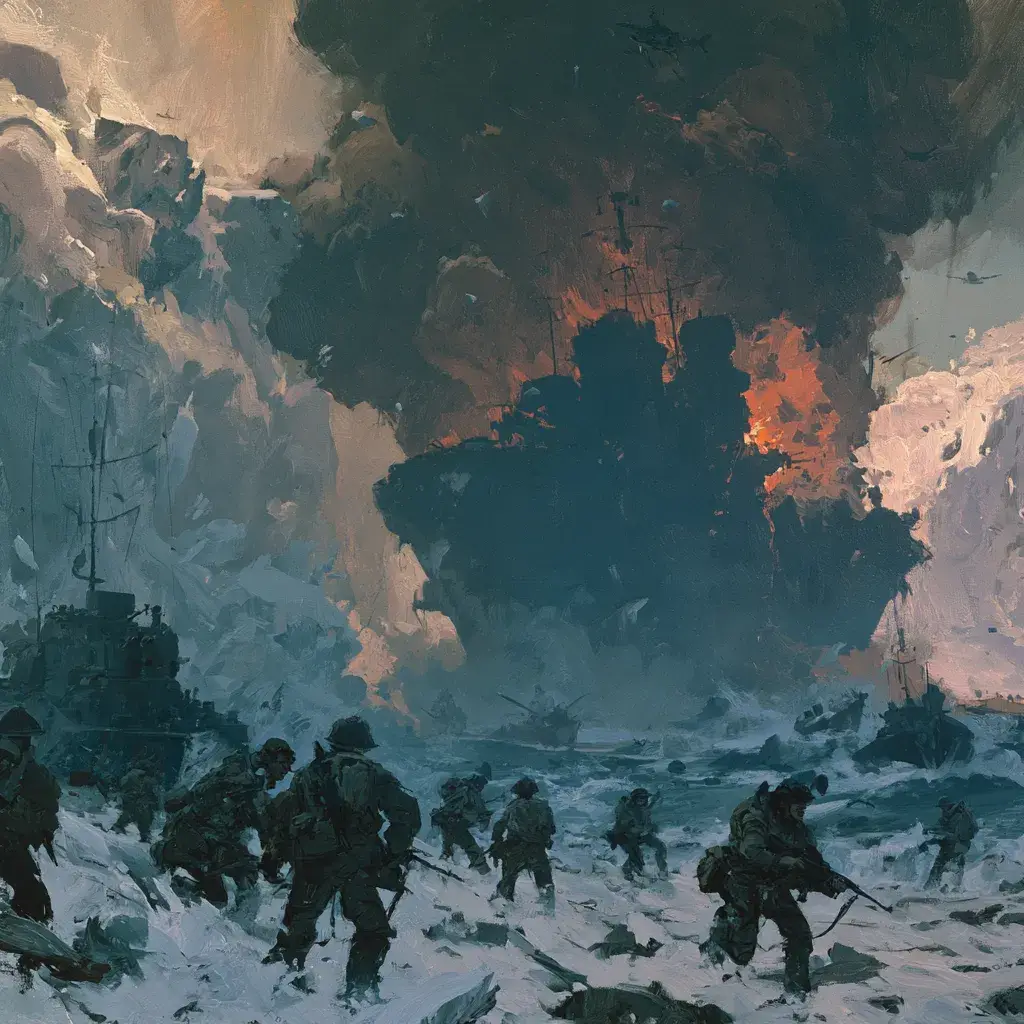
On 2 January 1833, Captain John Onslow steered the Royal Navy sloop HMS Clio into the waters off Port Louis on East Falkland. Buenos Aires had sent a governor and garrison to the islands the previous October, formalising a sovereignty claim the United Provinces had asserted since Argentina's 1816 independence from Spain. Onslow ran up a signal declaring the islands belonged to Great Britain, a claim reaching back to a 1690 landing and a settlement occupied between 1765 and 1774. The Argentine garrison, small and unsupported, withdrew under protest rather than fight. No shots were fired. Instead of a battle there was a departure by ship, the Argentine flag lowered and the British one raised over Port Louis. Britain formally reestablished rule in January 1834, sending Lieutenant Henry Smith to govern the islands it had just retaken without firing a shot. That January morning opened a dispute that is still, nearly two centuries on, the episode both governments point to first when the question of who owns the Falklands comes up.
The Falkland Islands
On 2 Jan 1833, HMS Clio evicted an Argentine garrison from Port Louis without a shot fired.
The Eviction of 1833
Frequently Asked Questions
Why did Argentina invade the Falkland Islands in 1982?
Argentina's military junta under General Leopoldo Galtieri faced economic crisis and falling public support and calculated that seizing the long-disputed islands would rally patriotic feeling. The junta believed Britain would not fight to defend a territory it had recently signalled little interest in, having ordered the patrol ship HMS Endurance withdrawn from the region in 1981.
How did the Falklands War end?
After British forces took the high ground above Stanley, General Mario Menendez surrendered his roughly 10,000 troops to Major General Jeremy Moore at 21:00 local time on 14 June 1982, ending 74 days of fighting. Around 11,300 Argentine troops across the islands became prisoners of war.
Did the war settle the sovereignty dispute over the Falklands?
No, Argentina never renounced its claim and the dispute remains formally unresolved at the United Nations. In a March 2013 referendum, 99.8 percent of Falkland Islanders voting on a 92 percent turnout chose to remain a British Overseas Territory.
Learn more
To continue the story, download the Chunks Microlearning app
Or get it straight away:
 Download on iOS
 Download on Android