
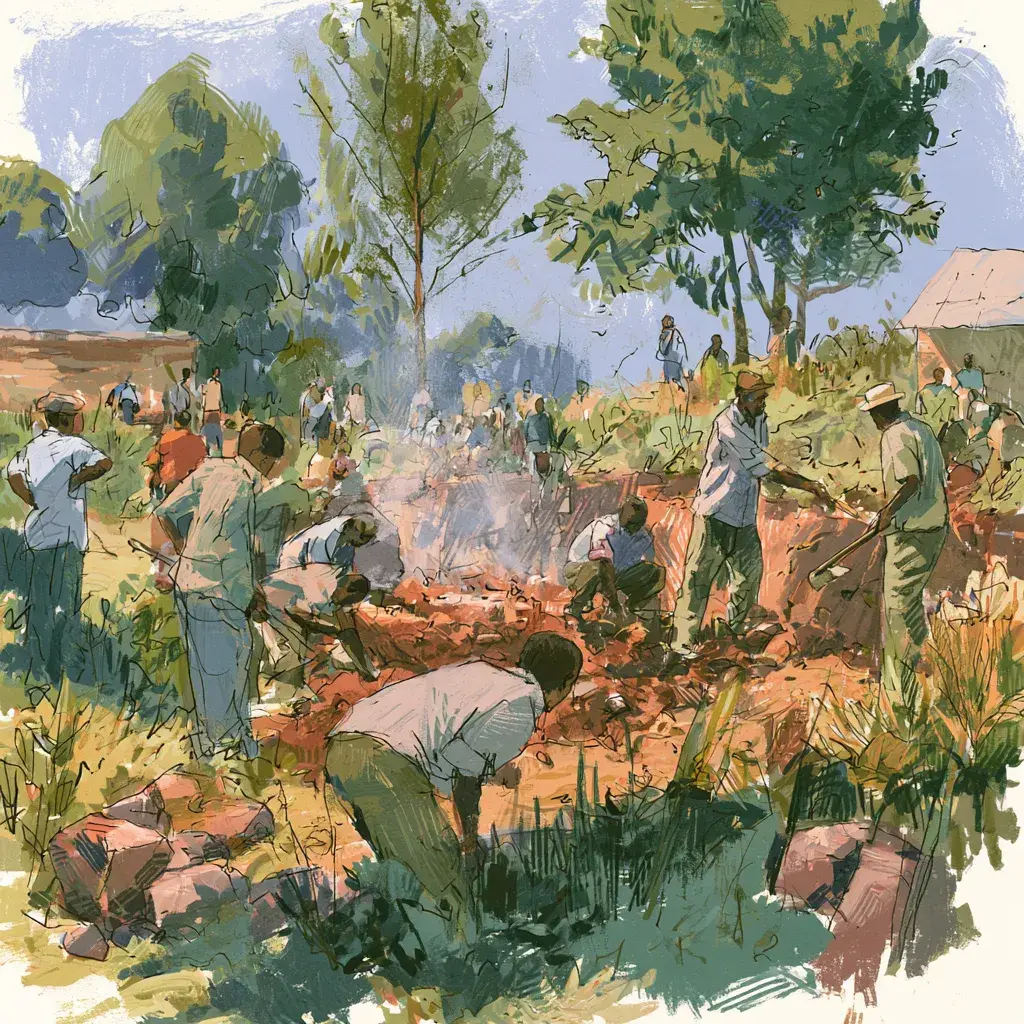
In the highlands of Rwanda, generations before any king's decree became law, families relied on a custom called umuganda whenever a household could not manage alone. Picture a homestead in the 16th century: a widow's roof beams sag, and by dawn neighbors arrive with poles and thatch, driving a wooden support pillar into the earth. Linguist Eugene Shimamungu later traced the word umuganda itself to that pillar, the timber that held a house frame upright, standing for people holding each other up. A related practice, ubudehe, was narrower, calling farmers together only to ready fields for planting season. Nobody enforced umuganda from above. It was expectation, not order: if a household's able workers were away, they sent a representative rather than skip entirely, and a missing healthy worker was itself how neighbors learned who needed help. Under the mwami, the king, this coexisted uneasily with harsher labor obligations peasants owed local chiefs. This gentler custom is what colonial rulers would later seize.
Rwanda's Umuganda, A Nation's Day of Service
By 2015, one year of Rwanda's monthly Umuganda labor was valued near 19 billion Rwandan francs.
The Pillar and the Neighbor
Frequently Asked Questions
What does the word umuganda originally mean?
Linguist Eugene Shimamungu traced umuganda to a wooden pillar driven into the ground to support a house frame. The word evoked people holding each other up, describing the pre-colonial custom of neighbors pooling labor to help a family that could not manage alone.
How did Belgian colonial rule change umuganda?
Belgian administrators, who governed Rwanda from 1916, introduced a system called uburetwa in the 1940s requiring every adult male to give sixty days of unpaid labor a year, mostly on export plantations and roads. This forced version replaced the earlier voluntary custom and left families little time to grow their own food.
How was Umuganda misused during the 1994 genocide?
Local officials called burgomasters and their councilors used the same authority they held for organizing community labor to instead summon armed assailants to massacre sites. Radio broadcasts urged Hutu civilians to go to work against Tutsi neighbors, borrowing the language of the labor tradition itself.
Learn more
To continue the story, download the Chunks Microlearning app
Or get it straight away:
 Download on iOS
 Download on Android