
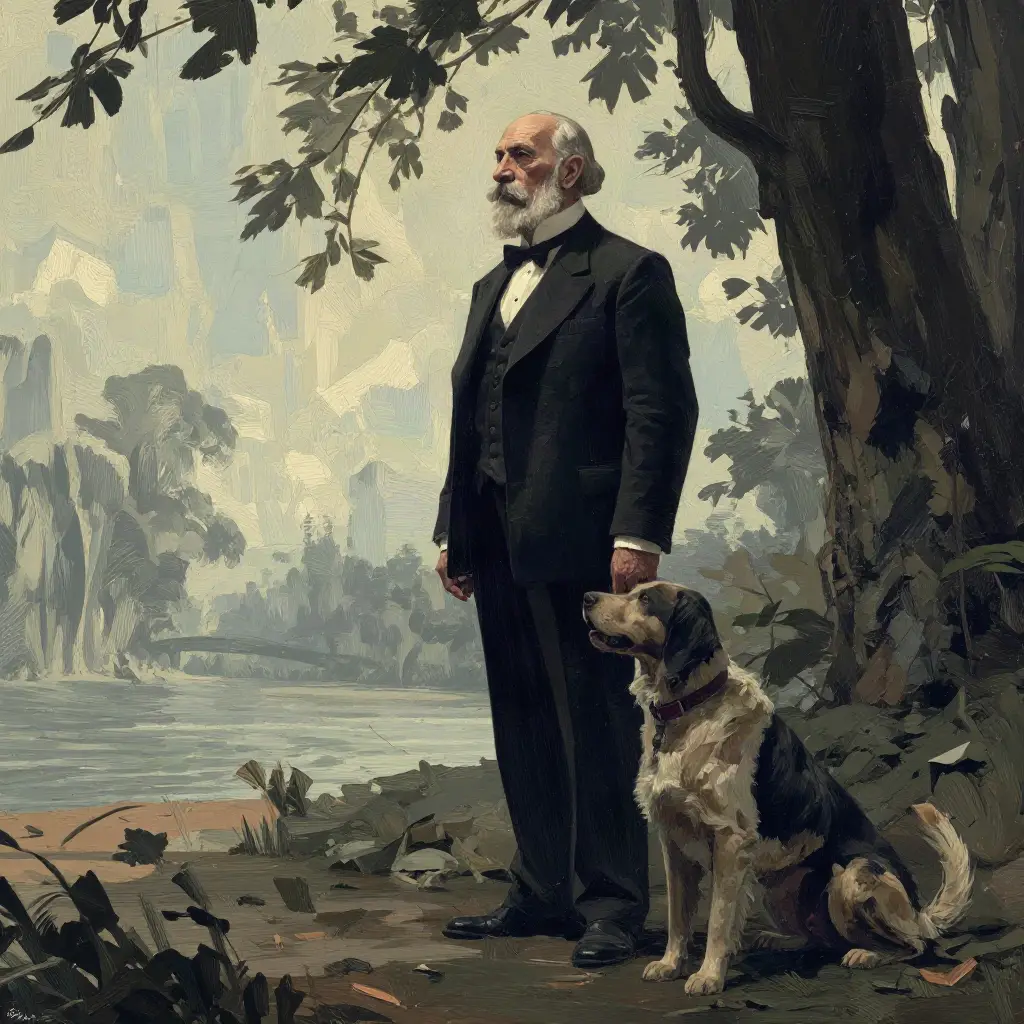
In the 1890s, the Russian physiologist Ivan Pavlov was investigating the mechanics of the stomach rather than the psychology of learning for which he is famous today. His work on digestion was so groundbreaking it earned him the Nobel Prize in 1904. For his research, he developed a surgical technique called a 'gastric fistula,' a permanent opening in a dog's stomach. This allowed him to collect and measure digestive juices in a living, healthy animal. His 1897 book, 'Lectures on the Work of the Principal Digestive Glands,' became a foundational text. It was an accidental observation during this work that would change his career forever.
Pavlov's Dogs
The true story of Ivan Pavlov, who discovered classical conditioning while conducting Nobel-winning research on digestion.
Chapter 1
The Stomach Scientist
0:42
Frequently Asked Questions
Did Pavlov really use a bell to train his dogs?
No, the bell is largely a myth. Ivan Pavlov preferred more precise, measurable signals for his experiments, such as a metronome whose speed he could vary. He also used buzzers, lights, and even a thermal stimulus applied to the skin.
What is classical conditioning?
It's a learning process where a natural, biological reflex gets associated with a new, neutral trigger. For Pavlov's dogs, the natural reflex was salivating for food. The new trigger was the sound of a metronome, which they learned to associate with the arrival of food.
Can a conditioned response be unlearned?
Yes, Pavlov called this process 'extinction.' If the signal, like a metronome, was presented repeatedly without the reward of food, the dogs eventually stopped salivating at the sound. However, the memory isn't erased, as the response could reappear after a rest period.
Learn more
To continue the story, download the Chunks Microlearning app
Or get it straight away:
 Download on iOS
 Download on Android