
In 625, Khalid ibn al-Walid was not a Muslim hero, but their most dangerous enemy. A brilliant commander for the Quraysh tribe of Mecca, he faced the early Islamic community at the Battle of Uhud. The Muslims were on the verge of victory. But Khalid, observing from the flank, noticed a critical error: the Muslim archers had abandoned their high ground to gather spoils from the battlefield. Seizing the moment, he led a swift cavalry charge into the exposed rear of the Muslim line. The surprise attack turned the tide completely, transforming a near-victory for the Muslims into a bloody rout. This crushing defeat, where the Prophet Muhammad himself was wounded, was the first undeniable proof of Khalid's tactical genius.
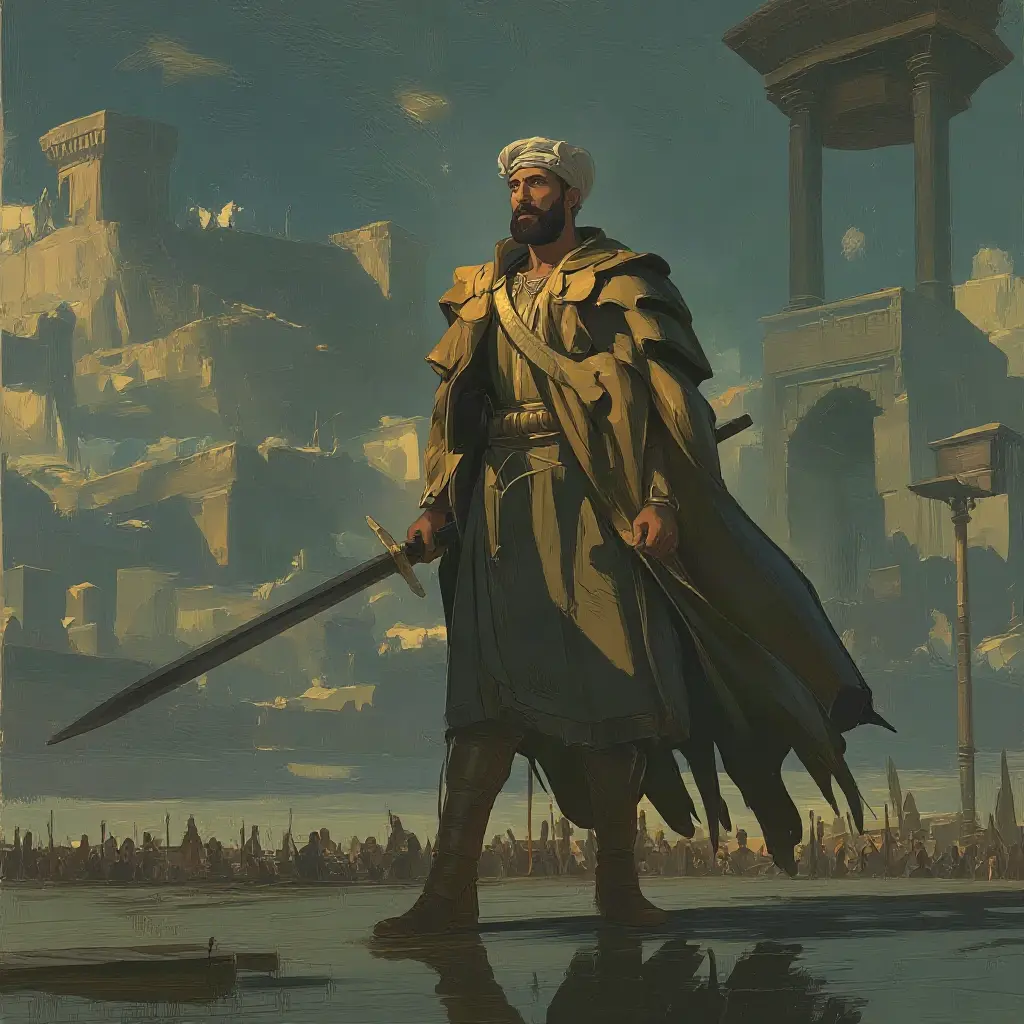
Khalid ibn al-Walid: The Sword of God
The story of Khalid ibn al-Walid, the 7th-century Arab general who defeated the Byzantines at the decisive Battle of Yarmouk in 636.
Chapter 1
The Genius of Uhud
0:48
Frequently Asked Questions
Why was Khalid ibn al-Walid called the 'Sword of God'?
He received the title 'Sayf Allah' directly from the Prophet Muhammad. After three Muslim commanders were killed at the Battle of Mu'ta in 629, Khalid took charge and saved the outnumbered army from a larger Byzantine force through a brilliant tactical withdrawal.
What was Khalid's most significant victory?
His most significant victory was the Battle of Yarmouk in 636. His defeat of a massive Byzantine army effectively ended Roman rule in Syria and Palestine, paving the way for further Muslim expansion.
If Khalid was undefeated, why was he dismissed from command?
The Caliph Umar dismissed him in 638 out of a concern that soldiers were starting to believe victory came from Khalid himself, rather than from God. The decision was meant to reinforce that ultimate power and success belong to God alone.
Learn more
To continue the story, download the Chunks Microlearning app
Or get it straight away:
 Download on iOS
 Download on Android