
In 532, the city of Constantinople was in flames. The Nika Riots, a massive insurrection that began over chariot races, had destroyed much of the city, including its main cathedral. For Emperor Justinian I, the crisis was also an opportunity. Just one month after brutally suppressing the riots, he launched a project of immense ambition: to build a new cathedral that would be the largest and most magnificent in the world. This was the Hagia Sophia, or "Holy Wisdom." He spared no expense, gathering rare marble and stone from across the Byzantine Empire. The goal was not just to rebuild a church, but to create a monument to God and to the power of his own reign.
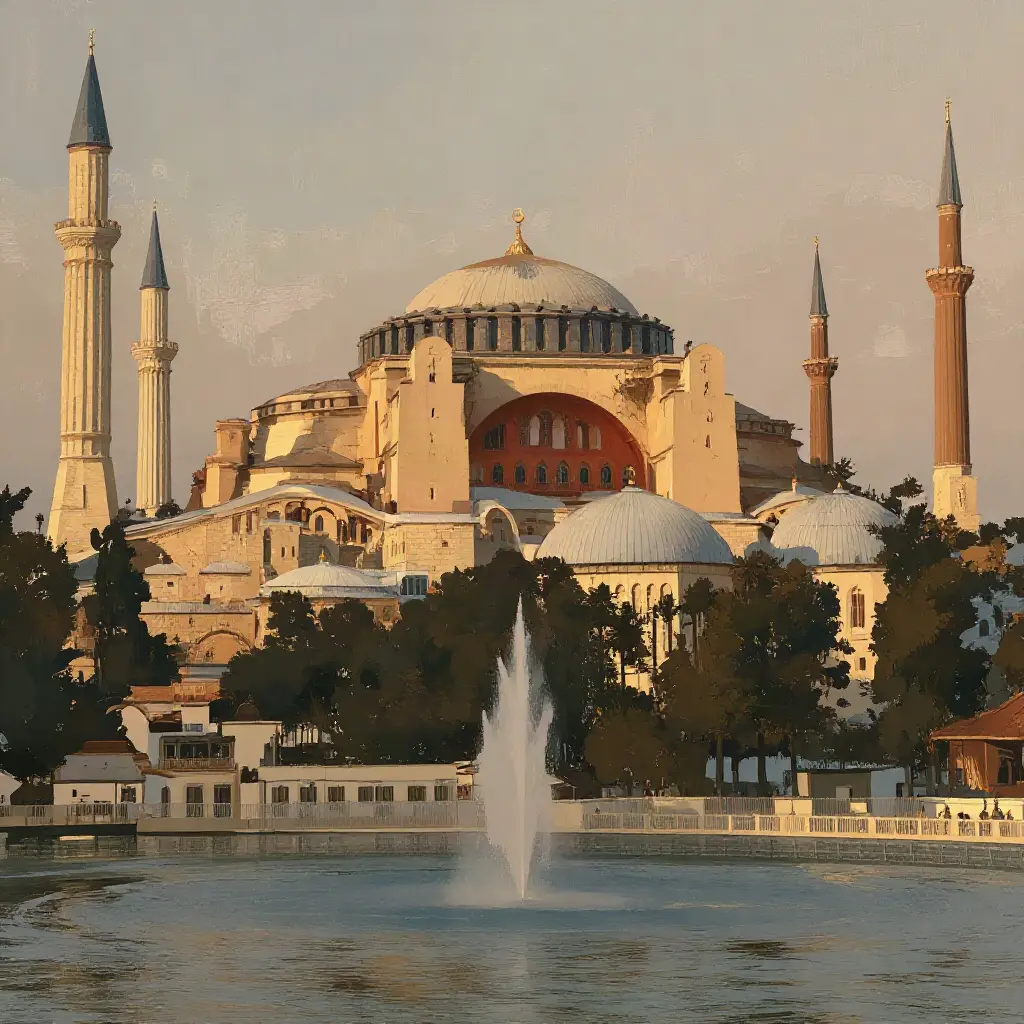
Hagia Sophia
Built in 537 by Emperor Justinian, Istanbul's Hagia Sophia is an architectural marvel famous for its massive dome and 1,500-year history.
Chapter 1
A Cathedral Born from Fire
0:47
Frequently Asked Questions
Why was the Hagia Sophia built?
Emperor Justinian I commissioned it in 532 to replace a cathedral destroyed during the Nika Riots in Constantinople. He intended it as a grand statement of his power and a monument to the Christian faith, designed to surpass all previous architectural achievements.
What is architecturally unique about Hagia Sophia's dome?
Its massive central dome appears to float above the main space. This effect was achieved by using pendentives, triangular segments of a sphere, which allowed the circular dome to be placed over a square base and channeled its weight into four massive piers.
Why is the Hagia Sophia's current status controversial?
After serving as a museum since 1934, a symbol of Turkey's secular state, it was converted back into a mosque in 2020. This decision was celebrated by some but drew criticism from international bodies like UNESCO who valued its status as a shared world heritage site.
Learn more
To continue the story, download the Chunks Microlearning app
Or get it straight away:
 Download on iOS
 Download on Android