
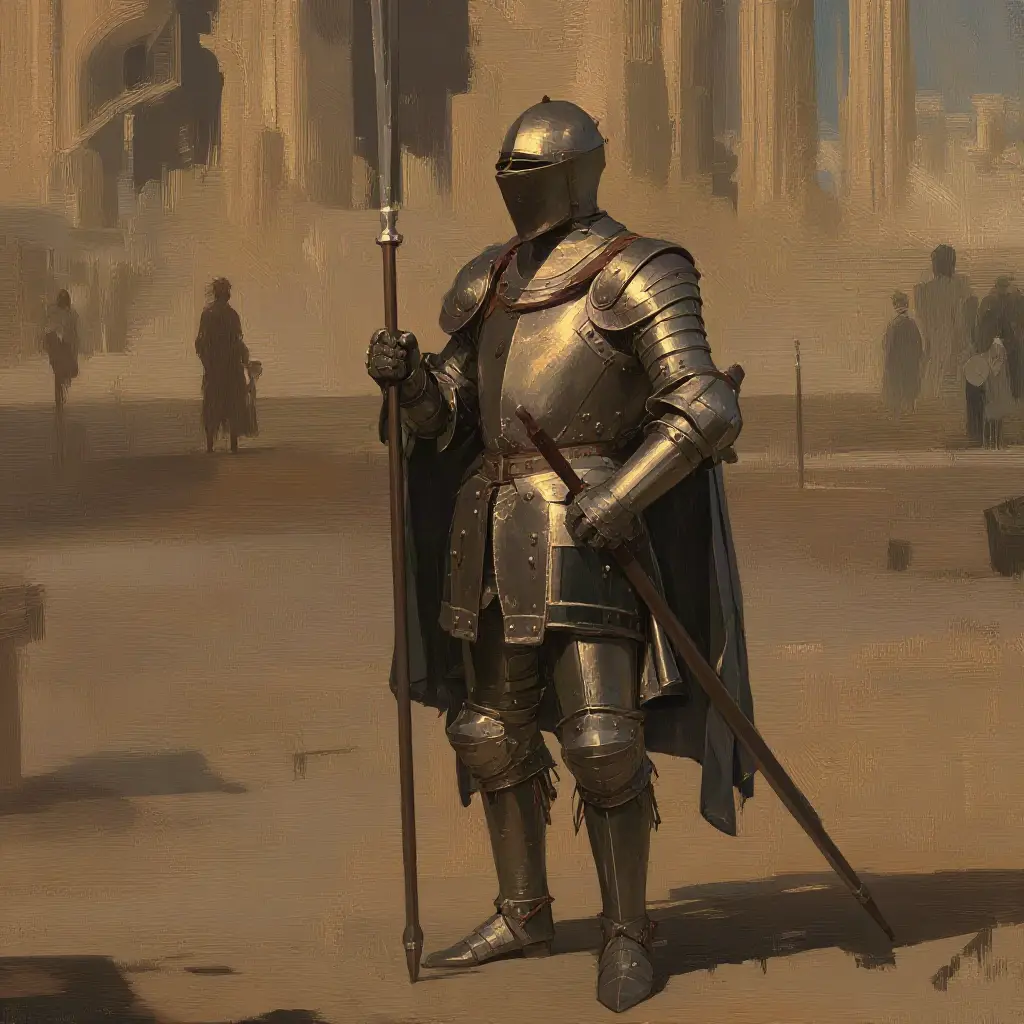
The medieval knight is an icon of honor, but what did chivalry actually mean? It wasn't just good manners. It was a formal system designed to justify the power of heavily armed horsemen. In the 13th century, a former knight named Ramon Llull wrote the definitive handbook, arguing that just as God rules the planets, knights should rule the people. But this right was conditional on their moral purity. Every piece of equipment held a symbolic meaning. The spear represented truth because it was straight. The helmet symbolized the 'dread of shame,' a reminder that a knight's reputation was his most vital protection. For over two centuries, this book defined the ideal of the perfect, pious warrior.
Chivalry and Knighthood
What medieval chivalry meant in practice: how knights were trained and dubbed, what horses and armour cost, the ideals set out by Ramon Llull and Geoffroi de Charny, and how knights treated commoners.
Chapter 1
The Knight's Justification
0:47
Frequently Asked Questions
What was the code of chivalry really about?
It was a formal social and military order designed to justify the power of knights over common people. Thinkers like Ramon Llull argued that knights should rule, but only by maintaining a moral purity as strict as a priest's, with their equipment symbolizing Christian virtues.
Was it expensive to become a knight?
The cost was immense. In the 13th century, a single high-quality warhorse could cost the equivalent of over 26 years of a common laborer's wages. This financial barrier effectively ensured that knighthood remained an exclusive class for the wealthy nobility.
Did chivalry apply to everyone in war?
No, the code applied almost exclusively to other nobles. Knights were often captured and held for a profitable ransom, sometimes released on their word of honor to raise the money. In contrast, common soldiers or peasants were frequently massacred without a second thought.
Learn more
To continue the story, download the Chunks Microlearning app
Or get it straight away:
 Download on iOS
 Download on Android