
In 17th-century France, a young boy was forbidden from studying mathematics. His father, Étienne Pascal, wanted him to master Latin and Greek first. But Blaise Pascal was a prodigy. According to his sister, Gilberte, at just 12 years old, Blaise secretly began exploring geometry on his own. Using charcoal on the floor tiles, he worked his way through its principles without any books. He independently proved that the angles of a triangle always add up to two right angles. When his father discovered him, he was so astonished by the boy's raw talent that he relented and gave him a book of geometry, opening the door to his formal mathematical education.
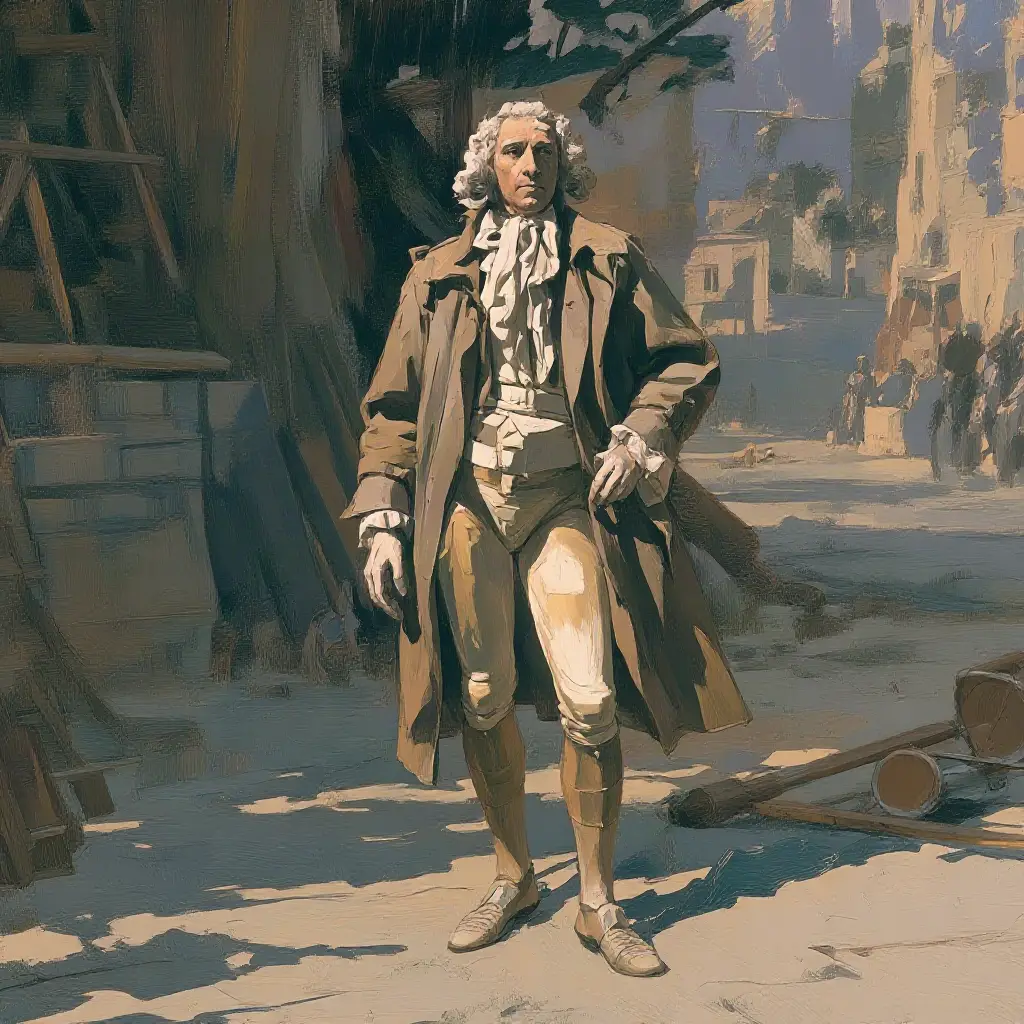
Blaise Pascal
The life of Blaise Pascal, the French mathematician and religious thinker behind the Pascaline calculator, the Puy de Dôme air-pressure experiment, early probability theory and the Pensées.
Chapter 1
The Child Mathematician
0:45
Frequently Asked Questions
What was the Pascaline?
The Pascaline was the first mechanical calculator intended for business use, invented by Blaise Pascal between 1642 and 1645. He designed the polished brass box to help his father with tax accounting. It used a series of wheels and dials to perform addition and subtraction.
What is Pascal's Wager?
Pascal's Wager is a philosophical argument from his posthumously published book, 'Pensées'. He argued that a rational person should live as if God exists because the potential gain, eternal life, is infinite, while the potential loss is finite and insignificant.
How did Pascal prove that air has weight?
In 1648, Pascal organized an experiment where his brother-in-law carried a mercury barometer up the Puy de Dôme mountain. The mercury level dropped significantly, proving that the column of air above was thinner and therefore lighter at a higher altitude. This demonstrated that air is a fluid with weight.
Learn more
To continue the story, download the Chunks Microlearning app
Or get it straight away:
 Download on iOS
 Download on Android