
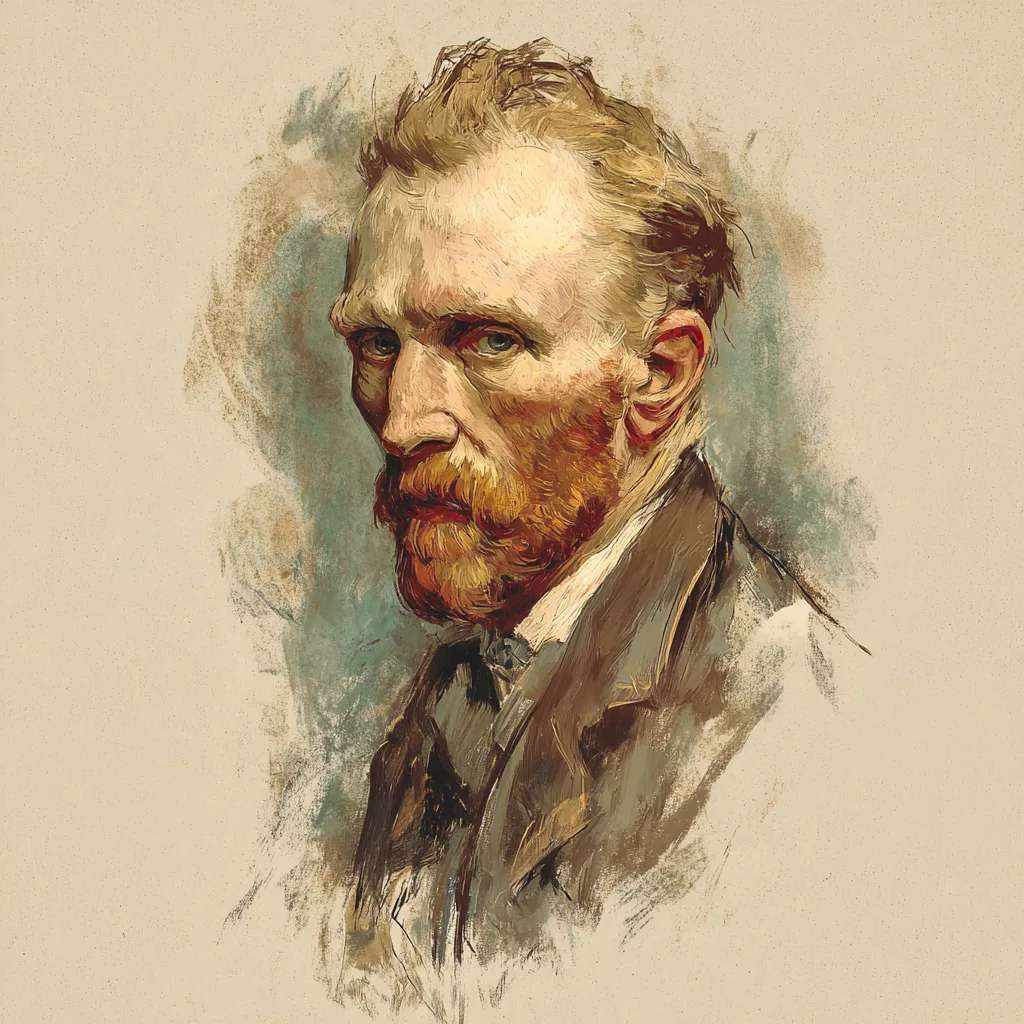
Who was Vincent van Gogh?
Vincent van Gogh (30 March 1853 – 29 July 1890) was a Dutch Post-Impressionist painter born in Zundert who created around 2,100 artworks in just over a decade, including roughly 860 oil paintings. His bold colours and expressive brushwork helped lay the foundations of modern art, though he struggled with poverty and mental illness throughout his life and died at 37.
Dutch post-impressionist painter whose emotionally charged works and tragic life story have made him one of history's most beloved artists. Despite selling only one painting during his lifetime, his bold colors and expressive brushwork profoundly influenced modern art.
Don't stop at the facts — continue Vincent van Gogh's story in free narrated chapters on Chunks.
 Download on iOS
 Download on Android
Quick facts
- Born
- 30 March 1853
- Birthplace
- Zundert
- Died
- 29 July 1890
- Place of death
- Auvers-sur-Oise
- Nationality
- Kingdom of the Netherlands
- Occupation
- Printmaker, draftsperson, painter
Vincent van Gogh: key facts
- Vincent Willem van Gogh was born on 30 March 1853 in Groot-Zundert, in the predominantly Catholic province of North Brabant in the Netherlands.
- In just over a decade of working as an artist, Van Gogh created about 2,100 artworks, including around 860 oil paintings, most of them completed in the last two years of his life.
- Before taking up painting in 1881, Van Gogh worked as an art dealer, attempted to become a pastor, and served as a Protestant missionary in the coal-mining district of Borinage in Belgium.
- Van Gogh's younger brother Theo, an art dealer, provided him with financial and emotional support throughout his career, and the two exchanged more than 600 letters between 1872 and 1890.
- After a confrontation with Paul Gauguin in December 1888 in Arles, Van Gogh severed part of his own left ear and was subsequently hospitalised, later entering the Saint-Paul-de-Mausole asylum in Saint-Rémy in May 1889.
- On 27 July 1890, Van Gogh shot himself in the chest with a revolver in Auvers-sur-Oise and died from his injuries two days later, aged 37.
- The Van Gogh Museum opened in Amsterdam in 1973 and regularly receives more than 1.5 million visitors a year, making it the second most visited museum in the Netherlands after the Rijksmuseum.
From Art Dealer to Struggling Artist: The Long Road to a Vocation
Vincent Willem van Gogh was born on 30 March 1853 in Groot-Zundert, a town in the predominantly Catholic province of North Brabant in the Netherlands. His father was a minister of the Dutch Reformed Church, and the family occupied a respectable upper-middle-class position in Dutch society. Van Gogh was a serious, quiet child encouraged to draw by his mother, though his earliest efforts showed little of what his later work would become.
In July 1869, his uncle Cent obtained a position for him at the art dealers Goupil and Cie in The Hague. Van Gogh proved capable, and after completing his training in 1873 he was transferred to the London branch on Southampton Street. By his own account these were happy years; at twenty he was earning more than his father. The happiness did not last. He became infatuated with his landlady's daughter, who rejected him, and he grew increasingly isolated and religiously obsessive. A transfer to Paris in 1875 only deepened his resentment, and he was dismissed a year later.
What followed was a period of restless searching. Van Gogh tried supply teaching in England, worked briefly in a bookshop in Dordrecht, and attempted to prepare for a theology entrance examination in Amsterdam, which he failed. He then enrolled in a Protestant missionary school near Brussels and failed to complete that course too. In January 1879 he took up a missionary post in the coal-mining district of Borinage in Belgium, where he gave away his comfortable lodgings to a homeless person and slept on straw — behaviour the church authorities considered undignified, and they dismissed him. It was only after this string of failures, and following his brother Theo's encouragement, that Van Gogh seriously took up art, around 1881.
Dark Palette and Early Mastery: The Nuenen and Antwerp Years
After returning to live with his parents in Nuenen, North Brabant, Van Gogh threw himself into painting and drawing. He worked outside rapidly, completing studies of weavers, their cottages, and the peasant labourers around him. His palette during this period consisted mainly of sombre earth tones and dark browns, with none of the blazing colour for which he would later become famous. The culmination of this phase was The Potato Eaters, completed in May 1885, which he considered his first major work. When Theo warned him that the painting was too dark for Parisian tastes, Van Gogh was undeterred.
The death of his father from a heart attack in March 1885 coincided with a period of intense productivity. Van Gogh completed nearly 200 oil paintings during his two years in Nuenen alone. In November 1885 he moved to Antwerp, where he rented a room above a paint dealer's shop and began studying the work of Peter Paul Rubens, broadening his palette to include carmine, cobalt blue and emerald green. He also discovered Japanese ukiyo-e woodblock prints in the Antwerp docklands, elements of which would eventually surface in the backgrounds of some of his paintings. His living conditions were severe — he subsisted mainly on bread, coffee and tobacco, and his teeth became loose from poor nutrition.
Paris, New Colour, and the Avant-Garde
Van Gogh moved to Paris in March 1886, sharing an apartment with Theo in Montmartre. He studied at the studio of Fernand Cormon, where he met Émile Bernard, Louis Anquetin, and Henri de Toulouse-Lautrec. Through Theo's gallery connections and the city's lively art scene, he also encountered Georges Seurat and Paul Signac, whose Pointillist technique — building images from small dabs of pure colour — he began to adopt. The contrast with his gloomy Dutch canvases was stark. His Portrait of Père Tanguy from 1887 shows the transformation clearly, with a brighter palette and a more confident personal style emerging.
He became fascinated by the theory that complementary colours, such as blue and orange, could create vibrant contrasts when placed side by side, a principle drawn from the colour theorist Charles Blanc. He also collected hundreds of Japanese ukiyo-e prints and even attempted his own Japonaiserie works. In November 1887, Theo and Vincent befriended Paul Gauguin, newly arrived in Paris, and Van Gogh exchanged work with him. By February 1888, after more than two years in the city and over 200 paintings completed, Van Gogh was worn out by Parisian life and left for the south of France.
Arles, the Yellow House, and the Collapse of a Friendship
Van Gogh arrived in Arles in February 1888 and entered one of the most productive periods of his life, completing 200 paintings and more than 100 drawings and watercolours. The southern light and landscape transformed his work: paintings from this period are rich in yellow, ultramarine and mauve, depicting wheat fields, orchards in blossom, olive trees and the night sky. On 1 May 1888 he signed a lease on four rooms at 2 Place Lamartine — the building he later painted as The Yellow House — envisioning it as a communal studio for artists.
He prepared obsessively for the arrival of Paul Gauguin, painting four versions of Sunflowers in a single week to decorate the guest room. Gauguin arrived in October 1888 and the two men painted together through November, but their relationship deteriorated quickly. Gauguin was domineering, Van Gogh feared being abandoned, and the tension between them escalated. On the evening of 23 December 1888, following an altercation, Van Gogh severed part of his own left ear with a razor, wrapped it, and delivered it to a woman at a nearby brothel. He was found unconscious the following morning and taken to hospital. The hospital's diagnosis was acute mania with generalised delirium. Gauguin left Arles immediately and never saw Van Gogh again.
Saint-Rémy, Auvers, and the Final Months
In May 1889, Van Gogh voluntarily entered the Saint-Paul-de-Mausole asylum in Saint-Rémy-de-Provence. He was given two cells with barred windows, one of which he used as a studio, and was allowed supervised walks outside. The asylum's garden and interiors became his primary subjects. Some of the most technically remarkable works of his career date from this period, including The Starry Night, characterised by swirling skies and a cypress that dominates the foreground. He also produced interpretations of works by Jean-François Millet, comparing the practice to a musician performing Beethoven.
In May 1890 Van Gogh discharged himself and moved to Auvers-sur-Oise, a village near Paris, to be closer to Theo and to the homoeopathic doctor Paul Gachet, who had treated several other artists. He worked at an extraordinary pace, completing roughly 70 oil paintings in as many days. His mood remained fragile. On 27 July 1890, aged 37, he shot himself in the chest with a revolver. The bullet was deflected by a rib and he was able to walk back to his lodgings at the Auberge Ravoux, where he was attended by doctors including Gachet. He died from the wound in the early hours of 29 July. Theo, who had rushed to his brother's side, reported that Vincent's last words were: 'The sadness will last forever.' Theo himself died only six months later.
Vincent van Gogh: timeline
- 1853Born in Groot-Zundert, in the province of North Brabant in the Netherlands, the oldest surviving child of a Dutch Reformed Church minister.
- 1869His uncle obtained a position for him at the art dealers Goupil & Cie in The Hague, marking the start of his career in the art world.
- 1876After being dismissed from Goupil & Cie, he returned to England to work as a supply teacher and then as a Methodist minister's assistant, deepening his religious devotion.
- 1881Took up painting seriously after moving back to his parents' home in Etten, supported financially by his younger brother Theo throughout this period.
- 1885Completed The Potato Eaters in May, his first major work, a culmination of several years of peasant studies painted in a dark, sombre palette.
- 1886Moved to Paris in March, studying at Fernand Cormon's studio and adopting a brighter palette under the influence of Impressionist and Post-Impressionist painters he encountered there.
- 1888Settled in Arles in February and entered one of his most prolific periods, completing 200 paintings including The Night Café, Bedroom in Arles, and a series of Sunflowers.
- 1888After a confrontation with Gauguin on the evening of 23 December, Van Gogh severed part of his own left ear and was hospitalised; Gauguin fled Arles and never saw him again.
- 1889Voluntarily entered the Saint-Paul-de-Mausole asylum in Saint-Rémy, where he produced major works including The Starry Night despite suffering repeated episodes of illness.
- 1890Moved to Auvers-sur-Oise in May to be near his brother Theo and the homoeopathic doctor Paul Gachet, completing around 70 oil paintings in as many days.
- 1890Died in the early hours of 29 July from a chest wound sustained two days earlier when he shot himself with a revolver, aged 37.
Listen: stories featuring Vincent van Gogh
Narrated chapters from the Chunks Microlearning app. Read a preview here, or listen to the full story in the app.
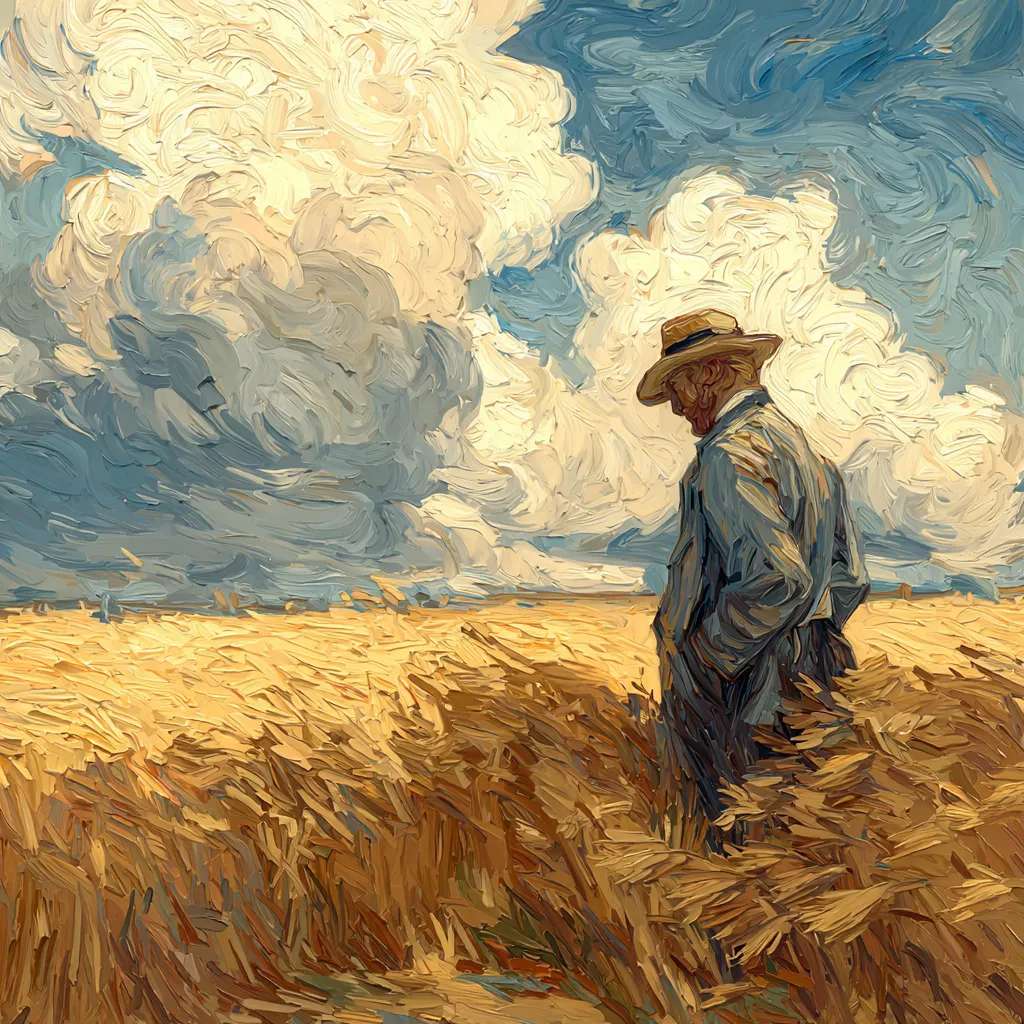
Continue Vincent van Gogh's story
You've read the summary — hear the full story as narrated 5-minute chapters on Chunks, alongside 200+ figures and events from history, philosophy and science. Free to start on iOS and Android.