
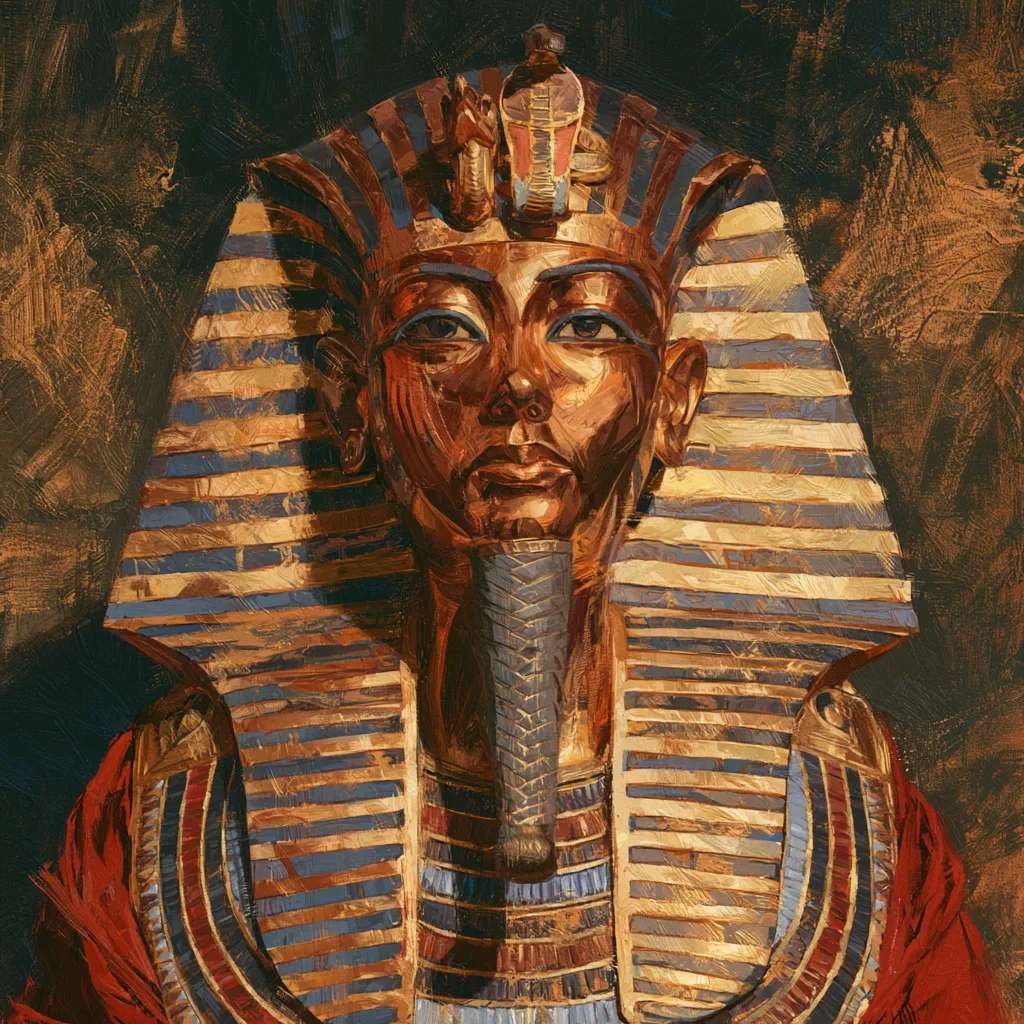
Who was Tutankhamun?
Tutankhamun (c. 1342 BC - c. 1323 BC) was a pharaoh of Egypt's Eighteenth Dynasty who reigned about nine years, restoring traditional religion after his father Akhenaten's Atenist reforms. He died around age eighteen, possibly from malaria combined with a leg fracture. His nearly intact tomb, found in the Valley of the Kings in 1922 by Howard Carter, revealed thousands of artifacts, including his famous gold mask, sparking worldwide fascination with ancient Egypt.
Tutankhamun was an Egyptian pharaoh who ruled during the 14th century BCE and died as a teenager. His tomb, discovered nearly intact in 1922, revealed extraordinary treasures that captivated the modern world.
Don't stop at the facts — continue Tutankhamun's story in free narrated chapters on Chunks.
Or get it straight away:
 Download on iOS
 Download on Android
Quick facts
- Born
- 1343 BC
- Birthplace
- Amarna
- Died
- 1324 BC
- Place of death
- Thebes
- Nationality
- Ancient Egypt
- Occupation
- Ruler
Tutankhamun: key facts
- Tutankhamun ruled ancient Egypt as pharaoh of the Eighteenth Dynasty from about 1332 to 1323 BC, dying at roughly age eighteen.
- He was originally named Tutankhaten, a name reflecting Atenism, before changing it to Tutankhamun to honor the god Amun after abandoning his father Akhenaten's religious reforms.
- His Restoration Stela, erected in his fourth regnal year, records his endowments to temples and his reversal of Akhenaten's religious policies.
- He moved the royal capital from Akhenaten's city of Amarna back to Memphis and later reestablished Thebes as the center of religious life.
- A 2012 study proposed that he died from a combination of malaria and a leg fracture, since his mummy's leg wound showed no signs of healing.
- Howard Carter, excavating for his patron George Herbert, 5th Earl of Carnarvon, discovered Tutankhamun's nearly intact tomb in the Valley of the Kings in November 1922.
- His tomb contained over 5,000 artifacts, including his iconic gold mask, which is preserved at the Egyptian Museum and remains a popular symbol of ancient Egypt.
A Boy Born Into Religious Upheaval
Tutankhamun began life as Tutankhaten, a name meaning living image of Aten, born around 1343 BC at Amarna during the reign of his father's generation, a period when Egypt's traditional religion had been upended by the pharaoh Akhenaten in favor of worship centered on the sun disk Aten. His exact parentage is not confirmed by any surviving inscription, but genetic testing has identified his father as the mummified man from tomb KV55, generally thought to be Akhenaten, and his mother as an unidentified mummy known as the Younger Lady found in tomb KV35. According to this genetic evidence, his parents were full siblings, both children of Amenhotep III and his chief wife, Tiye.
He became pharaoh at only eight or nine years old, following the brief reigns of Smenkhkare and a female ruler named Neferneferuaten. On taking the throne he adopted the name Nebkheperure and reigned for roughly nine years. As a child he married Ankhesenpaaten, one of Akhenaten's daughters, who later changed her name alongside his to Ankhesenamun. The couple had two daughters, both of whom died at or shortly after birth, one born prematurely and one at full term; both were buried alongside their father in his tomb.
Undoing His Father's Religious Revolution
Akhenaten's reign had suppressed the traditional Egyptian pantheon in favor of the Aten and had shifted the capital to the new city of Akhetaten at Amarna. Early in Tutankhamun's reign, evidence suggests his court was already working to reconcile the old religion with the new, and activity at Amarna slowed. By his third year on the throne, the young king had reversed his father's central religious policy, ending the exclusive worship of the Aten and restoring the god Amun to supremacy, along with the privileges of Amun's priesthood. It was at this point that he and his queen dropped the aten suffix from their names, becoming Tutankhamun and Ankhesenamun.
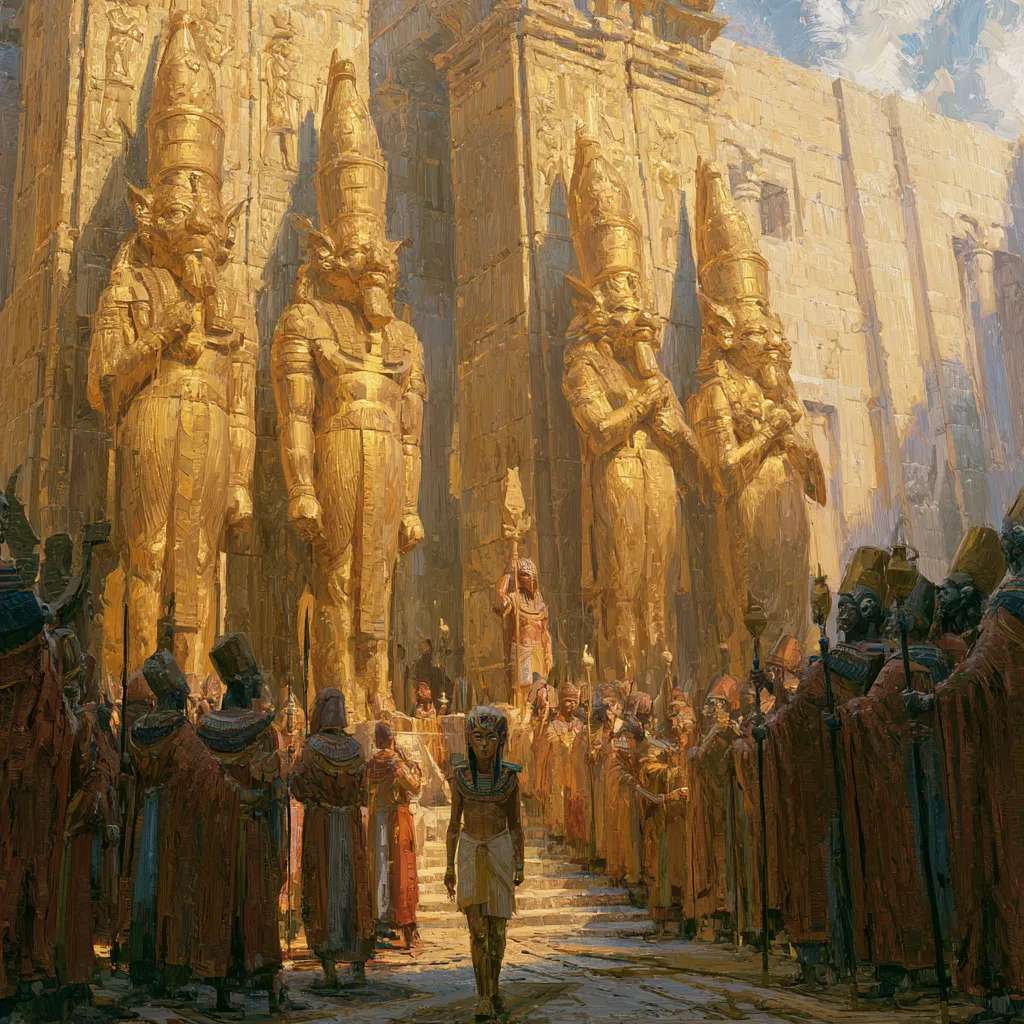
These changes were recorded on the Restoration Stela, erected in his fourth regnal year, which described his efforts to repair temples damaged during the Amarna period and to reburial his father's remains in the Valley of the Kings. The royal court abandoned Amarna, and the seat of government moved to Memphis, while Thebes was restored as Egypt's great center of religious life. Tutankhamun sponsored construction projects at Karnak, including a sphinx avenue leading to the temple of Mut using figures originally made for Akhenaten and Nefertiti, and completed decoration work at Luxor temple that had been started under Amenhotep III. Many of these projects were unfinished at his death and were later completed or claimed by his successors, particularly Horemheb.
Soldier, Diplomat, and Living God
Egypt's foreign relations had been neglected under Akhenaten, and Tutankhamun's reign saw efforts to restore diplomatic ties, particularly with the kingdom of Mitanni, reflected in gifts from foreign lands found in his tomb. His mortuary temple at Thebes recorded military victories against Nubians and Asiatics, and by the record available his reign was undefeated. His tomb contained an extensive array of weaponry, including hundreds of arrows, dozens of bows, swords, daggers, and shields, much of it inscribed with his name and showing signs of actual use, though how directly he took part in combat himself remains debated among historians.
Unusually for a pharaoh, Tutankhamun was worshipped as a living god during his own lifetime rather than only after death. Temples dedicated to his deified form were built in Nubia, at Kawa and at Faras, associating him directly with the god Amun. At Karnak, the Stela of Huy contains a hymn addressing Tutankhamun's divine aspect in language equating him with Amun himself, and this cult had its own priestly hierarchy modeled on that of Amun's regular clergy, with officials holding titles such as First and Second Prophet of Nebkheperure.
Injury, Illness, and an Early Death
Tutankhamun died at around eighteen years old, and no ancient record explains the circumstances. CT scans conducted in 2005 revealed he had suffered a compound fracture of his left leg shortly before death, with no signs of healing and embalming material inside the wound, indicating the injury occurred very close to the time he died. Genetic testing also detected DNA from the parasite responsible for the most severe form of malaria, showing he had been infected multiple times by different strains. Researchers have concluded that a combination of this leg injury and a severe malarial infection most likely caused his death, possibly worsened by other health issues.
Numerous other medical conditions have been proposed over the years to explain his early death or unusual depictions in art, including various podiatric conditions and inherited disorders, but several of these, such as gynecomastia and certain craniofacial syndromes, have since been ruled out through further genetic analysis. Because his death appears to have come earlier than expected, he was buried not in a grand royal tomb but in a small tomb likely intended for someone else, adapted quickly so that burial could occur within the customary seventy days after death.
An Intact Tomb and a Modern Sensation
Tutankhamun's tomb, designated KV62, was discovered in November 1922 in the Valley of the Kings by excavator Howard Carter, working on behalf of his patron George Herbert, 5th Earl of Carnarvon. Although the tomb had been entered and robbed in antiquity, it remained remarkably intact, yielding around 5,398 objects including a solid gold coffin and funerary mask, thrones, weapons, furniture, and the king's own undisturbed mummy. The discovery generated enormous worldwide press attention and gave rise to the popular nickname King Tut, along with lasting public fascination with ancient Egypt.
Rumors of a curse of the pharaohs spread after several people connected to the excavation died within a few years, most notably Lord Carnarvon, who died of pneumonia following an infection in 1923. In reality, most of those present at the tomb's opening lived for decades afterward, including Carter himself, who died of lymphoma in 1939. From the 1960s onward, selections of Tutankhamun's treasures toured internationally to museums in cities including Paris, Tokyo, London, and New York, drawing millions of visitors at each stop, before the collection was ultimately moved to the Grand Egyptian Museum in Cairo.
Tutankhamun: timeline
- c. 1342 BCBorn in Amarna during the reign of Akhenaten, originally named Tutankhaten, meaning living image of Aten.
- c. 1332 BCBecame pharaoh at about eight or nine years old, taking the throne name Nebkheperure.
- c. 1332-1329 BCMoved the royal court from Akhenaten's capital at Amarna back to Memphis, later shifting the seat of religious life to Thebes.
- c. 1330 BCIn his third regnal year, ended the worship of the Aten, restored the god Amun to supremacy, and changed his own name to Tutankhamun and his wife's to Ankhesenamun.
- c. 1329 BCHad the Restoration Stela erected in his fourth regnal year, recording his endowments to temples and priesthoods.
- c. 1330-1324 BCFathered two daughters with Ankhesenamun who died at or soon after birth and were buried alongside him.
- c. 1327-1324 BCMilitary campaigns against Nubians and Asiatics were recorded on his mortuary temple at Thebes, both remembered as victories.
- c. 1324-1323 BCDied at about eighteen years old, with modern analysis pointing to a combination of malaria and a severe leg fracture.
- c. 1323 BCWas buried in a small, non-royal tomb in the Valley of the Kings after his own royal tomb was left unfinished, with vizier Ay presiding over his funeral rites.
- 1922Excavators working for Howard Carter and Lord Carnarvon uncovered the first step leading to his long-lost tomb.
- 1923The burial chamber of the tomb was formally unsealed before a group of officials and witnesses.
- 1961The Egyptian government began allowing public tours of the tomb, decades after its discovery.
Listen: stories featuring Tutankhamun
Narrated chapters from the Chunks Microlearning app. Read a preview here, or listen to the full story in the app.
Frequently asked questions about Tutankhamun
Who was Tutankhamun?
Tutankhamun was an ancient Egyptian pharaoh who ruled around 1332 to 1323 BCE, becoming king as a child and dying around age 18 or 19. He is often called the boy king due to his young age at death.
Why is Tutankhamun's tomb famous?
Tutankhamun's tomb became famous after archaeologist Howard Carter discovered it nearly intact in 1922 in the Valley of the Kings. The tomb contained thousands of treasures, including the iconic golden death mask, offering unprecedented insight into ancient Egyptian burial practices.
What caused Tutankhamun's death?
The exact cause of Tutankhamun's death remains uncertain, though modern research suggests a combination of malaria and a leg fracture may have contributed. Genetic studies also revealed he suffered from several health conditions due to his family's practice of intermarriage.
Continue Tutankhamun's story
You've read the summary — hear the full story as narrated 5-minute chapters on Chunks, alongside 200+ figures and events from history, philosophy and science. Free to start on iOS and Android.