
Who is Thor?
Hear Thor's story
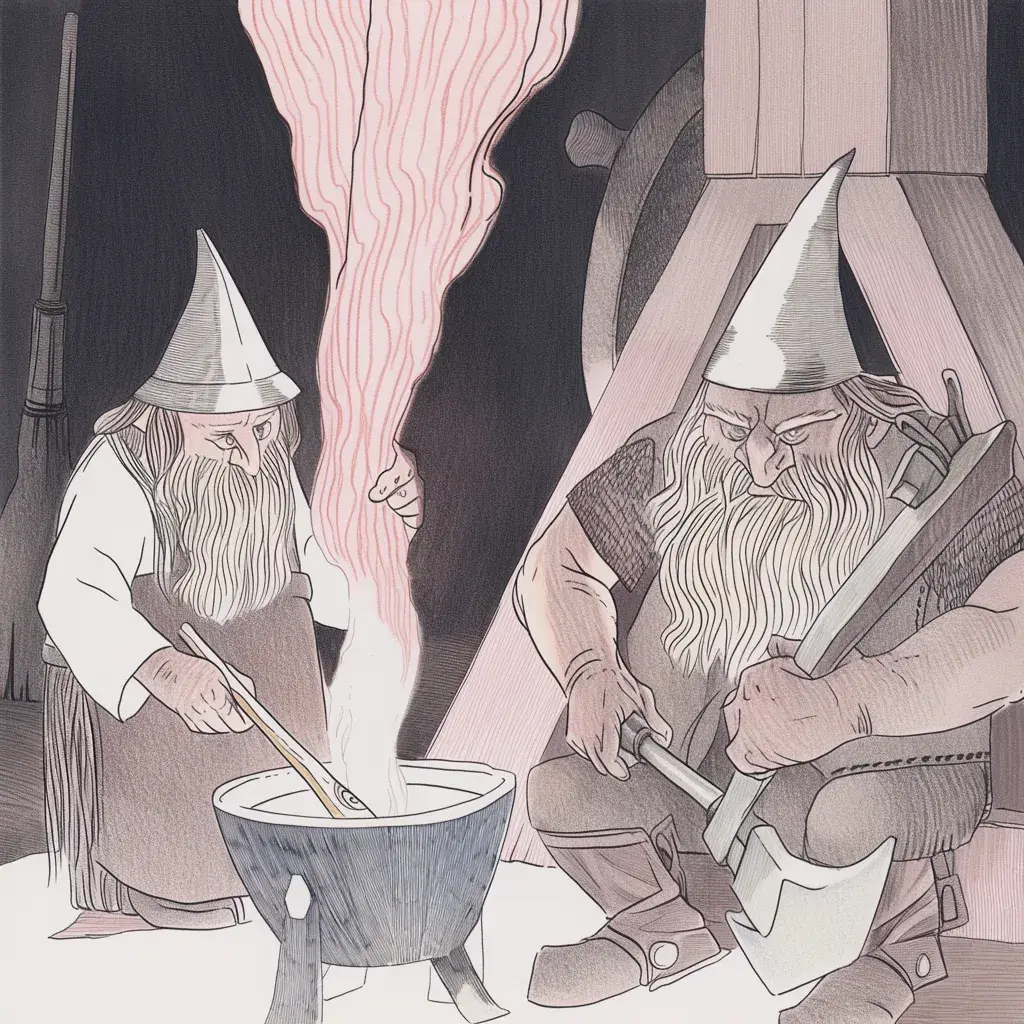
Chapter 1 of The Creation of Mjölnir · the full story is in the app
Thor is a major god in Germanic and Norse mythology, associated with thunder, storms, strength, and protection of humankind. Son of Odin, husband of the golden-haired Sif, he wields the hammer Mjolnir, wears the belt Megingjord, and rides a goat-drawn chariot. Norse sources recount his battles against giants and the serpent Jormungandr, with both foretold to die fighting at Ragnarok. His name survives in Thursday.
Norse god of thunder and wielder of the hammer Mjölnir.
Don't stop at the facts — continue Thor's story in free narrated chapters on Chunks.
See how Chunks works → Download on iOS
 Download on Android
Quick facts
- Role
- Dragonslayer
Thor: key facts
- Thor is the Norse god of thunder, strength, and protection, whose name derives from Proto-Germanic *Þun(a)raz, meaning Thunder.
- In Norse mythology Thor is the son of Odin and Jord, husband of the goddess Sif, and wields the hammer Mjoelnir along with the belt Megingjoerd and iron gloves Jarngreipr.
- The Roman historian Tacitus, writing in Germania in the late first century, identified Thor with the god Hercules due to shared associations with a club or hammer-like weapon.
- Medieval Icelandic sources such as the Poetic Edda and Prose Edda describe Thor's battles with the serpent Jormungandr, his trickery of the giant Thrymr to recover his stolen hammer, and his foretold death at Ragnarok.
- The eleventh-century chronicler Adam of Bremen described a statue of Thor enthroned at the center of the Temple at Uppsala in Sweden, calling him mightiest of the gods.
- Around 1000 Thor's hammer pendants have been excavated across Scandinavia, England, northern Germany, the Baltic states, and Russia, reflecting his popularity during the Viking Age.
- The English weekday name Thursday derives from Old English Thunresdaeg, meaning Thunor's day, named after Thor's Old English form.
A Name That Means Thunder
Thor's name comes from Proto-Germanic roots meaning thunder, and versions of it appear across the old Germanic-speaking world: Donar in Old High German, Thunor in Old English, Thuner in Old Frisian, and Thunar in Old Saxon, alongside the Old Norse Þórr that gave English its modern form. Scholars trace these names back to a reconstructed Proto-Germanic word, something like Thunaraz or Thunuraz, and further back still to a Proto-Indo-European root for thunder also found in the Latin title Tonans, applied to Jupiter, and in a related Vedic word meaning thunders. The resemblance to the Celtic thunder-god Taranis has led some researchers to argue that Germanic and Celtic peoples shared closely related words, and possibly closely related beliefs, about a thunder deity in prehistory.
Thor's association with thunder survives directly in the calendar. Thursday derives from Old English Thunresdaeg, meaning day of Thunor, itself a translation of the Latin Day of Jove, since Romans had linked their sky-god Jupiter with the Germanic thunder-god. Cognate weekday names appear in Old High German and other Germanic languages, all pointing back to a shared Proto-Germanic weekday name built on the god's title.
During the Viking Age, personal names built from the element Thor became extremely common, even though no such names are recorded from earlier periods. Some scholars suggest this surge was tied to the spread of Christianity, with pagan Scandinavians favoring Thor-based names, much as they took up wearing small hammer pendants, as a visible statement of loyalty to the old gods.
Seen Through Roman Eyes
The earliest written records of Thor come not from Scandinavians but from Romans describing Germanic peoples they encountered. Writing in the late first century, the historian Tacitus described the religious practices of the Suebi and identified their gods using Roman equivalents, a method called interpretatio romana. In this scheme, the god Odin became Mercury, the god Tyr became Mars, and Thor became Hercules, likely because Thor's hammer reminded Romans of Hercules's club. Tacitus also mentioned a sacred wood across the river Weser dedicated to this Hercules figure, understood to be Thor.
A Roman-era cult object known as Hercules Magusanus, venerated in parts of the Rhine region, has been linked by some scholars to Thor as well, on the theory that Magusanus began as a local title attached to the thunder-god before Roman observers folded him into their own Hercules.
From Scattered Inscriptions to the Viking Temple at Uppsala
Direct evidence of Thor worship appears gradually across the centuries following Rome's decline. The oldest surviving instance of his name is an inscription on a piece of jewelry called the Nordendorf fibula, found in Bavaria and dated to the Migration Period, which records the southern Germanic form Donar. Old English sources from the eighth century onward mention Thunor, sometimes using the name to translate Jupiter, while a ninth-century baptismal text from Mainz lists Thunaer alongside Woden and another god as pagan deities that converts to Christianity were required to formally renounce. Missionary accounts from the same era describe the felling of an oak tree sacred to Thor in the region of Hesse.
By the eleventh century, the chronicler Adam of Bremen gave a detailed account of a temple at Uppsala in Sweden, where a statue of Thor stood at the center of a triple throne alongside Odin and another god, Fricco. According to Adam, Thor was considered the mightiest of the three, ruling thunder, lightning, wind, storms, and fertility, and priests offered him sacrifices specifically in times of plague or famine. Adam also recorded that an English preacher was killed by a pagan crowd after he was seen as having insulted an image of Thor, underscoring how seriously the god's worship was still taken even as Christianity spread.
Material evidence from the Viking Age backs up these written accounts. Roughly a thousand pendants shaped like Thor's hammer have been found across Scandinavia, England, northern Germany, the Baltic region, and Russia, along with coins bearing the same symbol. Several runestones carry inscriptions invoking Thor's protection or blessing, and a handful show carved images of the god fishing for the monstrous serpent Jormungandr. Some scholars also connect the swastika symbol, found on various Germanic objects from the Migration Period through the Viking Age, to Thor's hammer or to lightning, suggesting it may have served as an alternative protective emblem.
The Stories Icelanders Told About Him
Most of what is known about Thor's personality and adventures comes from texts written down in medieval Iceland, especially the Poetic Edda and the Prose Edda, compiled in the thirteenth century from older oral material. These sources describe Thor as the son of Odin, husband of the golden-haired Sif, and father of several children, and give him a hammer called Mjolnir, a strength-giving belt, iron gloves, and a chariot pulled by two goats that he can kill and bring back to life. One poem, the Voluspa, foretells that at the final battle of Ragnarok Thor will kill the great serpent Jormungandr but die from its venom only nine steps later.
Several poems show Thor in more human, often comic, situations. In Hymiskvida he travels to fetch a giant cauldron large enough to brew ale for all the gods, along the way catching Jormungandr on a fishing line baited with an ox head. In the satirical poem Thrymskvida, Thor's hammer is stolen by the giant Thrymr, who demands the goddess Freyja as his bride in exchange for its return. When Freyja refuses, Thor disguises himself as the bride instead, enduring the giants' wedding feast until the hammer is placed in his lap, at which point he reveals himself and kills his hosts. In the poem Alvissmal, Thor tricks a dwarf seeking to marry his daughter into talking until sunrise, at which point the dwarf turns to stone.
The Prose Edda also recasts Thor through a euhemerized lens, describing him as a prince of Troy with pale skin and hair said to be fairer than gold, later reimagined by medieval saga writers as red-bearded. In Snorri Sturluson's Heimskringla, Thor is presented as a historical pagan priest granted a dwelling by a powerful chieftain later identified with Odin, reflecting a medieval tendency to explain the old gods as exceptional humans rather than supernatural beings.
A God Who Outlasted Conversion
Even after Scandinavia had formally converted to Christianity, memories of Thor persisted in folklore and language. A twelfth-century runic stick found in Bergen, Norway calls on both Thor and Odin for help, long after official conversion. Folk traditions surrounding the Christian king Olaf II of Norway absorbed traits once associated with Thor, including fierce temper and a reputation as a slayer of giants and trolls. Scandinavian languages kept indirect references to the god alive through words for thunder and lightning, and place names across Scandinavia, England, and Germany still preserve his name in various forms.
In the modern era, Thor's name was given to the chemical element thorium by the Swedish chemist Jons Jacob Berzelius, and later to a United States missile program. His clearest afterlife, however, has been in popular culture: since 1962, Marvel Comics has published a superhero version of Thor created by Stan Lee, Larry Lieber, and Jack Kirby, later portrayed on screen by Chris Hemsworth in the Marvel Cinematic Universe. Thor has also appeared in novels by Neil Gaiman and Rick Riordan, in the Netflix series Ragnarok, and in video games including Age of Mythology, God of War Ragnarok, and Smite, carrying his ancient association with strength and storms into entirely new forms.
Thor: timeline
- late 1st centuryRoman historian Tacitus describes the Suebi venerating a god he equates with Hercules, generally understood as Thor, in his work Germania.
- Migration PeriodThe Nordendorf fibula, found in Bavaria, bears the earliest known written form of the god's name, Þonar, in Elder Futhark runes.
- 8th centuryOld English texts begin referring to Thunor, the Anglo-Saxon form of the god, sometimes used to gloss the Roman god Jupiter.
- 8th centuryChristian missionary Saint Boniface fells an oak in Hesse dedicated to the god, later known as Donar's Oak.
- 9th centuryA codex from Mainz records the Old Saxon Baptismal Vow, in which converts renounce the god Thunaer alongside Woden and Saxnot.
- 9th-11th centuryDuring the Viking Age, personal names invoking Þórr and pendants shaped like his hammer Mjölnir become widespread across Scandinavia.
- 11th centuryChronicler Adam of Bremen describes a statue of Thor enthroned at the center of the pagan temple at Uppsala, Sweden.
- 1030An English preacher named Wulfred is killed by Germanic pagans after he is said to have profaned a representation of Thor.
- 13th centuryThe Poetic Edda and Prose Edda are compiled in Iceland, preserving most surviving narratives of Thor's exploits and eventual death at Ragnarök.
- 1962Comic creators Stan Lee, Larry Lieber, and Jack Kirby introduce a superhero version of Thor in Marvel Comics' Journey Into Mystery.
- 2013A newly described species of shrew from the Democratic Republic of Congo is named Thor's hero shrew after the god, for its unusual strength.
Listen: stories featuring Thor
Narrated chapters from the Chunks Microlearning app. Read a preview here, or listen to the full story in the app.
Continue Thor's story
You've read the summary — hear the myth of Thor as narrated 5-minute chapters on Chunks, alongside 200+ figures and events from history, myth, philosophy and science. Free to start on iOS and Android.