
Who was Steve Jobs?
Steve Jobs (February 24, 1955 – October 5, 2011) was an American businessman and inventor who co-founded Apple Inc. with Steve Wozniak in 1976 and helped pioneer the personal computer revolution. After being forced out of Apple in 1985, he founded NeXT and purchased Pixar before returning to Apple in 1997, leading the creation of the iMac, iPod, iPhone, and iPad.
American entrepreneur and co-founder of Apple Inc. who revolutionized personal computing, mobile phones, and digital media. His visionary leadership transformed Apple from a garage startup into one of the world's most valuable companies.
Don't stop at the facts — continue Steve Jobs's story in free narrated chapters on Chunks.
Or get it straight away:
 Download on iOS
 Download on Android
Quick facts
- Born
- 24 February 1955
- Birthplace
- San Francisco
- Died
- 5 October 2011
- Place of death
- Palo Alto
- Nationality
- United States
- Occupation
- Entrepreneur, inventor, designer
Steve Jobs: key facts
- Steve Jobs was born on February 24, 1955, in San Francisco, California, and was adopted shortly after birth by Paul and Clara Jobs.
- Jobs co-founded Apple Computer Company on April 1, 1976, with Steve Wozniak and Ronald Wayne, initially operating out of his parents' garage in Los Altos, California.
- After Apple's board forced him out in 1985, Jobs founded NeXT and purchased Pixar for $10 million; Pixar went on to produce Toy Story in 1995, the first computer-animated feature film.
- Jobs returned to Apple as CEO in 1997 after Apple acquired NeXT for $400 million, and led the company's revival with products including the iMac, iPod, iPhone, and iPad.
- The first iPhone was released on June 29, 2007, and Time magazine declared it Invention of the Year for 2007.
- In October 2003, Jobs was diagnosed with a pancreatic neuroendocrine tumor; he delayed surgery for nine months in favor of alternative treatments before undergoing a Whipple procedure in July 2004.
- Jobs died at his home in Palo Alto, California, on October 5, 2011, from respiratory arrest caused by complications of his pancreatic neuroendocrine tumor, and was posthumously awarded the Presidential Medal of Freedom in 2022.
From San Francisco Adoption to Silicon Valley Garage
Steven Paul Jobs was born in San Francisco on February 24, 1955, to Joanne Schieble and Abdulfattah Jandali, an unmarried graduate student couple who arranged a closed adoption shortly after his birth. He was taken in by Paul and Clara Jobs, a working-class couple who had to promise to fund their son's college education before Schieble would sign the adoption papers. The family eventually settled in Los Altos, California, in a home on Crist Drive that would later be recognized as the first site of Apple Computer.
Jobs struggled in conventional classrooms, resisted authority, and was bullied badly enough at one middle school that he gave his parents an ultimatum: move him or he would drop out. The family spent all their savings to relocate to the Cupertino School District so he could attend a better school. At Homestead High School, a classmate introduced him to Steve Wozniak, a meeting that would alter the course of computing history. A summer job obtained at age thirteen, after Jobs cold-called Bill Hewlett of Hewlett-Packard to ask for electronic parts, showed early his unusual directness and ambition.
After one semester at Reed College in Portland, Jobs dropped out without telling his parents, unwilling to spend their money on a education that felt meaningless. He continued to audit classes, including a calligraphy course he later credited with giving the Macintosh its distinctive typefaces. By 1974 he had returned to California, taken a job at Atari, and then traveled to India for seven months searching for spiritual guidance. He returned with a shaved head and Indian clothing, and shortly afterward began practicing Zen Buddhism under the guidance of Zen master Kobun Chino Otogawa.
Building Apple and the Personal Computer Revolution
In April 1976, Jobs, Wozniak, and a third partner named Ronald Wayne founded Apple Computer Company as a business partnership, operating first out of Jobs's bedroom and then the family garage. Wozniak had designed the Apple I circuit board, but it was Jobs who pushed the idea of selling it as a product. To fund the initial batch they each sold personal possessions — Wozniak his scientific calculator, Jobs his Volkswagen van. A local retailer purchased fifty fully assembled units at five hundred dollars each, and roughly two hundred were produced in total.
The Apple II, introduced at the West Coast Computer Faire in April 1977, became one of the first mass-produced microcomputers to achieve widespread commercial success. Wozniak designed the machine's core, while Jobs oversaw its casing and recruited engineer Rod Holt to develop its power supply. Within two years, Jobs was worth over one million dollars; by age twenty-five his net worth was estimated at two hundred and fifty million dollars, making him one of the youngest people ever to appear on the Forbes list of America's wealthiest individuals.
In 1979, Jobs observed a demonstration of a mouse-driven graphical interface at Xerox's research facility and recognized its commercial potential immediately. This visit led to the Apple Lisa in 1983 and then the Macintosh in January 1984, the first mass-market personal computer with a built-in graphical user interface and mouse. The Macintosh launch was accompanied by a television commercial directed by Ridley Scott, aired during the Super Bowl, that became one of the most celebrated advertisements in broadcasting history. The machine also launched the desktop publishing industry when paired with the Apple LaserWriter printer in 1985.
Exile, NeXT, and the Birth of Pixar
A power struggle with Apple's board and its CEO John Sculley ended with Jobs's departure from the company he had founded. In September 1985 he submitted his resignation, taking several senior employees with him to start a new venture called NeXT, a company focused on workstations for higher education and business. NeXT workstations were released in 1990 at nearly ten thousand dollars each and, like the Lisa before them, were praised for their technology but criticized as too expensive for the market they targeted. One machine, however, changed the world: English computer scientist Tim Berners-Lee used a NeXT computer to invent the World Wide Web in 1990.
In 1986, Jobs purchased the computer graphics division of Lucasfilm for ten million dollars, spinning it off as an independent company called Pixar. Under creative chief John Lasseter, Pixar produced Toy Story in 1995, the first feature-length computer-animated film, with Jobs credited as executive producer. The studio went on to produce a long run of commercially successful and critically acclaimed films. In January 2006, Disney agreed to purchase Pixar in an all-stock deal worth approximately 7.4 billion dollars, making Jobs the single largest individual shareholder in the Walt Disney Company.
During his years away from Apple, Jobs also matured personally. In 1989 he met Laurene Powell at a lecture he gave at Stanford's Graduate School of Business, and the two married on March 18, 1991, in a Buddhist ceremony at the Ahwahnee Hotel in Yosemite National Park. They had three children together: a son, Reed, and daughters Erin and Eve. Jobs also worked during this period to repair his relationship with his eldest daughter, Lisa Brennan, whom he had denied paternity of in the late 1970s before a DNA test confirmed he was her father.
The Return to Apple and a Decade of Transformative Products
Apple acquired NeXT in early 1997 for four hundred million dollars, bringing Jobs back to the company he had co-founded. He became interim CEO after the sitting chief executive was ousted in July 1997, and officially dropped the word 'interim' from his title at the 2000 Macworld Expo. The company he returned to was near bankruptcy; the one he rebuilt became the world's most valuable publicly traded company. Working closely with British designer Jony Ive, Jobs oversaw a string of products that redefined their respective categories: the iMac in 1998, the iPod in 2001, the iTunes Store in 2003, and then the iPhone on June 29, 2007, which combined a phone, music player, and mobile browser in a single touch-screen device.
The iPhone's cultural impact was immediate; a survey found that six in ten Americans were aware of its release before it went on sale. Time magazine named it Invention of the Year for 2007. Jobs followed it with the iPad, a tablet computer first released on April 3, 2010, that sold more than two hundred and fifty million units in the years following its introduction. Throughout this period Jobs was known for his keynote presentations, his uniform of a black mock turtleneck, Levi's jeans, and New Balance sneakers, and a management style that combined intense creative pressure with an insistence on products that were beautiful as well as functional.
Cancer, Decline, and Death at Fifty-Six
In October 2003, Jobs was diagnosed with a pancreatic neuroendocrine tumor. For nine months he refused surgery in favor of alternative approaches including dietary changes, acupuncture, and herbal remedies, a delay he later regretted. He eventually underwent a Whipple procedure in July 2004, which initially appeared to remove the tumor successfully. In April 2009, with cancer returning, he received a liver transplant at Methodist University Hospital in Memphis, Tennessee.
Jobs took a series of medical leaves from Apple in his final years, with Tim Cook running day-to-day operations during each absence. He resigned as CEO on August 24, 2011, writing to the board that the day had come when he could no longer meet his duties, and named Cook as his successor. He died at his home in Palo Alto, California, on October 5, 2011, from respiratory arrest caused by complications related to his cancer. His sister Mona Simpson reported that his final words, repeated three times, were 'Oh wow. Oh wow. Oh wow.' He was buried in an unmarked grave at Alta Mesa Memorial Park in Palo Alto, and was posthumously awarded the Presidential Medal of Freedom in 2022.
Steve Jobs: timeline
- 1955Born in San Francisco, California, and shortly afterward adopted by Paul and Clara Jobs.
- 1976Co-founded Apple Computer Company with Steve Wozniak and Ronald Wayne in his parents' Los Altos home.
- 1984Introduced the Macintosh 128K at Apple's shareholder meeting, the first mass-produced personal computer with a graphical user interface.
- 1985Resigned from Apple after a power struggle with the board and CEO John Sculley, then founded NeXT and purchased Pixar from Lucasfilm.
- 1995Pixar, under Jobs as chairman and majority shareholder, released Toy Story, the first computer-animated feature film, to widespread commercial and critical success.
- 1997Returned to Apple as CEO after Apple acquired NeXT, rescuing the company from near bankruptcy and beginning a sweeping product revival.
- 2001Apple launched the iPod, marking the company's entry into consumer electronics and transforming the music industry.
- 2007Apple released the iPhone, a multi-touch smartphone that revolutionized the mobile phone industry.
- 2009Underwent a liver transplant at Methodist University Hospital in Memphis after his pancreatic cancer, first diagnosed in 2003, had progressed.
- 2011Resigned as Apple's CEO, naming Tim Cook as his successor, and became chairman of the board.
- 2011Died at his home in Palo Alto, California, from respiratory arrest caused by complications of his pancreatic neuroendocrine tumor.
Listen: stories featuring Steve Jobs
Narrated chapters from the Chunks Microlearning app. Read a preview here, or listen to the full story in the app.
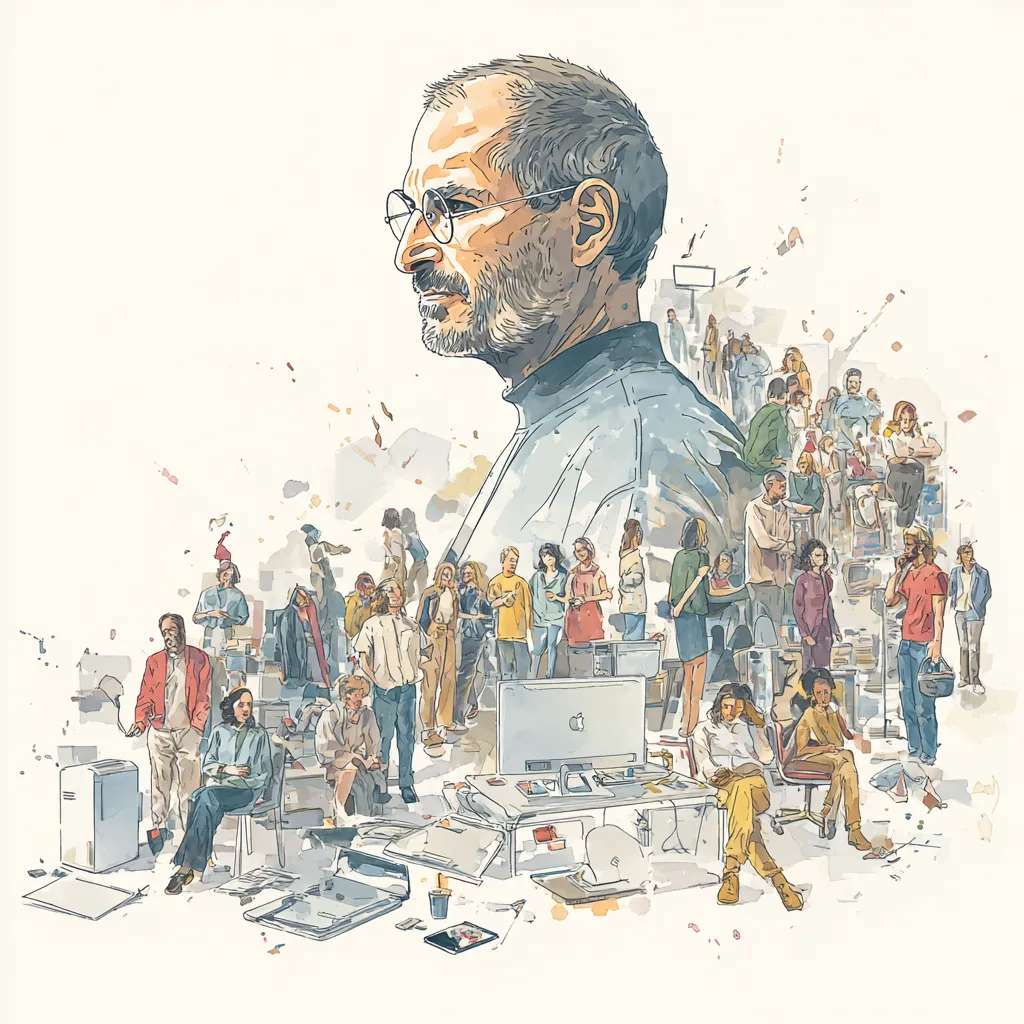
Continue Steve Jobs's story
You've read the summary — hear the full story as narrated 5-minute chapters on Chunks, alongside 200+ figures and events from history, philosophy and science. Free to start on iOS and Android.