
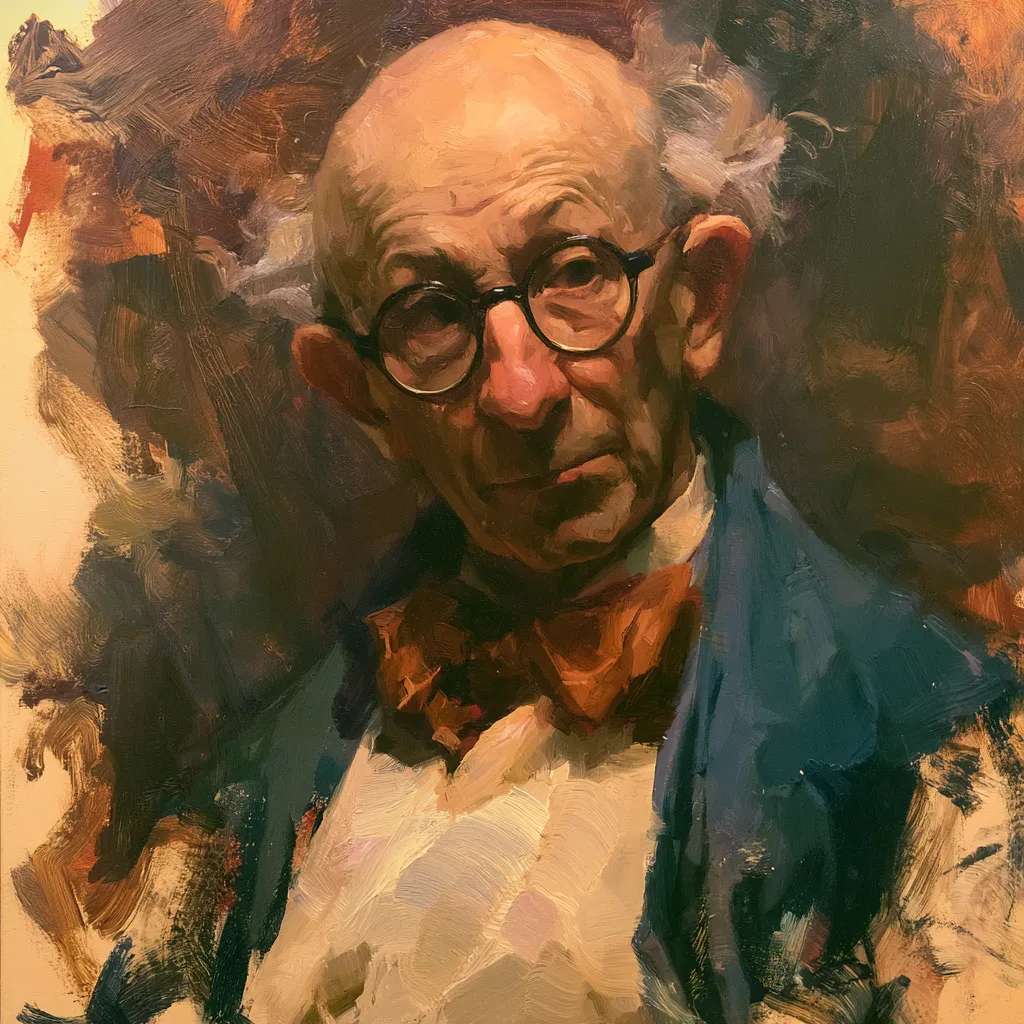
Who was Solomon Asch?
Solomon Asch (14 September 1907 – 20 February 1996) was a Polish-American Gestalt psychologist best known for the conformity experiments he ran at Swarthmore College in the 1950s. Participants asked to compare the lengths of lines frequently gave an answer they could see was wrong, simply because a unanimous group had given it first. He also produced foundational work on how we form impressions of other people.
Polish-American psychologist who conducted groundbreaking experiments on social conformity in the 1950s. His line-matching studies revealed how group pressure can make people doubt their own perceptions and conform to obviously wrong answers.
Don't stop at the facts — continue Solomon Asch's story in free narrated chapters on Chunks.
Or get it straight away:
 Download on iOS
 Download on Android
Quick facts
- Born
- 14 September 1907
- Birthplace
- Warsaw, Poland (then part of the Russian Empire)
- Died
- 20 February 1996 (aged 88)
- Place of death
- Haverford, Pennsylvania, USA
- Nationality
- Polish-American
- Occupation
- Social psychologist, professor
- Known for
- The Asch conformity experiments; research on impression formation and central traits
Solomon Asch: key facts
- Emigrated from Warsaw to the United States with his family in 1920 and learned English partly by reading Dickens.
- Earned his PhD at Columbia University in 1932 and was strongly shaped by Gestalt psychology, particularly the work of Max Wertheimer.
- Ran the conformity experiments at Swarthmore College, publishing the main results between 1951 and 1956.
- In the line-judgement task, around three quarters of participants conformed to an obviously wrong majority at least once.
- Adding a single dissenting confederate cut conformity dramatically — the key variable was unanimity, not group size.
- His 1946 paper on impression formation introduced the idea of central traits, showing that "warm" and "cold" reorganise how every other trait is read.
- Stanley Milgram worked as his assistant before running the obedience experiments.
From Warsaw to Columbia
Solomon Eliot Asch was born in Warsaw on 14 September 1907, then part of the Russian Empire, and moved with his family to the United States in 1920, settling on New York's Lower East Side. He took his bachelor's degree at the City College of New York in 1928 and his PhD at Columbia University in 1932.
His formative intellectual influence was Gestalt psychology, and above all Max Wertheimer, with whom he later worked closely. The Gestalt principle that a whole is organised differently from the sum of its parts runs through everything Asch did — including the conformity work, which he understood not as a study of weak-willed people but as a study of how a social context reorganises what a person perceives and reports.
The conformity experiments
At Swarthmore College in the early 1950s, Asch designed a deceptively simple task. A participant sat with a group of what they believed were fellow volunteers but who were in fact confederates. The group was shown a reference line and three comparison lines, and asked aloud which comparison line matched the reference. The correct answer was obvious.
On most trials the confederates answered correctly. On designated critical trials they all gave the same wrong answer, out loud, before the real participant's turn. The question was what the participant would then say.
About three quarters of participants went along with the obviously incorrect majority at least once, and roughly a third of all critical-trial responses conformed. In a control condition where participants wrote answers privately, the error rate was under one per cent. Follow-up variations showed that the decisive factor was unanimity: introducing a single confederate who broke ranks and gave the correct answer caused conformity to collapse, even when the rest of the majority remained.
What Asch actually concluded
The experiments are usually summarised as proof that people mindlessly follow the crowd. Asch's own reading was more interesting and more careful. He was struck that the majority of responses across all critical trials were still independent and correct, and that many participants who conformed did so while remaining privately certain the group was wrong.
In interviews afterwards, participants described very different internal experiences. Some genuinely doubted their own eyes. Some assumed they had misunderstood the task. Many knew the group was wrong and went along anyway to avoid standing out. Asch treated that variety as the real finding — that social pressure operates on perception, on judgement and on public behaviour by different routes.
Impression formation and influence
Asch's other major contribution came earlier. His 1946 paper "Forming Impressions of Personality" showed that people do not build an impression of someone by adding up traits independently. Given the same list of adjectives with only "warm" swapped for "cold", participants produced substantially different overall impressions — evidence that some traits are central and reorganise the reading of everything around them. The same work demonstrated the primacy effect, where traits presented first weigh more heavily than those presented later.
He taught at Swarthmore for nearly twenty years, and also held posts at Rutgers, Harvard and the University of Pennsylvania. Stanley Milgram, who worked as his assistant, went on to design the obedience experiments — a direct descendant of Asch's question about how far social pressure can override individual judgement. Asch died in Haverford, Pennsylvania, on 20 February 1996.
Solomon Asch: timeline
- 1907Born on 14 September in Warsaw, Poland.
- 1920Emigrates with his family to the United States.
- 1928Graduates from the City College of New York.
- 1932Receives his PhD from Columbia University.
- 1946Publishes "Forming Impressions of Personality", introducing central traits and the primacy effect.
- 1951Publishes the first results of the line-judgement conformity experiments at Swarthmore College.
- 1955–56Publishes the fuller conformity findings, including the effect of a single dissenter.
- 1966Leaves Swarthmore after nearly two decades on the faculty.
- 1996Dies on 20 February in Haverford, Pennsylvania.
Listen: stories featuring Solomon Asch
Narrated chapters from the Chunks Microlearning app. Read a preview here, or listen to the full story in the app.

Frequently asked questions about Solomon Asch
What were the Asch conformity experiments?
In the 1950s Solomon Asch asked participants to say aloud which of three comparison lines matched a reference line — an easy task with an obvious answer. Each participant sat with confederates who, on certain trials, unanimously gave the same wrong answer first. About three quarters of participants conformed to the wrong answer at least once, and roughly a third of critical-trial responses went along with the majority.
What did the Asch experiment prove?
It showed that unanimous social pressure can override a person's own clear perception, and that unanimity is the critical variable — a single confederate breaking ranks caused conformity to fall sharply. Asch also emphasised the opposite half of the result: most responses remained independent and correct, so the study is as much about resistance as about conformity.
When was Solomon Asch born and when did he die?
He was born on 14 September 1907 in Warsaw, Poland, and died on 20 February 1996 in Haverford, Pennsylvania, aged 88.
How is Solomon Asch connected to Stanley Milgram?
Milgram worked as Asch's assistant before designing his own obedience experiments in the early 1960s. Milgram's studies extended Asch's question about social pressure from a judgement about line lengths to a willingness to follow harmful instructions.
What is the difference between the Asch and Milgram experiments?
Asch studied conformity — pressure from peers of equal status, with no instruction to obey. Milgram studied obedience — pressure from an authority figure giving direct orders. Asch's participants risked only looking foolish; Milgram's believed they were harming another person.
Continue Solomon Asch's story
You've read the summary — hear the full story as narrated 5-minute chapters on Chunks, alongside 200+ figures and events from history, philosophy and science. Free to start on iOS and Android.