
It’s the early 1950s and a key question lingers in the air: why do people often ignore facts in favor of following the crowd? Across the world, psychologists seek to understand what drives human conformity and how groups can shape our perceptions, not just our actions. At Swarthmore College, Solomon Asch is both curious and skeptical. Inspired by earlier studies from figures like Muzafer Sherif who showed that people conform most when the truth is murky, Asch asks the question in a new way. What if there’s no doubt about the answer? Will people still conform if the truth is obvious? His curiosity sets the stage for an experiment that will rewrite what we know about the human mind and the pressure to fit in. Asch’s work is about to reveal the strange power of seeing what isn’t there.
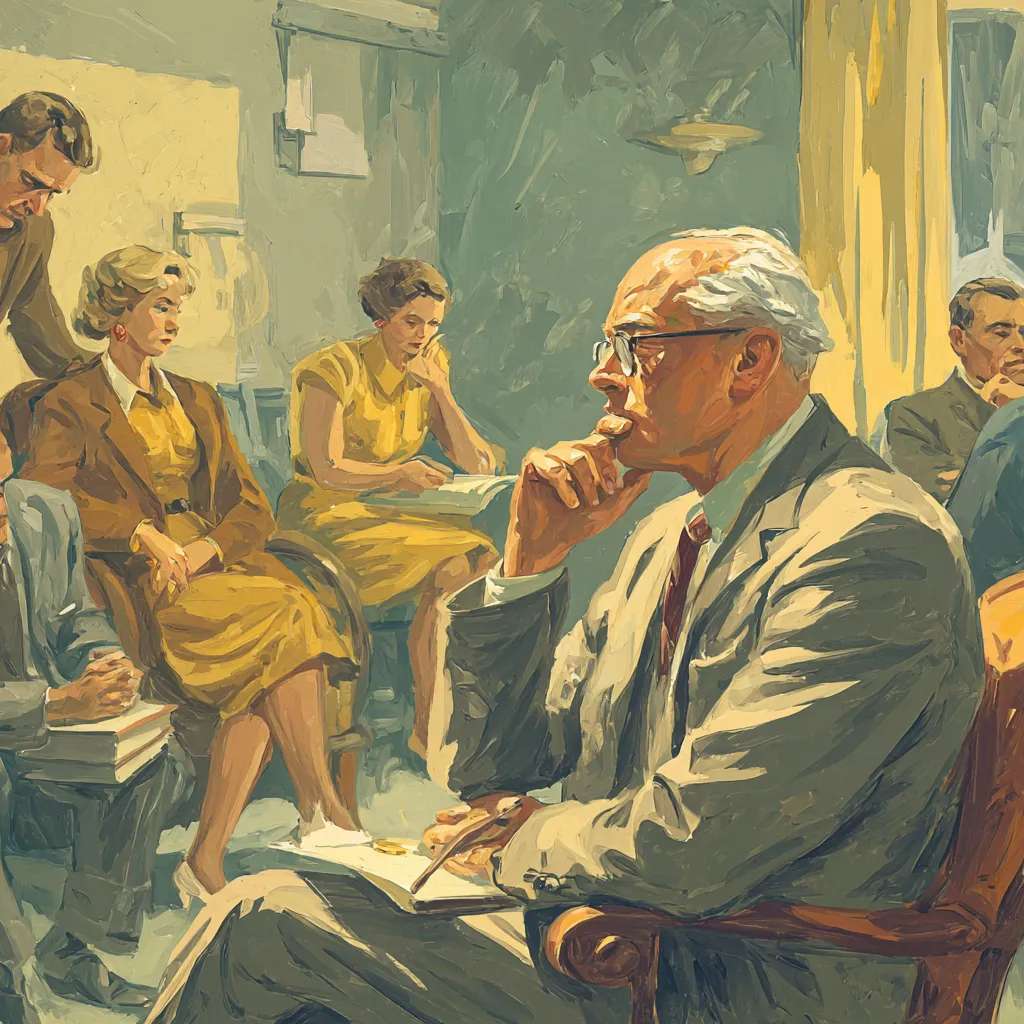
The Asch Conformity Experiments — Seeing What Isn’t There
How an experiment on matching lines revealed the power of group pressure.
The Psychology of Going Along
Frequently Asked Questions
What were the Asch Conformity Experiments and when did they take place?
The Asch Conformity Experiments were a series of psychological studies conducted by Solomon Asch in the 1950s. The experiments tested how individuals would respond to group pressure when making simple perceptual judgments about matching line lengths. Participants were asked to identify which of three comparison lines matched a standard line in length.
How did Solomon Asch design his line-matching experiment to test conformity?
Asch placed one real participant in a room with several confederates who were secretly working with the researcher. The group was shown cards with lines and asked to identify matches. The confederates deliberately gave incorrect answers on certain trials to see if the real participant would conform to the obviously wrong group consensus.
What percentage of participants conformed to the incorrect group answers in Asch's experiments?
Approximately 75% of participants conformed to the incorrect group judgment at least once during the experiment. On average, about one-third of all responses were conforming answers, even when the correct answer was clearly obvious. This demonstrated the powerful influence of group pressure on individual decision-making.
Learn more
To continue the story, download the Chunks Microlearning app
 Download on iOS
 Download on Android