
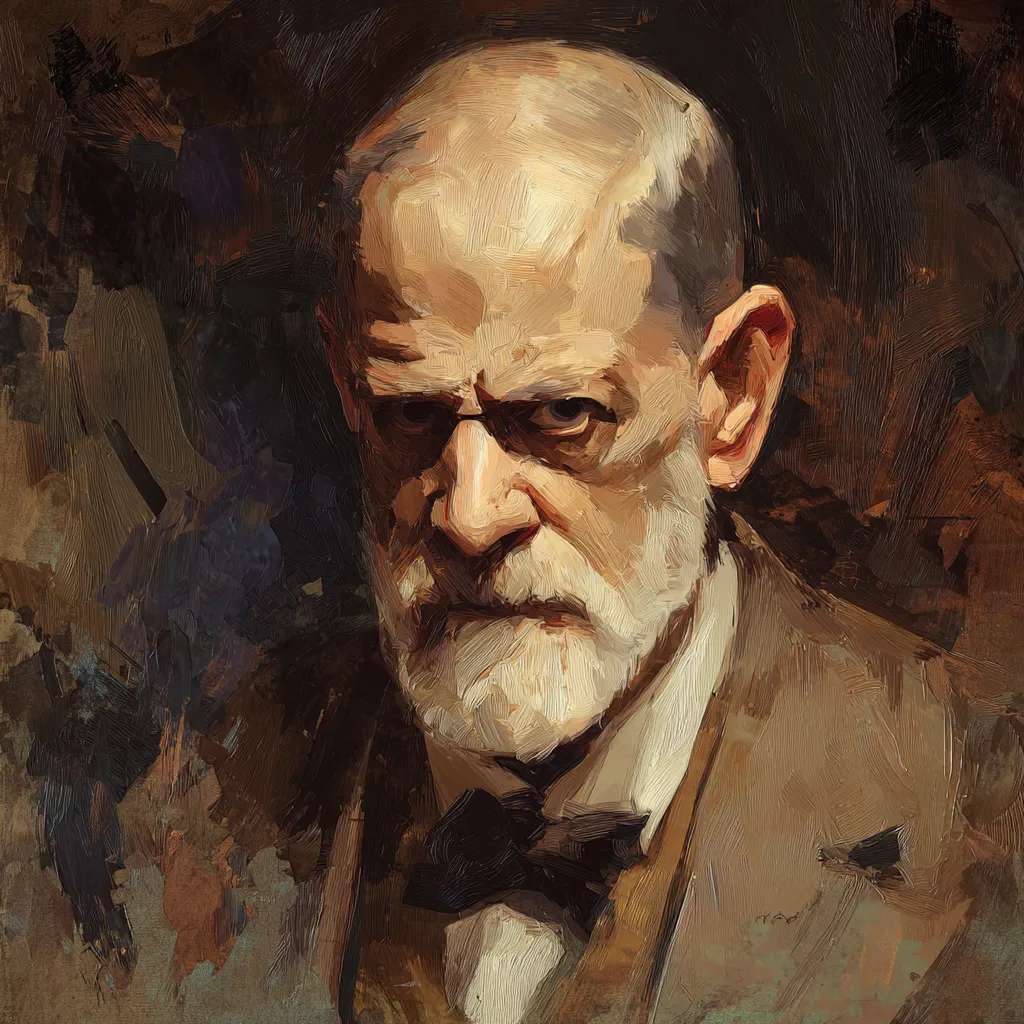
Who was Sigmund Freud?
Sigmund Freud (6 May 1856 – 23 September 1939) was an Austrian neurologist who founded psychoanalysis, a method of treating psychological disorders through dialogue between patient and analyst. He introduced techniques such as free association and dream interpretation, developed theories of the unconscious mind, and proposed the structural model of the psyche comprising id, ego, and superego.
Austrian neurologist who founded psychoanalysis and developed revolutionary theories about the unconscious mind, dreams, and human psychology. His work fundamentally changed how we understand mental health, personality, and human behavior.
Don't stop at the facts — continue Sigmund Freud's story in free narrated chapters on Chunks.
 Download on iOS
 Download on Android
Quick facts
- Born
- 6 May 1856
- Birthplace
- Příbor
- Died
- 23 September 1939
- Place of death
- London
- Nationality
- Austrian Empire, Cisleithania
- Occupation
- Psychoanalyst, neurologist, essayist
Sigmund Freud: key facts
- Sigmund Freud was born on 6 May 1856 in Freiberg, Moravia, in the Austrian Empire, a town now known as Příbor in the Czech Republic.
- Freud founded psychoanalysis, a clinical method for treating psychological disorders through dialogue, and introduced techniques including free association and dream interpretation.
- Freud developed the structural model of the human psyche, dividing it into three parts: the id, which drives instinctual impulses; the ego, which mediates reality; and the superego, which enforces moral standards.
- The Interpretation of Dreams, published in 1899, presented Freud's theory that dreams represent wish fulfillments shaped by unconscious desires and the mechanism of repression.
- After the Nazi annexation of Austria in March 1938 and the Gestapo interrogation of his daughter Anna Freud, Sigmund Freud fled Vienna and settled in London, where he died on 23 September 1939.
- Freud received his MD from the University of Vienna in March 1881 and initially built his career in neurology, publishing influential research on cerebral anatomy and aphasia before turning to psychoanalysis.
- The Wednesday Psychological Society, founded at Freud's Vienna apartment in 1902, grew into the Vienna Psychoanalytic Society and marked the beginning of the organised international psychoanalytic movement.
From Moravia to Vienna: A Jewish Family on the Move
Sigmund Freud was born Sigismund Schlomo Freud on 6 May 1856 in Freiberg, a Moravian town in the Austrian Empire, now known as Příbor in the Czech Republic. He was the first of eight children born to Jakob Freud, a wool merchant, and Amalia Nathansohn, who was twenty years younger than her husband. Jakob had two sons from a previous marriage and came from a Hasidic Jewish background, though he had moved away from strict religious observance. The family lived in a rented room in a locksmith's house when Sigmund was born.
In 1859 the family left Freiberg, eventually settling in Vienna in 1860, where Freud would spend most of his life. He proved an exceptional student, graduating from the Leopoldstädter Kommunal-Realgymnasium with honors in 1873 and demonstrating fluency in multiple languages including German, French, Italian, Spanish, English, Hebrew, Latin, and Greek. He entered the University of Vienna at seventeen, initially intending to study law before joining the medical faculty, where he studied philosophy under Franz Brentano, physiology under Ernst Brücke, and zoology under Carl Claus.
From Neurology Research to the Birth of Psychoanalysis
Freud spent years in serious scientific research before turning to psychology. At Brücke's physiology laboratory he compared the brains of humans with those of vertebrates and invertebrates, work that contributed to the eventual discovery of the neuron. He graduated with a medical degree in March 1881 and began his clinical career at Vienna General Hospital in 1882, where research into cerebral anatomy led to an influential 1884 paper on cocaine and eventually his first book, on the neurological disorder aphasia, published in 1891.
The decisive shift toward psychology came after Freud travelled to Paris in late 1885 to study with the neurologist Jean-Martin Charcot, who was using hypnosis to investigate hysteria. Back in Vienna, Freud initially used hypnosis in his practice, drawing on the approach of his colleague Josef Breuer, whose patient Anna O. had found relief by talking about her symptoms under hypnosis — coining the phrase 'talking cure.' Freud eventually abandoned hypnosis in favor of asking patients to speak freely without censorship, a method he named free association. By 1896 he was using the term 'psychoanalysis' to describe both the technique and the theories behind it.
Dreams, the Unconscious, and the Architecture of the Mind
In 1899 Freud published The Interpretation of Dreams, the work he considered his most important. He argued that dreams were wish fulfillments shaped by unconscious desires, and that analyzing their content revealed the mechanisms of repression underlying psychological symptoms. An abridged version, On Dreams, appeared in 1901, and he extended his theories into everyday life with The Psychopathology of Everyday Life the same year. In 1905 he published Three Essays on the Theory of Sexuality, laying out his theory of infantile sexuality and the stages of psychosexual development, as well as the idea that neurosis could be traced to disturbances in this development.
Freud's theories of the mind went through two major phases of elaboration. His first model distinguished between the unconscious, the preconscious, and conscious thought. In later work, particularly The Ego and the Id published in 1923, he introduced a second structural model: the id, a reservoir of instinctual drives governed by the pleasure principle; the ego, the rational part that mediates between inner drives and external reality; and the superego, the moral component. Central to the whole system was the Oedipus complex — the child's erotic feelings toward one parent and rivalry toward the other — which Freud regarded as a universal feature of psychological development and a key source of neurotic conflict.
Building an International Movement, Then Defending It
From 1902, a small circle of Viennese physicians began meeting at Freud's apartment every Wednesday to discuss psychology and neuropathology. This Wednesday Psychological Society, founded at the suggestion of Wilhelm Stekel, grew into the Vienna Psychoanalytic Society and eventually into an international movement. By 1908, when Freud's followers gathered for what is now counted as the first International Psychoanalytic Congress in Salzburg, the group included figures such as Carl Jung, Alfred Adler, Karl Abraham, and Sándor Ferenczi. In 1909, Freud was invited to give five lectures at Clark University in Massachusetts, the first major public recognition of his work in the United States.
The movement was marked by significant defections. Adler resigned from the Vienna society in 1911 after his views on neurosis diverged sharply from Freud's, going on to found what he called Individual Psychology. Jung broke away in 1912, calling his own system analytical psychology. To protect the theoretical core of psychoanalysis, Ernest Jones organized a secret inner committee of loyalists that included Freud, Jones, Abraham, Ferenczi, Otto Rank, and Hanns Sachs. Rank himself eventually departed in 1926 after his book The Trauma of Birth was read by other committee members as abandoning the Oedipus complex. His place on the committee was taken by Anna Freud.
Exile, Illness, and Death in London
Freud had been diagnosed with cancer of the jaw in 1923, a consequence of his lifelong cigar smoking. Despite serious illness he continued working and seeing patients. When the Nazi Party took control of Germany in 1933, his books were among those publicly burned. Even after the German annexation of Austria in March 1938 and the subsequent arrest of his daughter Anna by the Gestapo, Freud was reluctant to leave Vienna. It was Jones, then president of the International Psychoanalytical Association, who flew to Vienna and pressed Freud to seek exile in Britain. Funds to pay the Nazis' financially extortionate exit conditions were provided by the French psychoanalyst and princess Marie Bonaparte. Freud, his wife Martha, and Anna left Vienna on the Orient Express on 4 June 1938, arriving in London on 6 June.
Freud settled with his family at 20 Maresfield Gardens in Hampstead, where his study was arranged to recreate the atmosphere of his Vienna consulting rooms. He continued seeing patients and completed his final books, including Moses and Monotheism. By mid-September 1939 his jaw cancer had become inoperable and was causing severe pain. Freud reminded his physician Max Schur of a prior agreement about the terminal stages of his illness. After consulting Anna Freud, Schur administered doses of morphine on 21 and 22 September, and Freud died in the early hours of 23 September 1939. He was cremated at Golders Green Crematorium three days later, with funeral orations delivered by Jones and the Austrian author Stefan Zweig.
Sigmund Freud: timeline
- 1856Born Sigismund Schlomo Freud in Freiberg, Moravia, in the Austrian Empire, the first of eight children of wool merchant Jakob Freud and his wife Amalia.
- 1873Graduated from the Leopoldstädter Kommunal-Realgymnasium with honors and entered the University of Vienna at age 17, initially intending to study law before joining the medical faculty.
- 1881Graduated with a medical doctorate from the University of Vienna after nearly nine years of study, during which he researched neurophysiology and studied philosophy under Franz Brentano.
- 1882Began his medical career at Vienna General Hospital, working across several departments and developing a growing interest in clinical work through time spent in Theodor Meynert's psychiatric clinic.
- 1886Resigned from Vienna General Hospital to open a private practice specializing in nervous disorders, and married Martha Bernays, granddaughter of Hamburg chief rabbi Isaac Bernays.
- 1895Co-authored Studies on Hysteria with Josef Breuer, describing the treatment of Anna O. and laying the foundations for what would become the psychoanalytic method.
- 1938Following the Nazi Anschluss of Austria and the Gestapo's arrest of his daughter Anna, Freud left Vienna on 4 June and settled with his family in London at 20 Maresfield Gardens, Hampstead.
- 1939Died in London in the early hours of 23 September, after his doctor administered morphine at Freud's own request as his jaw cancer had become inoperable and was causing severe pain.
Listen: stories featuring Sigmund Freud
Narrated chapters from the Chunks Microlearning app. Read a preview here, or listen to the full story in the app.
Continue Sigmund Freud's story
You've read the summary — hear the full story as narrated 5-minute chapters on Chunks, alongside 200+ figures and events from history, philosophy and science. Free to start on iOS and Android.