.webp?v=1769011787766)
Who was Salvador Dalí?
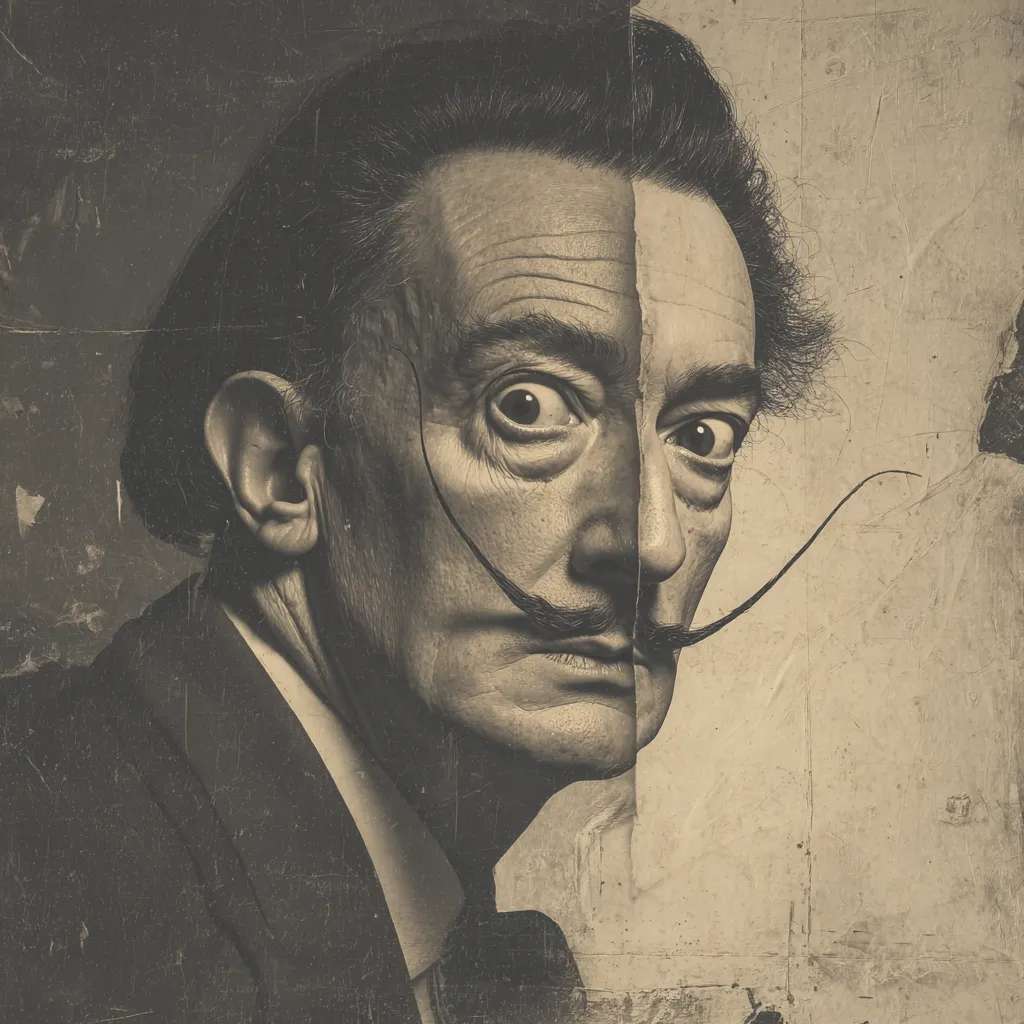
Salvador Dalí (11 May 1904 – 23 January 1989) was a Spanish surrealist artist born in Figueres, Catalonia, renowned for his technical precision and strikingly bizarre imagery. He joined the Surrealist group in 1929 and completed his best-known painting, The Persistence of Memory, in 1931. His eccentric public behavior and flamboyant persona often drew as much attention as his artwork.
Spanish surrealist painter famous for his dreamlike images, melting clocks, and flamboyant personality. His technical skill combined with bizarre imagination made him one of the most recognizable artists of the 20th century and a master of self-promotion.
Don't stop at the facts — continue Salvador Dalí's story in free narrated chapters on Chunks.
Or get it straight away:
 Download on iOS
 Download on Android
Quick facts
- Born
- 11 May 1904
- Birthplace
- Figueres
- Died
- 23 January 1989
- Place of death
- Figueres
- Nationality
- Spain
- Occupation
- Painter, sculptor, writer
Salvador Dalí: key facts
- Salvador Dalí was born on 11 May 1904 in Figueres, Catalonia, Spain, and died in the same town on 23 January 1989 at the age of 84 from cardiac arrest.
- The Persistence of Memory, completed in August 1931 and featuring iconic melting watches, remains Dalí's best-known painting and is widely interpreted as a rejection of the idea that time is rigid or fixed.
- Dalí studied at the Real Academia de Bellas Artes de San Fernando in Madrid from 1922, where his Cubist experiments attracted significant attention from fellow students and critics.
- In 1929 Dalí officially joined the Surrealist group in the Montparnasse quarter of Paris, and that same year met Elena Ivanovna Diakonova, known as Gala, who became his lifelong muse and wife.
- Dalí collaborated with director Luis Buñuel on the 1929 short film Un Chien Andalou, co-writing the script, and the two also worked together on the 1930 feature L'Age d'Or.
- King Juan Carlos granted Dalí the hereditary title of Marquess of Dalí de Púbol in 1982, which Dalí subsequently requested be changed to a life-only title in 1983.
- Two major museums are dedicated to Dalí's work: the Dalí Theatre-Museum in his hometown of Figueres, Spain, and the Salvador Dalí Museum in St. Petersburg, Florida, USA.
A Catalan Childhood and the Road to Madrid
Salvador Domingo Felipe Jacinto Dalí i Domènech was born on 11 May 1904 in Figueres, a town in the Catalonia region of Spain close to the French border. His father was a middle-class lawyer and notary who took a strict approach to raising his children, while his mother actively encouraged Salvador's artistic ambitions. The family was haunted by the death of an older brother, also named Salvador, who had died of gastroenteritis nine months before the painter was born. Dalí grew up acutely aware of this dead sibling, later incorporating the brother's image into his art and writing, describing him as a first version of himself conceived in the absolute.
Dalí showed artistic promise early, attending the Municipal Drawing School in Figueres in 1916 and having his first public exhibition at the Municipal Theatre there in 1918. A summer trip to Cadaqués with a local artist's family introduced him to modern painting, and his uncle supplied him with books and magazines on Cubism and contemporary art. When his mother died of uterine cancer in 1921, Dalí was sixteen and later described it as the greatest blow he had ever experienced. The following year he moved to Madrid, where he enrolled at the Royal Academy of Fine Arts and began befriending poets and intellectuals, including Federico García Lorca and Luis Buñuel, who would shape the rest of his life.
From Cubism to Surrealism: Finding a Language for the Unconscious
At the Royal Academy, Dalí's experiments with Cubism attracted more attention from fellow students than anything else he produced, since no Cubist artists were then working in Madrid. He left the Academy in 1926 without sitting his final exams, having already made his first trip to Paris, where he met Pablo Picasso. By the late 1920s his work was absorbing the influence of Freud's writings on the unconscious, and erotic, dreamlike imagery began to appear alongside precise, almost photographic draftsmanship. Two 1927 paintings, Honey is Sweeter than Blood and Gadget and Hand, which he described as standing midway between Cubism and Surrealism, signalled the direction he was heading.
In 1929 Dalí collaborated with Luis Buñuel on the short film Un Chien Andalou, contributing to the script, and held his first Paris exhibition at the Goemans Gallery in November of that year. The same year he met Gala, born Elena Ivanovna Diakonova, a Russian immigrant then married to Surrealist poet Paul Éluard. She became his lifelong muse and eventually his wife. Dalí formally joined the Surrealist group in Paris in 1929, and its members were enthusiastic about what he called his paranoiac-critical method, a technique of accessing the subconscious to generate unexpected imagery. His best-known painting, The Persistence of Memory, with its soft melting watches draped across a barren landscape, was completed in August 1931.
The Melting Watches and the Meaning Behind the Images
The Persistence of Memory is generally interpreted as a rejection of the idea that time is rigid or fixed, consistent with Einstein's theory of relativity. Dalí himself later claimed the idea for the melting clocks came to him while he was contemplating a piece of Camembert cheese. The painting is dense with symbolism typical of his mature Surrealist work: ants devouring one of the watches carry connotations of death and decay, while the vast, flat coastal landscape evokes his native Catalonia. The whole image operates in that unsettling zone between sleep and waking that Dalí returned to throughout his career.
Food, animals, and scientific ideas all fed into the symbolic vocabulary Dalí developed across his life. Bread appeared in his work from early pieces like The Basket of Bread to elaborate public performances, and he described it as sacred. The egg recurred as a symbol of prenatal hope and love. From the mid-1950s, rhinoceros horns and DNA strands proliferated in his paintings, reflecting his serious interest in mathematics and atomic physics. He also made extensive use of optical illusions, anamorphosis, trompe-l'oeil effects, and, later in his career, holography, treating each as tools for destabilising the viewer's assumptions about what they were seeing.
Commercial Success, Controversy, and the American Years
Dalí's relationship with the Surrealist movement broke down completely by 1939. André Breton expelled him from the group that year, citing his refusal to denounce fascism and what Breton saw as the commercialisation of his work. Breton later coined the anagram nickname 'Avida Dollars' as a derisive jab at Dalí's pursuit of wealth and fame. When the Spanish Civil War ended and World War II began in Europe, Dalí and Gala left France in 1940, crossing into Portugal with visas issued by the Portuguese consul in Bordeaux, and sailing from Lisbon to New York. They spent eight years in the United States, splitting time between New York and California, during which Dalí achieved considerable commercial success.
During the American years Dalí designed the dream sequence for Alfred Hitchcock's 1945 film Spellbound, worked with Walt Disney and animator John Hench on the animated film Destino, and produced designs for ballets, perfume bottles, and fashion collaborations with Elsa Schiaparelli. He delivered lectures at the Museum of Modern Art, and major retrospectives of his work toured American cities. His autobiography, The Secret Life of Salvador Dalí, was published in 1942 and reviewed widely, with Time magazine calling it one of the most irresistible books of the year. The public Dalí persona, complete with waxed upturned mustache, walking stick, and extravagant declarations of his own genius, became as famous as the paintings themselves.
Return to Spain, Nuclear Mysticism, and the Final Decades
Dalí and Gala returned to their house in Port Lligat, on the coast near Cadaqués, in 1948. His decision to live under Francisco Franco's regime and publicly support it caused outrage among anti-Francoist artists and intellectuals, including Pablo Picasso, who refused to acknowledge Dalí's existence for the rest of his life. Dalí announced a return to the Catholic faith and developed what he called Nuclear Mysticism, a fusion of Catholic iconography, classical painting technique, and imagery drawn from atomic physics. Works such as The Christ of Saint John of the Cross and The Disintegration of the Persistence of Memory attempted to combine Christian symbolism with the fragmentation and energy suggested by nuclear science and Heisenberg's quantum mechanics.
In 1960 Dalí began work on his Theatre-Museum in Figueres, the largest single project of his life, which opened in 1974. Gala died on 10 June 1982, and her death accelerated Dalí's physical and mental decline. He had already been treated for depression, drug dependence, and a severe tremor in his right arm. In 1982 King Juan Carlos bestowed on him the title of Marquess of Dalí de Púbol. A fire broke out in his bedroom in August 1984 under circumstances that were investigated but attributed to an electrical fault. Dalí spent his final years in the Torre Galatea, an annex to his Theatre-Museum, and died of cardiac arrest on 23 January 1989, at the age of 84. He is buried in the crypt beneath the stage of the very museum he built in his hometown of Figueres.
Salvador Dalí: timeline
- 1904Born in Figueres, Catalonia, Spain, the son of a notary and a mother who encouraged his artistic interests.
- 1922Moved to Madrid to study at the Royal Academy of Fine Arts, where he befriended Luis Buñuel and Federico García Lorca and began experimenting with Cubism.
- 1926Left the Royal Academy shortly before his final exams and made his first trip to Paris, where he met Pablo Picasso.
- 1929Joined the Surrealist group in Paris, met his future wife Gala, and collaborated with Luis Buñuel on the short film Un Chien Andalou.
- 1931Completed The Persistence of Memory, depicting soft melting watches in a dreamlike landscape, which became his most celebrated painting.
- 1934Civilly married Gala in Paris; she became his business manager as well as his lifelong muse and primary relationship.
- 1940Fled occupied France with Gala using visas issued by Portuguese consul Aristides de Sousa Mendes, and sailed from Lisbon to New York, beginning eight years in the United States.
- 1946Worked with Walt Disney and animator John Hench on an animated short film called Destino, which was left unfinished at the time.
- 1948Returned to Spain, settling in Port Lligat, announced his return to the Catholic faith, and developed his Nuclear Mysticism style blending science and religion.
- 1974Opened his largest single project, the Dalí Theatre-Museum in Figueres, a building he had been developing since 1960.
- 1982His wife Gala died, and King Juan Carlos granted Dalí the title of Marquess of Dalí de Púbol.
- 1989Died of cardiac arrest in Figueres at the age of 84 and was buried in the crypt beneath the stage of his Theatre-Museum.
Listen: stories featuring Salvador Dalí
Narrated chapters from the Chunks Microlearning app. Read a preview here, or listen to the full story in the app.
Continue Salvador Dalí's story
You've read the summary — hear the full story as narrated 5-minute chapters on Chunks, alongside 200+ figures and events from history, philosophy and science. Free to start on iOS and Android.