
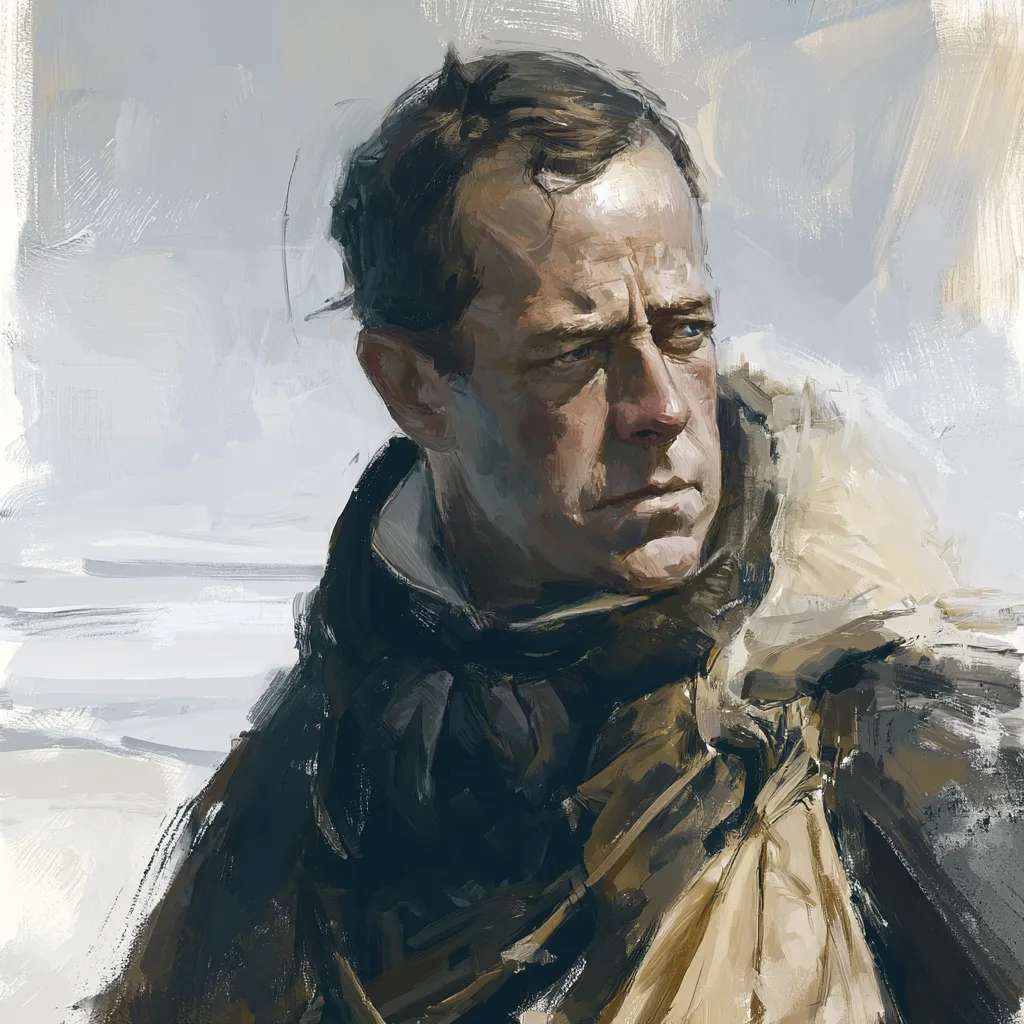
Who was Robert Falcon Scott?
Robert Falcon Scott (6 June 1868 – c. 29 March 1912) was a British Royal Navy officer and explorer who led two Antarctic expeditions. His Terra Nova Expedition reached the South Pole on 17 January 1912, only to find Amundsen had arrived five weeks earlier. Scott and his four companions died on the return journey, 162 miles from their base camp at Hut Point.
British Royal Navy officer and polar explorer who led the ill-fated Terra Nova Expedition to the South Pole in 1912. Though he reached the pole second and died on the return journey, his courage and scientific dedication made him a legendary figure in exploration history.
Don't stop at the facts — continue Robert Falcon Scott's story in free narrated chapters on Chunks.
Or get it straight away:
 Download on iOS
 Download on Android
Quick facts
- Born
- 6 June 1868
- Birthplace
- Plymouth
- Died
- 29 March 1912
- Place of death
- Ross Ice Shelf
- Nationality
- United Kingdom of Great Britain and Ireland
- Occupation
- Explorer, naval officer, non-fiction writer
Robert Falcon Scott: key facts
- Robert Falcon Scott was born on 6 June 1868 in Stoke Damerel, near Devonport, and began his naval career in 1881 at the age of 13 as a cadet.
- Scott led the Discovery Expedition of 1901–1904, during which he set a new southern record by reaching latitude 82°17′S and discovered the Antarctic Plateau on which the South Pole sits.
- On 17 January 1912, Scott and four companions reached the South Pole, only to find that Roald Amundsen's Norwegian expedition had beaten them there by roughly five weeks.
- Scott and his remaining two companions died around 29 March 1912 on the Ross Ice Shelf, approximately 12.5 miles from One Ton Depot and 162 miles from their base camp at Hut Point.
- A planned rendezvous with dog teams that Scott had ordered in writing on 20 October 1911 failed to materialise, a key factor in the party's death; the written orders were only rediscovered in 2012.
- When the search party found the tent in November 1912, Scott's group had 35 pounds of Glossopteris tree fossils with them — the first Antarctic fossils ever discovered, proving the continent was once forested and connected to other landmasses.
- Scott's only child, Peter Markham Scott, born 14 September 1909, went on to found the World Wide Fund for Nature (WWF).
A Naval Officer Turned Polar Explorer
Robert Falcon Scott was born on 6 June 1868 in Stoke Damerel, near Devonport, the third of six children. His family had deep military and naval roots, with his grandfather and four uncles having served in the army or navy. At thirteen, Scott began his naval career as a cadet after passing the entrance examinations for HMS Britannia at Dartmouth. He passed out as a midshipman in July 1883, seventh in a class of 26, and went on to serve on several ships over the following years.
A pivotal moment came on 1 March 1887, when a senior official named Clements Markham — then Secretary of the Royal Geographical Society — noticed the young midshipman Scott winning a cutter race in St Kitts. Markham made a habit of identifying promising naval officers for future polar work, and Scott caught his eye. More than a decade later, in June 1899, Scott had a chance street encounter with Markham again, by which time Markham had been knighted and become President of the Royal Geographical Society. Scott learned of a planned Antarctic expedition and, within days, volunteered to lead it. His motivation at that point was less a passion for exploration than a desire for early command and a way to advance a career on which his family's finances depended.
The Discovery Expedition and the Race to 82 Degrees South
Scott commanded the British National Antarctic Expedition of 1901 to 1904, known as the Discovery Expedition after its ship. He was promoted to commander before the voyage departed on 6 August 1901. The expedition carried dogs and skis but had almost no prior Antarctic experience among its fifty-strong crew. Disease killed the dogs in the first season, and one man, George Vince, died after slipping over a precipice during a blizzard on 11 March 1902.
The central geographic achievement was a southern march undertaken by Scott, Ernest Shackleton, and Edward Wilson, which reached latitude 82 degrees 17 minutes south — the furthest south anyone had gone at that point, roughly 530 miles from the pole. The return journey left Shackleton physically broken, and he was sent home on a relief ship, a decision that would later generate lasting bitterness between the two men. In the expedition's second year, Scott made a western journey that led to the discovery of the Polar Plateau, the high interior plain on which the South Pole sits. The expedition returned to Britain in September 1904, where Scott was promoted to captain and treated as a public hero.
The Terra Nova Expedition Sets Out for the Pole
Scott's second Antarctic venture, the Terra Nova Expedition, left Cardiff on 15 June 1910. Its stated main objective was reaching the South Pole and claiming that achievement for the British Empire. Scott planned to use a combination of motor sledges, Manchurian ponies, dogs, and ultimately man-hauling to cross the Polar Plateau. Arriving in Melbourne in October 1910, he received a telegram from the Norwegian explorer Roald Amundsen announcing that Amundsen was also heading to Antarctica, signalling a direct race.
Early misfortunes accumulated. Terra Nova was trapped in pack ice for twenty days on the way south. One motor sledge broke through sea ice and sank during unloading at Cape Evans. The depot-laying journey was hampered by weak ponies and bad weather, meaning the expedition's main supply point, One Ton Depot, ended up 35 miles short of its intended position at 80 degrees south. Lawrence Oates, who managed the ponies, advised Scott to slaughter them for food and push the depot to its planned location; Scott refused. That shortfall in the depot's position would later carry deadly consequences.
On 20 October 1911, eleven days before the polar march began, Scott issued written orders to dog driver Cecil Meares instructing him to travel south with the dog teams in early February 1912 to meet the returning polar party at around latitude 82 degrees south on 1 March. The existence of these written orders, rediscovered in 2012, overturned an earlier claim that no such formal instructions had ever been given.
Reaching the Pole Second, and the Fatal Return
The southbound march began on 1 November 1911. Scott progressively reduced the party size as support groups turned back, and on 4 January 1912, at latitude 87 degrees 34 minutes south, he announced the final five who would go to the Pole: himself, Edward Wilson, Henry Bowers, Lawrence Oates, and Edgar Evans. On 16 January, the group spotted a black flag left by Amundsen, confirming the Norwegians had already passed. They reached the South Pole on 17 January 1912, finding a tent and a letter dated 18 December left by Amundsen. Scott wrote in his diary, 'Great God! This is an awful place.'
The 862-mile return began on 19 January. Edgar Evans's condition deteriorated after a fall on 4 February; he died near the foot of the Beardmore Glacier on 17 February. The remaining four struggled north across the Ross Ice Shelf in worsening weather with inadequate fuel in the depots. By 10 March, temperatures had dropped below minus 40 degrees Celsius. On 16 March, Oates — his feet severely frostbitten — walked out of the tent and did not return. Scott recorded his last words as 'I am just going outside and may be some time.'
The three survivors made their final camp on 19 March, approximately 12.5 miles short of One Ton Depot. A fierce blizzard pinned them there. Scott wrote his last diary entry on 29 March 1912, closing with the words 'For God's sake look after our people.' He is presumed to have died that day. A search party found the tent on 12 November 1912. Beside the bodies lay 35 pounds of Glossopteris tree fossils, the first Antarctic fossils ever discovered, which the men had dragged on hand sledges during their final desperate miles. The fossils demonstrated that Antarctica had once been forested and connected to other continents.
A Reputation Pulled Apart and Partially Restored
Scott became a national hero almost immediately after the news of his death reached Britain in February 1913. Within a dozen years, more than thirty monuments were erected across Britain, including the founding of the Scott Polar Research Institute in Cambridge. His widow Kathleen was granted the precedence of a widow of a Knight Commander of the Order of the Bath in lieu of the knighthood Scott would likely have received had he survived.
That heroic image held for decades but began fracturing in the late 1970s when Roland Huntford published a dual biography depicting Scott as a 'heroic bungler' whose poor planning and stubbornness cost lives. Huntford's characterisation became the dominant view for roughly two decades. In 2001, meteorologist Susan Solomon published research demonstrating that the Barrier weather conditions during February and March 1912 were extraordinarily severe, with temperatures dropping below minus 40 degrees Celsius, and argued these conditions were a primary cause of the party's deaths rather than organisational failure alone.
The reassessment continued in 2012 when researcher Karen May published her discovery of Scott's written orders to Meares for the dog-team rendezvous. Huntford had claimed those instructions were given only as a casual spoken remark during the march itself; May showed that claim was an error. The failure of the dog teams to reach Scott on time resulted from a chain of decisions made at base camp by others, not from any absence of orders. These findings shifted the balance of historical judgment back toward Scott, without entirely resolving the debate over his leadership and planning.
Robert Falcon Scott: timeline
- 1868Born in Stoke Damerel, near Devonport, the third of six children of John Edward Scott and Hannah Scott.
- 1881Began his naval career as a 13-year-old cadet after passing entrance examinations for the training ship HMS Britannia at Dartmouth.
- 1899A chance encounter in London with Sir Clements Markham, president of the Royal Geographical Society, led Scott to volunteer to lead a planned Antarctic expedition.
- 1901-1904Led the Discovery Expedition to Antarctica, reaching a new southern record of 82°17′S and discovering the Antarctic Plateau on which the South Pole is located.
- 1908Married sculptor and socialite Kathleen Bruce at the Chapel Royal, Hampton Court Palace.
- 1910Departed for Antarctica aboard Terra Nova, having learned by telegram that Roald Amundsen was also heading south, signalling a race to the Pole.
- 1912Reached the South Pole with four companions, only to find Amundsen had beaten them there by roughly five weeks.
- 1912Died on the Ross Ice Shelf, approximately 12.5 miles from One Ton Depot, after his party was halted by a fierce blizzard and exhausted supplies on the return from the Pole.
Listen: stories featuring Robert Falcon Scott
Narrated chapters from the Chunks Microlearning app. Read a preview here, or listen to the full story in the app.
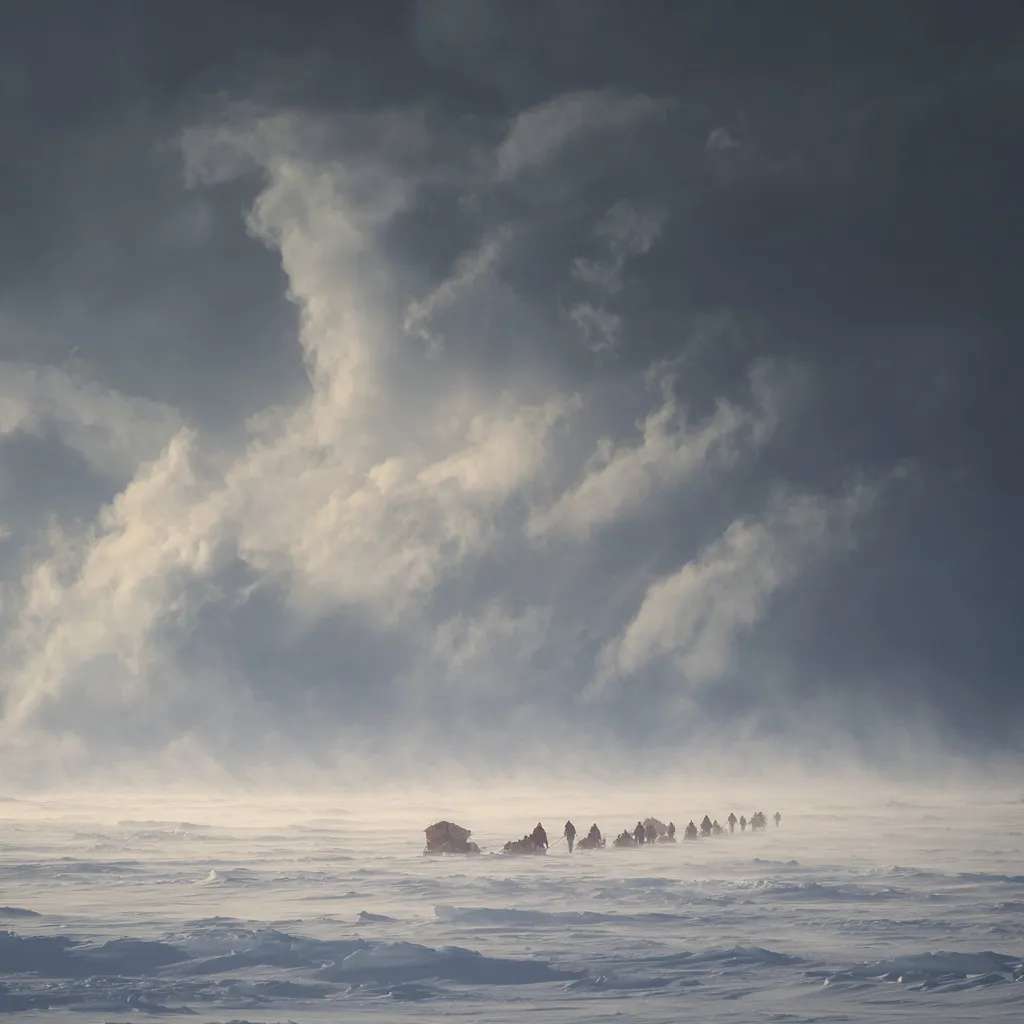
Continue Robert Falcon Scott's story
You've read the summary — hear the full story as narrated 5-minute chapters on Chunks, alongside 200+ figures and events from history, philosophy and science. Free to start on iOS and Android.