
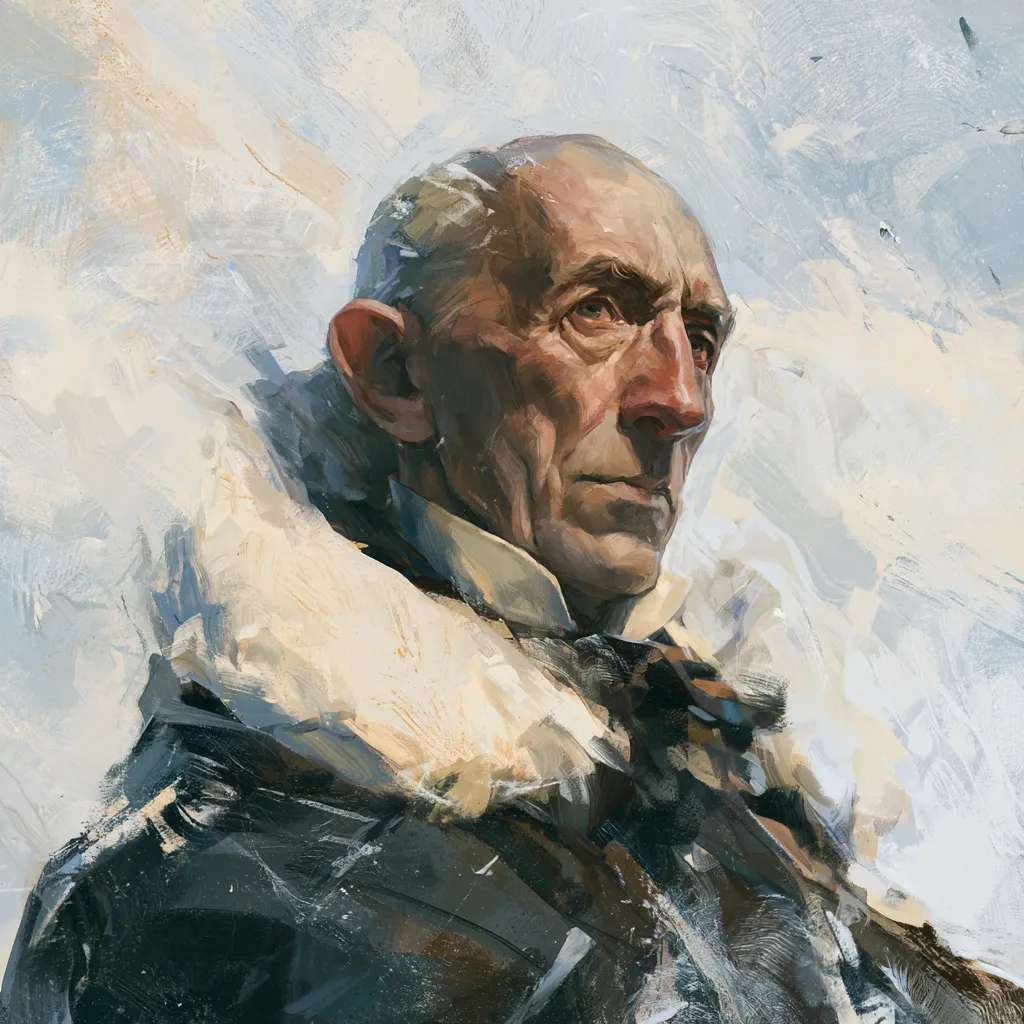
Who was Roald Amundsen?
Roald Amundsen (16 July 1872 – c. 18 June 1928) was a Norwegian explorer who led the first expedition to reach the South Pole on 14 December 1911, arriving roughly a month before Robert Falcon Scott. He also led the first successful traverse of the Northwest Passage and, in 1926, was among the first verified to reach the North Pole by airship. He disappeared during an Arctic rescue mission in 1928.
Norwegian polar explorer who led the first successful expedition to the South Pole in 1911, beating British explorer Robert Falcon Scott by 34 days. His meticulous planning, use of sled dogs, and Arctic expertise made him one of history's greatest polar explorers.
Don't stop at the facts — continue Roald Amundsen's story in free narrated chapters on Chunks.
Or get it straight away:
 Download on iOS
 Download on Android
Quick facts
- Born
- 16 July 1872
- Birthplace
- Borge Municipality
- Died
- 18 June 1928
- Place of death
- Arctic Ocean
- Nationality
- Norway
- Occupation
- Explorer, writer, sailor
Roald Amundsen: key facts
- Roald Amundsen was born on 16 July 1872 in Borge, Østfold, Norway, into a family of shipowners and captains, and died around 18 June 1928 in the Arctic.
- On 14 December 1911, Amundsen led a five-person party — including Olav Bjaaland, Helmer Hanssen, Sverre Hassel, and Oscar Wisting — to become the first people to reach the South Pole.
- From 1903 to 1906, Amundsen commanded the sloop Gjøa on the first successful navigation of the Northwest Passage, travelling from the Atlantic to the Pacific through the Canadian Arctic.
- On 12 May 1926, Amundsen and 15 other men crossed the Arctic in the airship Norge, becoming the first explorers verified to have reached the North Pole.
- Amundsen's South Pole success relied heavily on techniques learned from the Netsilik Inuit, including the use of sled dogs for transport and animal-skin clothing instead of heavy wool.
- Amundsen began his polar career as first mate on the Belgian Antarctic Expedition of 1897–1899, led by Adrien de Gerlache aboard the RV Belgica — the first expedition to overwinter in Antarctica.
- Amundsen disappeared on 18 June 1928 while flying a rescue mission in the Arctic searching for survivors of the crashed airship Italia; his remains were never found.
A Norwegian Childhood Shaped by Franklin's Arctic Journals
Roald Engelbregt Gravning Amundsen was born on 16 July 1872 in Borge, a community situated between the towns of Fredrikstad and Sarpsborg in Norway. He came from a family of shipowners and captains, and the sea was an expected inheritance. His mother, however, had different ambitions for her youngest son, steering him toward medicine. Amundsen honoured that wish until she died when he was 21, at which point he abandoned university and turned immediately to life at sea.
The moment that set his direction came even earlier, at the age of fifteen, when he read the Arctic narratives of the British explorer Sir John Franklin. Amundsen later described reading those accounts with a fascination that shaped the whole course of his life. Growing up in the Uranienborg neighbourhood, he was also an occasional childhood playmate of Carsten Borchgrevink, who would himself become a pioneering Antarctica explorer.
Learning to Survive: The Belgian Expedition and the Northwest Passage
Amundsen's first major polar experience came in 1897, when he joined the Belgian Antarctic Expedition as first mate at the age of 25. Led by Adrien de Gerlache aboard the ship Belgica, the expedition became the first to overwinter in Antarctica, though not by design — the vessel became locked in sea ice off Alexander Island. The crew was poorly prepared for the Antarctic winter, and Amundsen credited the expedition's American doctor, Frederick Cook, with likely saving the crew from scurvy by hunting animals and ensuring the men ate fresh meat.
In 1903, Amundsen took command of his own expedition, leading a crew of six men on the 45-ton fishing vessel Gjoa with the goal of traversing the Northwest Passage. He deliberately chose a small, shallow-drafted ship that could hug the coastline, and the vessel was fitted with a 13-horsepower paraffin engine. The route ran through Baffin Bay, the Parry Channel, Peel Sound, James Ross Strait, Simpson Strait and Rae Strait. The crew spent two winters at King William Island, where contact with the local Netsilik Inuit proved transformative. Amundsen learned to use sled dogs for transport and to wear animal skins rather than heavy wool, lessons he would apply directly to later expeditions.
The ship cleared the Canadian Arctic Archipelago on 17 August 1905, completing the first successful traverse of the Northwest Passage. Because the nearest telegraph station was 500 miles away in Eagle, Alaska, Amundsen made an overland journey to send his success message on 5 December. The crew eventually returned to Oslo in November 1906, after nearly three and a half years away.
Racing to the Bottom of the World: The South Pole, 1911
Amundsen's original plan after the Northwest Passage was to reach the North Pole, but when Frederick Cook claimed to have reached it in 1908 and Robert Peary claimed the same feat in 1909, he shifted his sights to Antarctica. He kept his true intentions quiet, and both Robert F. Scott and Norwegian supporters felt misled when Amundsen made his intentions clear. He sailed from Oslo on 3 June 1910 aboard the ship Fram, and at Madeira he informed his crew of the real destination, also sending Scott a brief telegram announcing that Fram was headed for Antarctica.
The expedition arrived at the Bay of Whales on 14 January 1911 and established a base camp called Framheim. Amundsen laid supply depots at 80, 81, and 82 degrees south along a direct line toward the pole, and planned to use sled dogs not only for transport but also as emergency food — dogs would be slaughtered along the route and fed to the remaining animals and men. A first attempt in September was driven back by extreme cold, which triggered a serious quarrel within the group. A second attempt, made by a team of five — Olav Bjaaland, Helmer Hanssen, Sverre Hassel, Oscar Wisting, and Amundsen — departed on 19 October with four sledges and 52 dogs.
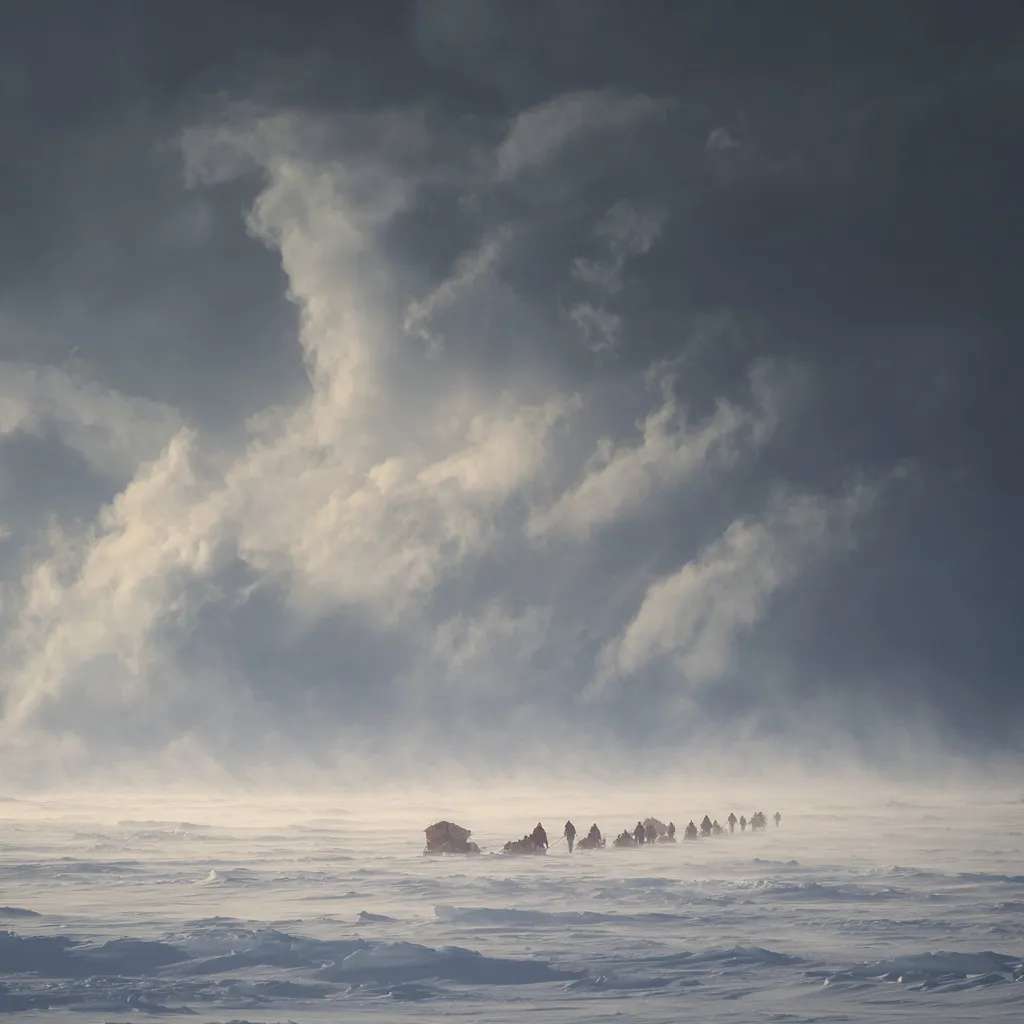
The party ascended via the previously unknown Axel Heiberg Glacier, reached the edge of the Polar Plateau on 21 November, and arrived at the South Pole on 14 December 1911. Amundsen named the camp Polheim and renamed the Antarctic Plateau King Haakon VII's Plateau. The team left a tent and a letter documenting their achievement in case they did not survive the return. All five made it back to Framheim on 25 January 1912, with 11 dogs still alive, and Amundsen publicly announced his success in Hobart, Australia, on 7 March 1912.
From the Arctic Ship Maud to the Airship Norge: Reaching the North Pole
In 1918, Amundsen set out on a new Arctic venture aboard a purpose-built ship called Maud, aiming to navigate the Northeast Passage and then drift across the North Pole locked in the polar ice, as Fridtjof Nansen had attempted with the Fram years earlier. The ship made it through the Northeast Passage, but the drifting plan stalled when the ice proved too thick. Amundsen himself suffered a broken arm and a polar bear attack during this period. After multiple winters trapped in the ice and significant financial difficulties, the expedition yielded scientific results through the work of geophysicist Harald Sverdrup, but never achieved its navigational goal.
Amundsen turned to aviation instead. In 1925, he and Lincoln Ellsworth took two Dornier Do J flying boats north, reaching 87 degrees 44 minutes north latitude, the northernmost point yet reached by aircraft. One plane was damaged and radio contact between the two aircraft was lost, but all six crew members reunited, spent over three weeks manually clearing an ice runway, and managed to take off in the single surviving aircraft.
In 1926, Amundsen and 15 others — including Ellsworth, Hjalmar Riiser-Larsen, Oscar Wisting, and an Italian air crew led by engineer Umberto Nobile — crossed the Arctic in the airship Norge. They departed Spitsbergen on 11 May, flew over the North Pole on 12 May, and landed in Alaska the following day. Three earlier claims to have reached the North Pole, by Cook in 1908, Peary in 1909, and Richard E. Byrd just days before the Norge, are disputed by some researchers, meaning the Norge crew may represent the first verified arrival at the pole.
Disappearance Over the Barents Sea, June 1928
In May 1928, Nobile's new airship Italia crashed in the Arctic while returning from the North Pole, leaving survivors stranded on the ice. Amundsen joined a search effort, boarding a French Latham 47 flying boat on 18 June 1928. His team included Norwegian pilot Leif Dietrichson and French pilot René Guilbaud, along with three other Frenchmen. The aircraft never returned.
A wing-float and a fuel tank later recovered near the Tromsø coast were identified as coming from the plane, and it is generally assumed the aircraft went down in the Barents Sea. The Norwegian government called off the search in September 1928. Subsequent searches in 2004 and 2009, conducted by the Royal Norwegian Navy using an unmanned submarine, covered a large area of the sea floor but found nothing connected to the flight. Amundsen's remains have never been recovered.
Roald Amundsen: timeline
- 1872Born in Borge, between Fredrikstad and Sarpsborg, Norway, into a family of shipowners and captains.
- 1897Joined Adrien de Gerlache's Belgian Antarctic Expedition as first mate, becoming part of the first crew to overwinter in Antarctica.
- 1903Departed to lead the first expedition to traverse Canada's Northwest Passage, sailing the small fishing vessel Gjøa with a crew of six.
- 1905Cleared the Canadian Arctic Archipelago on 17 August, completing the first successful navigation of the Northwest Passage.
- 1910Left Oslo aboard the ship Fram, secretly redirecting the expedition toward Antarctica after rivals claimed the North Pole.
- 1911Arrived at the Bay of Whales on the Ross Ice Shelf and established his base camp, which he named Framheim.
- 1911Led a party of five to become the first explorers to reach the South Pole, naming the camp there Polheim.
- 1918Departed on the ship Maud to attempt a traverse of the Northeast Passage and drift over the North Pole, an expedition that ultimately lasted until 1925 without achieving its main goal.
- 1926Crossed the Arctic in the airship Norge with 15 others, flying over the North Pole and becoming the first explorers verified to have reached it.
- 1928Disappeared over the Arctic while piloting a rescue mission searching for survivors of the crashed airship Italia; his remains were never found.
Listen: stories featuring Roald Amundsen
Narrated chapters from the Chunks Microlearning app. Read a preview here, or listen to the full story in the app.
Continue Roald Amundsen's story
You've read the summary — hear the full story as narrated 5-minute chapters on Chunks, alongside 200+ figures and events from history, philosophy and science. Free to start on iOS and Android.