
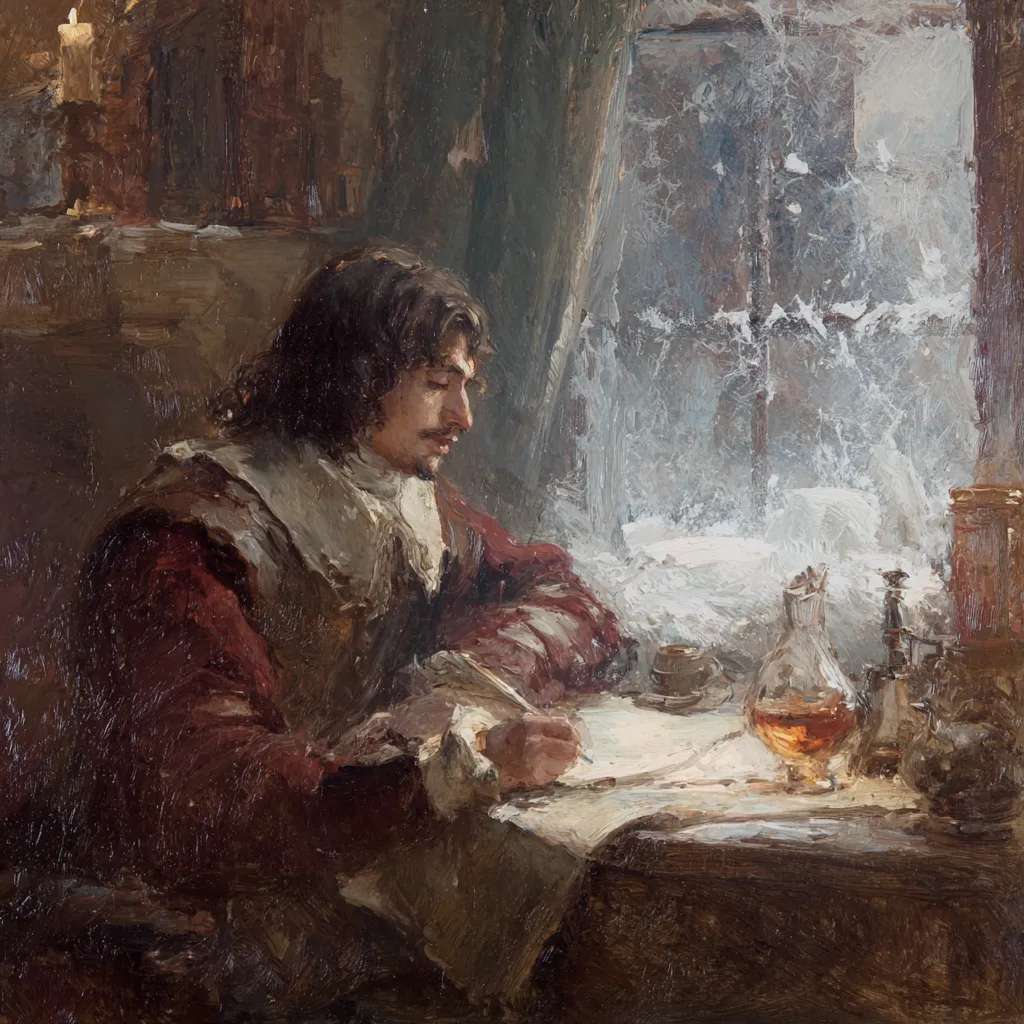
Who was René Descartes?
René Descartes (31 March 1596 – 11 February 1650) was a French philosopher and mathematician credited as the father of modern philosophy for introducing a systematic, method-based approach to knowledge. His famous principle 'cogito, ergo sum' — I think, therefore I am — anchored his philosophy in rational doubt. He also founded analytic geometry, connecting algebra and geometry into a unified system.
French philosopher, mathematician, and scientist known as the 'Father of Modern Philosophy' for his systematic approach to doubt and reason. His famous declaration 'I think, therefore I am' became a fundamental principle of Western philosophy and rationalism.
Don't stop at the facts — continue René Descartes's story in free narrated chapters on Chunks.
Or get it straight away:
 Download on iOS
 Download on Android
Quick facts
- Born
- 31 March 1596
- Birthplace
- Descartes
- Died
- 11 February 1650
- Place of death
- Stockholm
- Nationality
- France
- Occupation
- Philosopher, mathematician, musicologist
René Descartes: key facts
- René Descartes was born on 31 March 1596 in La Haye en Touraine, France, a town later renamed Descartes in his honour, and died on 11 February 1650 in Stockholm, Sweden.
- Descartes is credited as the father of modern philosophy for transforming methodology by introducing a systematic, doubt-based approach to acquiring knowledge, most famously expressed in the Latin phrase 'cogito, ergo sum' — 'I think, therefore I am'.
- Descartes co-developed analytic geometry with Pierre de Fermat, connecting the previously separate fields of algebra and geometry, and the Cartesian coordinate system is named after him.
- In 1637, Descartes published Discourse on the Method alongside three scientific essays covering optics, meteorology, and geometry, laying out rules for grounding knowledge on clear and indubitable foundations.
- Descartes published Meditations on First Philosophy in 1641, a landmark Latin treatise in which he argued for the existence of God and the distinction between the human mind and body, a doctrine known as Cartesian dualism.
- Descartes invented the convention of representing unknown quantities in equations with the letters x, y, and z, and pioneered the use of superscript notation for exponents, such as x².
- Queen Christina of Sweden invited Descartes to Stockholm in 1649 to tutor her and help establish a new scientific academy; he died there of pneumonia on 11 February 1650.
From La Haye to the Jesuit College: A Fragile Child's Education
René Descartes was born on 31 March 1596 in La Haye en Touraine, in the Province of Touraine — a town that now bears his name. His father, Joachim, held a seat in the Parlement of Rennes, placing the family among the educated professional class. In May 1597, his mother, Jeanne Brochard, died a few days after giving birth to a stillborn child. René was raised by his grandmother and great-uncle, in a region controlled by the Protestant Huguenots despite the family's Roman Catholicism.
Because of fragile health, Descartes entered the Jesuit College of La Flèche only in 1607, later than was typical. There he encountered mathematics and physics for the first time. After graduating in 1614, he spent two years at the University of Poitiers, earning a Baccalauréat and Licence in canon and civil law in 1616 — a qualification his father wanted so that he might become a lawyer. He then moved to Paris, setting aside the law for pursuits that would occupy the rest of his life.
Military Service, Dreams in a Heated Room, and the Birth of a Method
In 1618, seeking a career as a professional military officer, Descartes joined the Protestant Dutch States Army in Breda under Maurice of Nassau as a mercenary. He undertook formal study of military engineering under the system established by Simon Stevin, and it was in Breda that he met Isaac Beeckman, principal of a Dordrecht school, who drew him into serious mathematical inquiry. For Beeckman he wrote the Compendium of Music in 1618, a treatise on music theory.
Descartes later served under the Catholic Duke Maximilian of Bavaria and was present at the Battle of the White Mountain near Prague in November 1620. According to the biographer Adrien Baillet, the decisive intellectual moment came on the night of 10 to 11 November 1619, when Descartes shut himself in a heated room in Neuburg an der Donau to escape the cold. There he experienced three vivid dreams, which he interpreted as a divine revelation pointing him toward a new philosophy grounded in mathematics. By the time he left the room, he had formulated the core ideas of analytic geometry and the ambition to apply mathematical method to all knowledge.
Two Decades in the Netherlands: Major Works and Personal Losses
Descartes left the army in 1620 and eventually settled in the Dutch Republic in 1628, where he would spend more than twenty years and produce all of his major writings. He enrolled at the University of Franeker in April 1629 and subsequently at Leiden University under the name 'Poitevin,' studying mathematics with Jacobus Golius and astronomy with Martin Hortensius. In Amsterdam he had a relationship with a servant, Helena Jans van der Strom, and in 1635 their daughter Francine was born in Deventer. She died of scarlet fever at the age of five, in 1640, and Descartes wept openly — an unusual response for a moralist of the period.
The year 1633 brought a significant setback: when the Italian Inquisition condemned Galileo, Descartes abandoned plans to publish his Treatise on the World, on which he had labored for four years. He salvaged portions of the work, releasing them in 1637 as three essays — 'Les Météores,' 'La Dioptrique,' and La Géométrie — prefaced by his celebrated Discours de la méthode, the Discourse on the Method. In it he set out four rules of thought designed to ensure that knowledge rests on an unshakeable foundation. La Géométrie, developed partly in collaboration with Pierre de Fermat, established what became known as analytic geometry, linking algebra and geometry through a coordinate system that now bears Descartes's name.
In 1641 he published Meditationes de Prima Philosophia, the Meditations on First Philosophy, in Latin, followed in 1644 by Principia Philosophiae, the Principles of Philosophy, dedicated to Sophia of Hanover. His final major work, Les Passions de l'âme, The Passions of the Soul, appeared in 1649, dedicated to Princess Elisabeth of Bohemia, with whom he had maintained a long philosophical correspondence on moral and psychological subjects.
Cogito, Ergo Sum: The Philosophy of Doubt and the Thinking Self
The philosophical project that made Descartes famous was rooted in a single methodological move: the deliberate rejection of anything that could be doubted, in order to discover what could not. He called this approach hyperbolic or metaphysical doubt. Rather than a scepticism for its own sake, it was a tool for excavating certainty — clearing away uncertain beliefs as a builder clears topsoil before laying foundations. From this process Descartes arrived at a single indubitable first principle: the fact that he was thinking. From that he concluded he must exist. The Latin formulation, 'cogito, ergo sum' — I think, therefore I am — first appeared in French as 'Je pense, donc je suis' in the Discourse on the Method.
Descartes's theory of mind and body, known as Cartesian dualism, held that the universe contained two fundamentally different kinds of substance: mind, defined as thinking and immaterial, and body, defined as matter and extension. He argued that these two substances were genuinely distinct because each could, in principle, exist without the other. The pineal gland, he proposed, served as the site where mind and body interacted, with animal spirits — light, fast-moving fluids in the nervous system — carrying signals between brain and muscles. This framework expelled final causes and divine purpose from the physical world, providing philosophical grounding for the new mathematical physics of Kepler and Galileo while leaving room for theological beliefs about the immortality of the soul.
Stockholm, a Queen Who Kept Early Hours, and Death Far from France
By 1649 Descartes was among Europe's most celebrated philosophers and scientists. That year Queen Christina of Sweden invited him to Stockholm to help establish a new scientific academy and to tutor her in his ideas. He accepted and moved to the Swedish Empire in the middle of winter, staying at the house of the French resident Pierre Chanut on Västerlånggatan, less than five hundred meters from Castle Tre Kronor. There Chanut and Descartes used a Torricellian mercury barometer to take what Descartes considered the first barometric readings in Stockholm, exploring whether atmospheric pressure could forecast weather.
The arrangement proved uncomfortable. Christina required Descartes to tutor her three times weekly at five in the morning in her cold castle. By 15 January 1650 the two had actually met only four or five times, and it became clear they did not suit each other: she had no interest in his mechanical philosophy and he did not share her enthusiasm for ancient Greek literature. On 1 February 1650 Descartes fell ill with pneumonia. Chanut reported the cause as pneumonia, though Christina's physician Johann van Wullen identified it as peripneumonia; in any case Descartes refused van Wullen's treatment. He died on 11 February 1650.
As a Catholic in a Protestant country, Descartes was buried in the churchyard of what became Adolf Fredrik Church in Stockholm. In 1666 his remains were taken to France and interred at Saint-Étienne-du-Mont. In 1819 they were moved again, to the Abbey of Saint-Germain-des-Prés, though the reburial was incomplete — a finger and the skull were missing. An alleged skull is held at the Musée de l'Homme in Paris, though research conducted in 2020 suggests it may be a forgery.
René Descartes: timeline
- 1596Born in La Haye en Touraine, Province of Touraine, France.
- 1597His mother, Jeanne Brochard, died a few days after giving birth to a stillborn child, leaving Descartes to be raised by his grandmother and great-uncle.
- 1607Entered the Jesuit College of La Flèche, where he was introduced to mathematics and physics, delayed due to his fragile health.
- 1616Earned a Baccalauréat and Licence in canon and civil law from the University of Poitiers, fulfilling his father's wish that he become a lawyer.
- 1618Joined the Protestant Dutch States Army in Breda as a mercenary, studied military engineering, and met Isaac Beeckman, who drew him toward a mathematical study of nature.
- 1637Published the Discourse on the Method alongside three scientific essays, including La Géométrie, which established analytic geometry and connected algebra and geometry into a unified system.
- 1641Published Meditations on First Philosophy in Latin, presenting his method of hyperbolic doubt and the famous principle 'cogito, ergo sum' — I think, therefore I am.
- 1644Published Principles of Philosophy, outlining his natural philosophy including three laws of motion and an early form of the conservation of momentum.
- 1649Accepted Queen Christina of Sweden's invitation to her court in Stockholm to tutor her and help organise a new scientific academy, relocating in the middle of winter.
- 1650Died in Stockholm of pneumonia, having tutored Queen Christina only four or five times before falling ill.
Listen: stories featuring René Descartes
Narrated chapters from the Chunks Microlearning app. Read a preview here, or listen to the full story in the app.
Continue René Descartes's story
You've read the summary — hear the full story as narrated 5-minute chapters on Chunks, alongside 200+ figures and events from history, philosophy and science. Free to start on iOS and Android.