
.webp?v=1769012089035)
Who was Pablo Picasso?
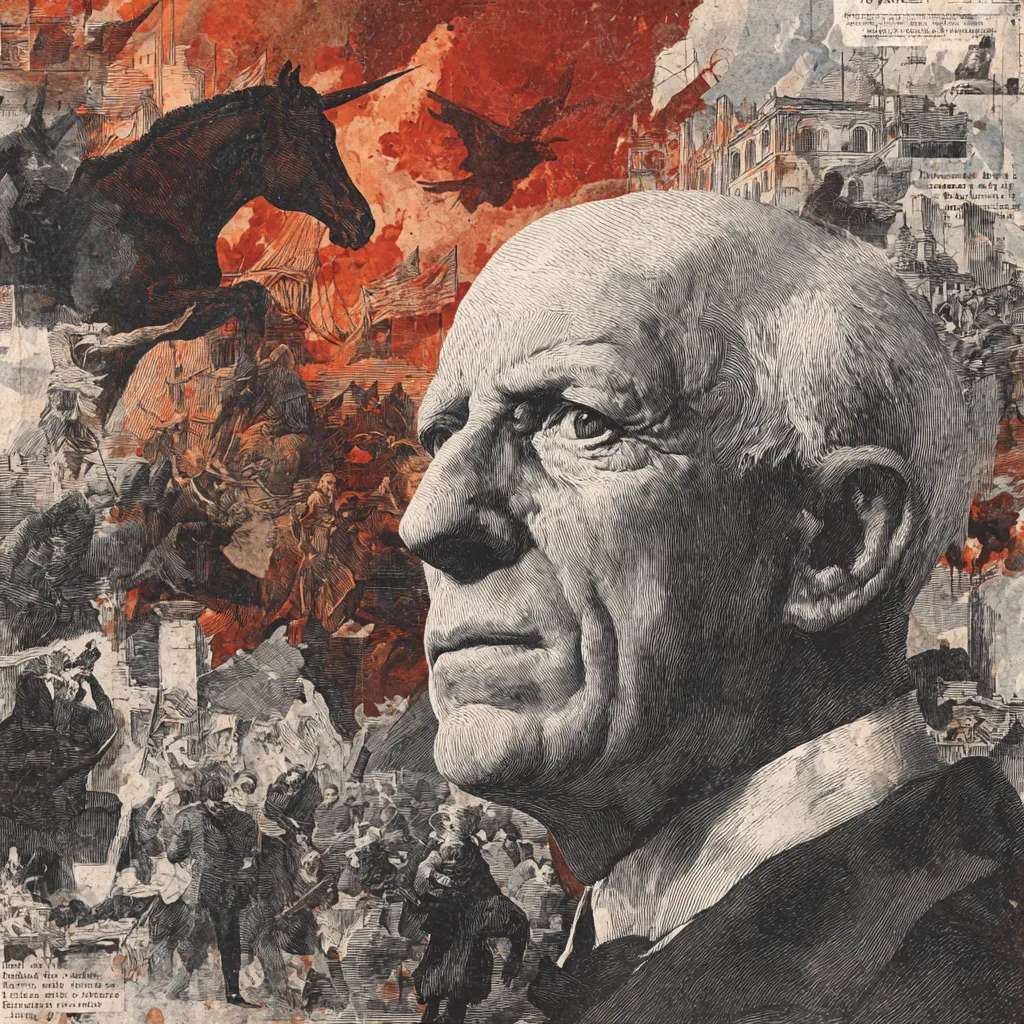
Pablo Picasso (25 October 1881 – 8 April 1973) was a Spanish painter and sculptor, born in Málaga, who spent most of his adult life in France. He co-founded the Cubist movement, contributed to the invention of constructed sculpture and collage, and produced landmark works including Les Demoiselles d'Avignon (1907) and the anti-war painting Guernica (1937).
Spanish painter and sculptor who co-founded the Cubist movement and became one of the most influential artists of the 20th century. His relentless experimentation and revolutionary approach to form and perspective fundamentally changed how we see and create art.
Don't stop at the facts — continue Pablo Picasso's story in free narrated chapters on Chunks.
 Download on iOS
 Download on Android
Quick facts
- Born
- 25 October 1881
- Birthplace
- Málaga
- Died
- 8 April 1973
- Place of death
- Mas Notre-Dame-de-Vie de Mougins
- Nationality
- Spain
- Occupation
- Painter, sculptor, printmaker
Pablo Picasso: key facts
- Pablo Picasso was born on 25 October 1881 in Málaga, Andalusia, southern Spain, and went on to become one of the most influential artists of the 20th century.
- Picasso co-founded the Cubist movement alongside Georges Braque, developing both Analytic Cubism (1909–1912) and Synthetic Cubism (1912–1919).
- Guernica (1937), Picasso's large-scale painting depicting the German and Italian bombing of a Basque town during the Spanish Civil War, became one of history's most powerful anti-war artworks.
- Les Demoiselles d'Avignon (1907), a proto-Cubist painting influenced by Iberian sculpture and African art, marked a radical turning point in Picasso's style and in Western art more broadly.
- Picasso's career is divided into named periods, including the Blue Period (1901–1904), characterised by sombre blue-toned paintings, and the Rose Period (1904–1906), which featured warmer colours and circus subjects.
- At his death on 8 April 1973 in Mougins, France, Picasso's estate contained more than 45,000 unsold works, including paintings, sculptures, ceramics, and drawings.
- Picasso received his first formal artistic training from his father, José Ruiz y Blasco, a painter and art professor, beginning around age seven.
A Child Who Painted Before He Could Write
Pablo Ruiz Picasso was born on 25 October 1881 in Málaga, in southern Spain. His father, José Ruiz y Blasco, was a painter who specialized in naturalistic depictions of birds and game, and worked as an art professor and museum curator. According to Picasso's mother, his first words were a shortened form of the Spanish word for pencil — a detail that, true or not, fits a boy who showed an extraordinary grip on drawing from the earliest age.
Formal training began when Picasso was seven, under his father's strict academic method: copying the masters, sketching from plaster casts, and working from live models. The family moved to Barcelona in 1895, where Picasso sat the entrance exam for the advanced class at the city's School of Fine Arts. A process that normally took students a month, he completed in a week. He was thirteen. Despite this technical command, he was an indifferent student who formed friendships more readily than he followed rules.
At sixteen, Picasso was sent to Madrid's Royal Academy of Fine Arts — the most prestigious art school in Spain — but he stopped attending classes almost immediately. He spent his time instead at the Prado, where he was particularly drawn to El Greco, whose elongated figures and charged colors would echo in his own work for decades.
Blue Paint, Poverty, and the Making of a Style
Picasso made his first trip to Paris in 1900, then the undisputed capital of European art. He arrived with little money and spent early periods in genuine hardship, reportedly burning drawings for warmth. He met journalist and poet Max Jacob, who helped him navigate the language and the city. The two shared an apartment, keeping opposite hours — Jacob slept at night while Picasso worked through the dark and slept during the day.
The Blue Period, lasting from roughly 1901 to 1904, grew partly from the suicide of Picasso's close friend Carles Casagemas and from a journey through Spain. Working almost exclusively in shades of blue and blue-green, occasionally warmed by other colors, Picasso painted gaunt figures — beggars, blind men, prostitutes — with a spare, melancholy clarity. The period produced works like The Frugal Repast, an etching of a blind man and an emaciated woman at a near-empty table, and the allegorical painting La Vie.
The Rose Period followed from 1904 to 1906, marked by a warmer palette of orange and pink and by subject matter drawn from circus life — acrobats, harlequins, and saltimbanques. The shift in mood coincided with Picasso meeting Fernande Olivier, a bohemian artist who became his companion and appeared in many paintings of the period. By 1905, American collectors Leo and Gertrude Stein had begun acquiring his work, and Gertrude in particular became his principal patron, exhibiting his pieces in her Paris salon.
Cubism and the Shattering of Visual Convention
In 1907, Picasso completed Les Demoiselles d'Avignon, a painting that would later be recognized as the launching point of Cubism. The figures on the left were shaped by Iberian sculpture, while the faces on the right were repainted after Picasso encountered African artifacts at the Palais du Trocadéro in Paris. When he showed the work to friends in his studio, reactions ranged from shock to outright hostility — Henri Matisse reportedly dismissed it as a hoax. Picasso did not exhibit it publicly until 1916.
Working alongside the French painter Georges Braque, Picasso developed Analytic Cubism between 1909 and 1912, using muted browns and neutral tones to disassemble objects and reconstruct them from multiple viewpoints simultaneously. Synthetic Cubism followed from 1912 to 1919, introducing cut paper, newspaper fragments, and wallpaper into compositions. The seminal work of this phase was Still Life with Chair Caning from 1912, which is widely regarded as the first Cubist collage and among the earliest assemblages in art history.
In 1911, in the middle of this extraordinarily creative period, Picasso was arrested and questioned in connection with the theft of the Mona Lisa from the Louvre. His friend Guillaume Apollinaire had been implicated first, and Apollinaire named Picasso, who had previously purchased stolen artworks from a mutual acquaintance. Facing potential deportation to Spain, Picasso denied ever having met Apollinaire. Both men were ultimately cleared. The episode illustrates the tangled personal loyalties and precarious legal standing that Picasso navigated as a foreign national in France.
Guernica and the Turn Toward Political Art
For most of his career, Picasso kept his art apart from explicit political statements. That changed in 1937 when German and Italian air forces bombed the Basque town of Guernica during the Spanish Civil War. The large canvas Picasso produced in response remains among the most recognizable anti-war images ever made. He said that its symbolism was for viewers to interpret themselves, refusing to offer a fixed reading.
Guernica was displayed at the Spanish Pavilion during the 1937 Paris International Exposition and then toured Scandinavia and England. After Francisco Franco's forces won the civil war, the painting was sent to the United States to raise funds for Spanish refugees. Picasso stipulated it should not return to Spain until democracy was restored there. It remained at the Museum of Modern Art in New York until 1981.
The anti-fascist photographer and painter Dora Maar, Picasso's companion during this period, documented the creation of the painting in photographs and was allowed exclusive access to his studio throughout the process. Her black-and-white photography is thought to have influenced the painting's stark monochrome scheme. At Picasso's request, Maar painted parts of the dying horse at the center of the composition.
The Scale of a Life's Work
Picasso's career stretched more than 76 years, from his late teens until his death on 8 April 1973 in Mougins, France, from a heart attack brought on by pulmonary edema. He died without leaving a will. At the time of his death, his estate held more than 45,000 unsold works, including nearly 1,900 paintings, over 1,200 sculptures, more than 3,200 ceramics, and thousands of drawings, prints, and sketchbooks.
The catalogue of his paintings and drawings compiled by Christian Zervos across 33 volumes lists more than 16,000 works — and is not considered exhaustive. His output spanned identifiable periods — the Blue Period, the Rose Period, the African-influenced Period, Analytic Cubism, Synthetic Cubism, Neoclassicism, and Surrealist-inflected work in the 1920s — though Picasso himself rejected the idea that these represented an evolution toward any single goal. He stated plainly that different subjects had simply demanded different means of expression.
Because he died intestate, the French state received part of his estate as payment of death duties in the form of artworks, which became the core collection of the Musée Picasso in Paris. Museums dedicated to his work also exist in Barcelona and in his birthplace of Málaga. Several of his paintings rank among the highest prices ever paid at auction, with Women of Algiers selling for over 179 million dollars at Christie's in New York in 2015.
Pablo Picasso: timeline
- 1881Born in Málaga, Andalusia, Spain, the first child of painter and art instructor José Ruiz y Blasco and María Picasso y López.
- 1900Made his first trip to Paris, then the art capital of Europe, where he met journalist and poet Max Jacob, his first Parisian friend.
- 1907Completed Les Demoiselles d'Avignon, a proto-Cubist painting that shocked viewers including Matisse, and began his African-influenced period, laying the groundwork for Cubism.
- 1909–1912Developed Analytic Cubism alongside Georges Braque, breaking objects into fragmented, monochrome forms and fundamentally transforming Western painting.
- 1937Exhibited Guernica at the Paris International Exposition, a large-scale condemnation of the German and Italian bombing of the Basque town during the Spanish Civil War.
- 1944Joined the French Communist Party after the liberation of Paris, a membership he retained until his death.
- 1949Created the lithograph Dove, which became widely known as the Dove of Peace after being used to illustrate a poster at the 1949 World Peace Council.
- 1961Married Jacqueline Roque, a salesgirl he had met at a pottery store in Vallauris, in his second marriage; the two remained together for the rest of his life.
- 1973Died of a heart attack brought on by pulmonary edema at his home in Mougins, France, at the age of 91, leaving an estate of more than 45,000 unsold works.
Listen: stories featuring Pablo Picasso
Narrated chapters from the Chunks Microlearning app. Read a preview here, or listen to the full story in the app.
Continue Pablo Picasso's story
You've read the summary — hear the full story as narrated 5-minute chapters on Chunks, alongside 200+ figures and events from history, philosophy and science. Free to start on iOS and Android.