
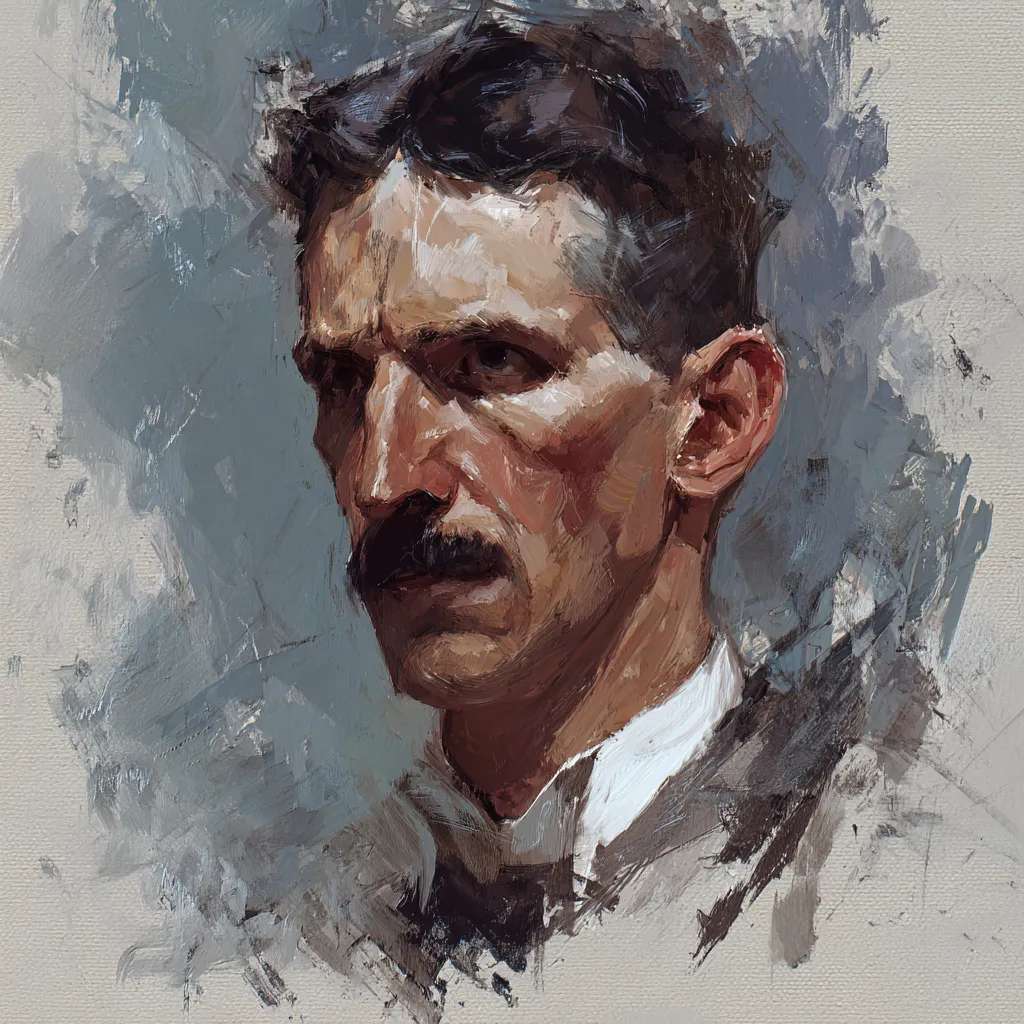
Who was Nikola Tesla?
Nikola Tesla (10 July 1856 – 7 January 1943) was a Serbian-American inventor and electrical engineer best known for designing the modern alternating current electricity supply system. Born in Smiljan in the Austrian Empire, he immigrated to the United States in 1884 and developed the AC induction motor, which Westinghouse Electric licensed and used to power a polyphase system that transformed electrical distribution worldwide.
Serbian-American inventor and electrical engineer who developed the alternating current (AC) electrical system and numerous other innovations. His visionary work in electricity, magnetism, and wireless technology helped shape the modern world.
Don't stop at the facts — continue Nikola Tesla's story in free narrated chapters on Chunks.
 Download on iOS
 Download on Android
Quick facts
- Born
- 10 July 1856
- Birthplace
- Smiljan
- Died
- 7 January 1943
- Place of death
- New York City
- Nationality
- Austrian Empire, Hungary
- Occupation
- Inventor, electrical engineer, physicist
Nikola Tesla: key facts
- Nikola Tesla was born on 10 July 1856 in Smiljan, a village then in the Military Frontier of the Austrian Empire, into a family of ethnic Serbs.
- Tesla emigrated to the United States in June 1884 and became a naturalized citizen on 30 July 1891.
- In 1888, Westinghouse Electric licensed Tesla's polyphase induction motor and transformer designs for $60,000 in cash and stock plus a royalty of $2.50 per AC horsepower produced.
- Tesla demonstrated a radio-controlled boat, which he called a telautomaton, at an electrical exhibition at Madison Square Garden in 1898.
- In 1899, Tesla set up an experimental station in Colorado Springs to study electrical transmission, where he produced artificial lightning discharges of up to 135 feet in length.
- Tesla attempted to build the Wardenclyffe Tower on Long Island as an intercontinental wireless communication and power transmitter, but ran out of funding before completing it.
- The General Conference on Weights and Measures named the SI unit of magnetic flux density the tesla in his honor in 1960, seventeen years after his death in New York City on 7 January 1943.
From the Austrian Empire to the Laboratories of New York
Nikola Tesla was born on 10 July 1856 in Smiljan, a village in the Military Frontier of the Austrian Empire, into a Serbian family. His father was an Eastern Orthodox priest, and his mother, though formally uneducated, possessed a remarkable ability to memorize Serbian epic poetry and a gift for constructing mechanical devices at home. Tesla credited both his memory and his inventive imagination to her influence. He attended the Higher Real Gymnasium in Karlovac, where a physics professor's electrical demonstrations captivated him, and he graduated in 1873 at the age of 17.
After surviving a severe bout of cholera following graduation, Tesla enrolled at the Imperial-Royal Technical College in Graz on a military scholarship in 1875, where his fascination with electricity deepened under professor Jakob Pöschl. He passed nearly twice the required number of exams in his first year but left without a degree. By 1881, he had moved to Budapest to work at the Budapest Telephone Exchange, rising to the position of chief electrician. The following year, a connection through his Budapest employer secured him a position in Paris with the Continental Edison Company, where he gained extensive hands-on experience in electrical engineering. In June 1884, he emigrated to the United States and began working almost immediately at the Edison Machine Works in New York City.
The AC Induction Motor and the War of Currents
After leaving the Edison company in late 1884 over a disputed bonus, Tesla spent a difficult period working manual jobs before finding backers who could support his electrical research. In April 1887, he formed the Tesla Electric Company with attorney Charles Fletcher Peck and Western Union superintendent Alfred S. Brown. Working in a laboratory on Liberty Street in Manhattan, Tesla developed an induction motor powered by alternating current, a format gaining rapid ground in both Europe and the United States. The motor generated a rotating magnetic field without requiring a commutator, eliminating the sparking and mechanical wear that plagued DC motors. It was patented in May 1888.
George Westinghouse, who was already building an AC power network, recognized that Tesla's motor was exactly what his system needed. In July 1888, Westinghouse licensed Tesla's polyphase motor and transformer patents for sixty thousand dollars in cash and stock, plus a royalty of two dollars and fifty cents per AC horsepower produced. This deal placed Tesla at the center of the intense commercial rivalry between Westinghouse, Edison, and Thomson-Houston Electric. When financial pressures threatened Westinghouse Electric around 1891, Tesla agreed to release the company from the royalty clause in their contract, a significant personal sacrifice. Westinghouse later purchased Tesla's patent outright for two hundred and sixteen thousand dollars as part of a broader patent-sharing agreement with General Electric.
The practical significance of Tesla's AC system was demonstrated publicly at the 1893 World's Columbian Exposition in Chicago, where Westinghouse lit the entire fairground using alternating current. Tesla personally attended the fair and staged demonstrations of his wireless lighting system, illuminating gas-discharge lamps and incandescent bulbs without wires. The following year, on the strength of Tesla's advice, the Niagara Falls Cataract Construction Company awarded Westinghouse a contract to build a two-phase AC generating station at Niagara Falls, a project that confirmed AC power as the standard for large-scale electricity transmission.
The Tesla Coil, X-Rays, and the Radio-Controlled Boat
Through the 1890s, Tesla operated a series of Manhattan laboratories where he pursued an unusually wide range of experiments. After learning of Heinrich Hertz's electromagnetic radiation experiments at the 1889 Paris Exposition, Tesla tried to reproduce and extend them. Attempting to power a Ruhmkorff coil at high frequency, he found that the iron core overheated and the insulation failed. His solution was an air-gap transformer with a movable iron core, which came to be known as the Tesla coil. It produced high-voltage, high-frequency alternating current and became the foundation for his later wireless power experiments.
Starting in 1894, Tesla began investigating what he called radiant energy from invisible sources after noticing damaged photographic film in his lab. He worked with Crookes tubes and developed a high-energy vacuum tube that produced what would later be recognized as X-rays. His investigations were set back when a fire in March 1895 destroyed his South Fifth Avenue laboratory, consuming equipment, notes, and demonstration pieces including items that had been shown at the Columbian Exposition. He rebuilt and continued, and in March 1896 he was producing X-ray images using a circuit based on his Tesla coil.
In 1898, at an electrical exhibition at Madison Square Garden, Tesla demonstrated a small boat steered by radio control, which he called a telautomaton. The vessel used a coherer-based radio receiver to respond to transmitted commands, making it one of the earliest wirelessly controlled vehicles ever built. Tesla attempted to interest the United States military in the technology as a form of radio-controlled torpedo, but found no takers.
Wardenclyffe and the Collapse of the Wireless Power Dream
From the late 1890s onward, Tesla devoted enormous energy to the idea of transmitting electrical power without wires across great distances. To study the behavior of electricity at high altitude, he set up an experimental station in Colorado Springs in 1899, funded in part by a hundred-thousand-dollar investment from John Jacob Astor IV. There he operated a massive resonant transformer that produced artificial lightning discharges up to 135 feet in length and, at one point, accidentally overloaded and burned out the local power company's generator. He concluded from his observations that the Earth itself could serve as a conductor for electrical energy, though this conclusion proved incorrect.
Returning to New York, Tesla secured one hundred and fifty thousand dollars from financier J. P. Morgan in March 1901 in exchange for a 51 percent share of any wireless patents generated, and began construction of a large transmission tower at Shoreham, New York, known as Wardenclyffe Tower. The facility was intended as a transatlantic wireless communication and power transmitter. However, in December 1901, Guglielmo Marconi successfully transmitted a wireless signal across the Atlantic, shifting investor confidence away from Tesla. Funding dried up, Wall Street backed Marconi's system, and construction at Wardenclyffe stalled. By 1905 the project had effectively stopped, and Tesla mortgaged the property to cover debts at the Waldorf-Astoria Hotel where he was living, debts that eventually reached twenty thousand dollars.
Decline, Recognition, and Death in New York City
After Wardenclyffe, Tesla continued to invent with diminishing commercial success. On his 50th birthday in 1906, he demonstrated a bladeless turbine producing 200 horsepower at 16,000 rpm. He pursued patents in areas ranging from a VTOL biplane design to ozone-producing therapeutic devices. From 1910 onward, he worked out of offices in Manhattan skyscrapers while his finances steadily deteriorated. He moved through a succession of New York hotels, consistently leaving behind unpaid bills. By the time he took up residence at the Hotel New Yorker in 1934, Westinghouse Electric had begun quietly paying his rent and a monthly fee of 125 dollars, framed as a consulting arrangement to avoid wounding his pride.
Beginning in 1931, Tesla held annual birthday press conferences at his hotel, drawing journalists with elaborate spreads of food and a stream of extravagant claims: a motor running on cosmic rays, a superweapon he called Teleforce capable of destroying entire armies and fleets of aircraft at distances of hundreds of miles, and new theories of energy incompatible with Einstein's physics. These events kept his name in the press but also reinforced a public image of eccentricity. In the fall of 1937, Tesla was struck by a taxicab while crossing a street near the Hotel New Yorker, breaking three ribs and severely injuring his back. He refused medical attention and never fully recovered. On the night of 7 January 1943, Tesla died alone in his hotel room at the age of 86. The cause of death was determined to be coronary thrombosis.
Following his death, the General Conference on Weights and Measures formally honored Tesla in 1960 by naming the SI unit of magnetic flux density the tesla. His archive of over 160,000 documents is held at the Nikola Tesla Museum in Belgrade and is included in the UNESCO Memory of the World Programme. At least 278 patents issued to Tesla in 26 countries have been identified. In 2013, Time magazine named Tesla one of the 100 most significant figures of all time.
Nikola Tesla: timeline
- 1856Born in Smiljan, a village in the Military Frontier of the Austrian Empire, into a family of ethnic Serbs.
- 1884Emigrated to the United States and began working at the Edison Machine Works in New York City, troubleshooting generators and power installations.
- 1887Founded the Tesla Electric Company with backers Alfred S. Brown and Charles Fletcher Peck, setting up a Manhattan laboratory to develop new electric motors and generators.
- 1888Patented his AC induction motor and licensed the polyphase motor and transformer designs to Westinghouse Electric for $60,000 plus royalties, securing his financial independence.
- 1891Became a naturalized citizen of the United States and patented the Tesla coil, a resonant transformer capable of producing high-voltage, high-frequency alternating current.
- 1893Demonstrated wireless lighting and AC power systems at the World's Columbian Exposition in Chicago, a landmark public showcase of alternating current technology.
- 1899Established an experimental station in Colorado Springs to study high-altitude electrical conduction, producing artificial lightning discharges of up to 135 feet in length.
- 1901Secured $150,000 from J. P. Morgan and began constructing the Wardenclyffe Tower on Long Island, intended as an intercontinental wireless communication and power transmitter.
- 1905The Wardenclyffe Tower project halted after funding ran out, ending Tesla's most ambitious attempt at worldwide wireless power transmission.
- 1934Moved to the Hotel New Yorker, where Westinghouse Electric began paying him a monthly fee and covering his rent, effectively supporting the impoverished inventor in his final years.
- 1943Died alone in his room at the Hotel New Yorker at age 86; the cause of death was ruled coronary thrombosis.
Listen: stories featuring Nikola Tesla
Narrated chapters from the Chunks Microlearning app. Read a preview here, or listen to the full story in the app.
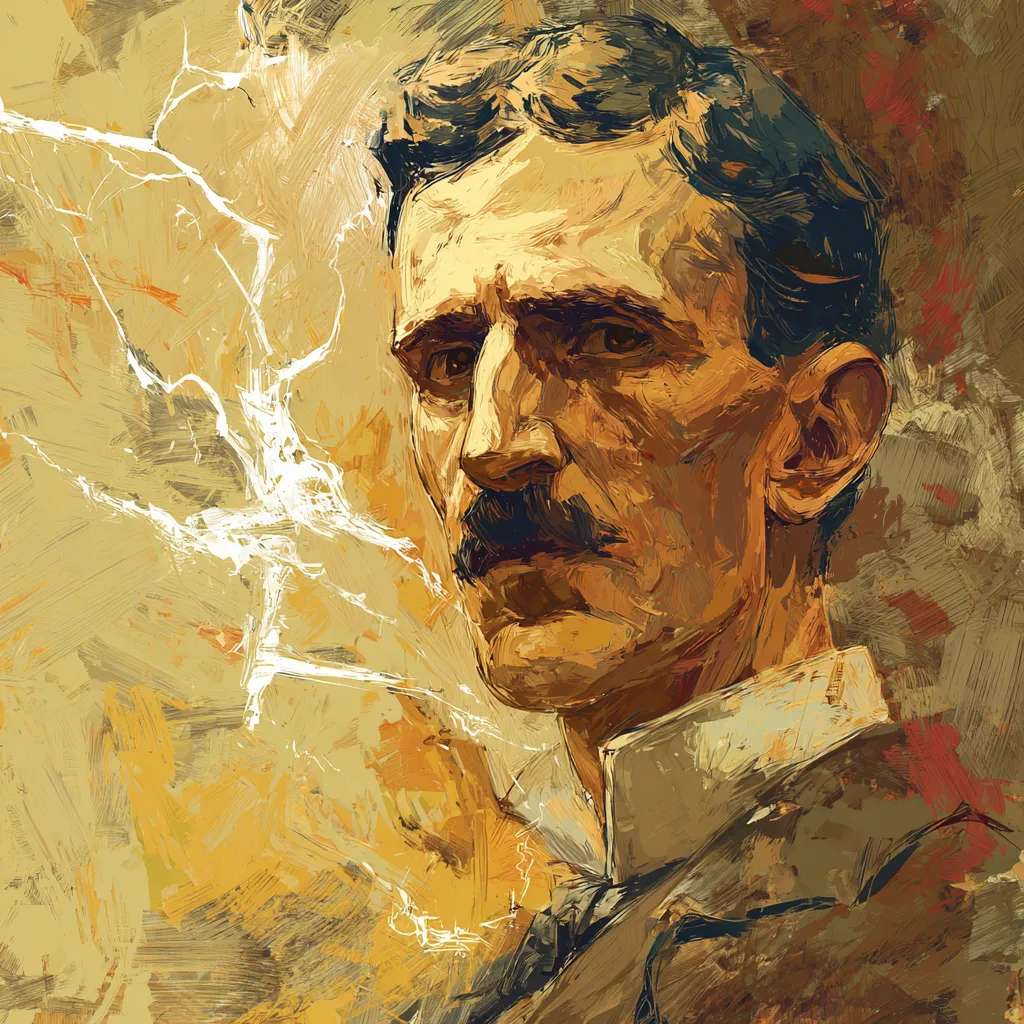
Continue Nikola Tesla's story
You've read the summary — hear the full story as narrated 5-minute chapters on Chunks, alongside 200+ figures and events from history, philosophy and science. Free to start on iOS and Android.