
Nikola Tesla was born during a thunderstorm in 1856, in the small village of Smiljan, Croatia, then part of the Austro-Hungarian Empire. According to family legend, lightning struck as he entered the world—a fitting omen for the boy who would dedicate his life to harnessing electric power. Even as a child, Tesla's extraordinary memory and vivid imagination set him apart. He could visualize complex machines in his mind long before drawing them, and he was fascinated by flashes of light and the mysteries of the storm. His schooling in engineering and physics, first at Graz and later Prague, was brief—he never completed a degree, but his hunger for knowledge was insatiable. Tesla was tormented by perfectionism and obsessive tendencies, often haunted by compulsive rituals that ruled his daily life. He would later say that these traits made him a better inventor, as he sought precision in everything he did. In his early years, Tesla tinkered endlessly, designing mechanical inventions and experimenting with alternating current machines, planting the seeds of genius that would one day light up cities. After brief work stints in Budapest and Paris, the young inventor boarded a ship for New York in 1884, clutching a few belongings and a letter of recommendation to Thomas Edison—the wizard of American electricity.
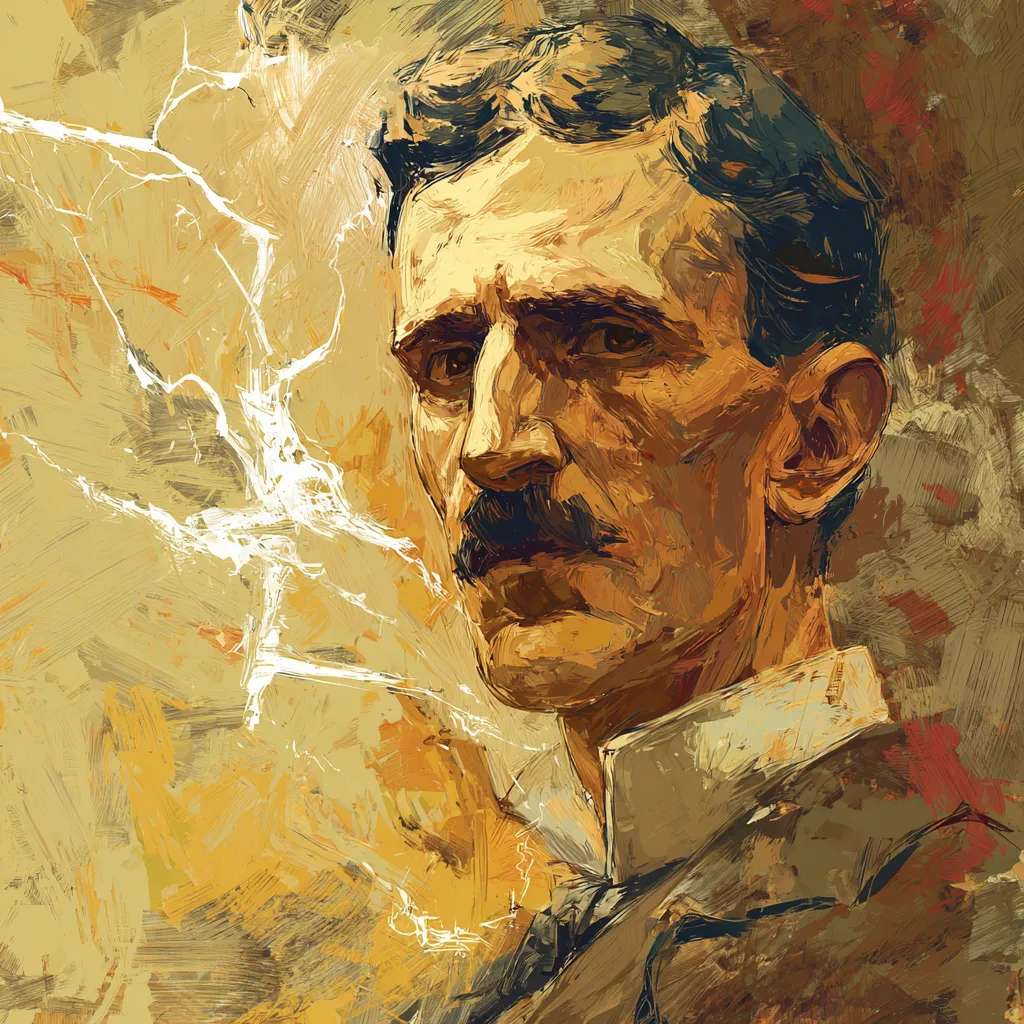
Nikola Tesla and the War of Currents
The electrifying life of Nikola Tesla, from childhood dreams to shaping the world's future.
The Boy Who Dreamed in Lightning
Frequently Asked Questions
What was the War of Currents between Tesla and Edison?
The War of Currents was a fierce competition in the 1880s and 1890s between Thomas Edison's direct current (DC) electrical system and Nikola Tesla's alternating current (AC) system. Edison promoted DC power, which could only travel short distances, while Tesla's AC system could transmit electricity over long distances more efficiently. Tesla eventually won this battle when his AC technology was adopted as the standard for electrical power distribution.
How did the 1893 Chicago World's Fair demonstrate Tesla's electrical innovations?
At the 1893 Chicago World's Fair, Tesla and Westinghouse showcased the superiority of AC electricity by illuminating the entire exposition with 200,000 incandescent bulbs. This spectacular display of electric lighting amazed millions of visitors and proved that AC power was safer and more practical than Edison's DC system. The fair marked a turning point in public acceptance of Tesla's electrical technology.
Why did Tesla partner with George Westinghouse instead of working with Edison?
Tesla initially worked for Edison but left due to conflicts over payment and competing visions for electrical systems. Westinghouse recognized the value of Tesla's AC motor patents and purchased them for a substantial sum, providing Tesla with the resources and support to develop his ideas. This partnership allowed Tesla to compete directly with Edison's DC system and ultimately revolutionize electrical power distribution.
Learn more
To continue the story, download the Chunks Microlearning app
 Download on iOS
 Download on Android