
Who was Nikita Khrushchev?
Hear Nikita Khrushchev's story
Chapter 1 of The Cuban Missile Crisis · the full story is in the app
Nikita Khrushchev (15 April 1894 - 11 September 1971) was a Soviet politician who led the Communist Party as First Secretary from 1953 to 1964 and served as Chairman of the Council of Ministers from 1958. Born in Kalinovka, he denounced Stalin's purges in his 1956 Secret Speech, pursued de-Stalinization, and presided over the 1962 Cuban Missile Crisis, placing then withdrawing nuclear missiles from Cuba. Ousted in 1964, he died in Moscow.
Soviet leader who placed nuclear missiles in Cuba and then withdrew them in 1962.
Don't stop at the facts — continue Nikita Khrushchev's story in free narrated chapters on Chunks.
See how Chunks works → Download on iOS
 Download on Android
Quick facts
- Born
- 3 April 1894
- Birthplace
- Kalinovka
- Died
- 11 September 1971
- Place of death
- Moscow
- Nationality
- Russian Empire, Russian Socialist Federative Soviet Republic
- Occupation
- Politician, military personnel, revolutionary
Nikita Khrushchev: key facts
- Nikita Khrushchev was born on 15 April 1894 (3 April Old Style) in the village of Kalinovka, near present-day Kursk Oblast in Russia.
- He served as First Secretary of the Communist Party of the Soviet Union from 1953 to 1964 and as Chairman of the Council of Ministers from 1958 to 1964.
- On 25 February 1956, at the 20th Party Congress, he delivered the 'Secret Speech' denouncing Joseph Stalin's purges, launching a period of de-Stalinization.
- During World War II he served as a political commissar and was present at the Battle of Stalingrad, an experience he took great pride in.
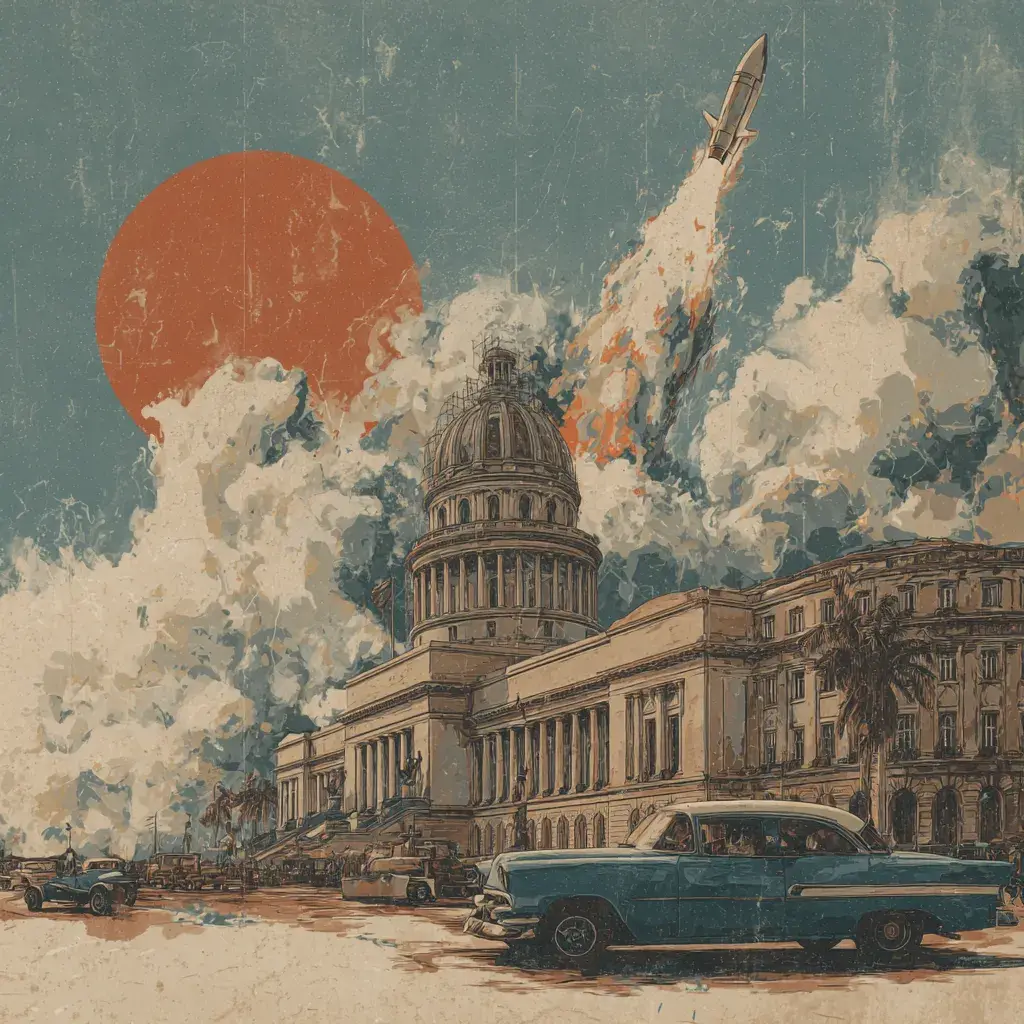
- He presided over the 1962 Cuban Missile Crisis, in which the Soviet Union placed nuclear missiles in Cuba and then agreed to withdraw them after a tense standoff with the United States.
- His domestic initiatives included the Virgin Lands farming campaign and a large-scale housing program that produced the prefabricated apartment blocks known as khrushchyovkas.
- He was removed from power on 14 October 1964 by his Communist Party colleagues and died on 11 September 1971 at his dacha near Moscow.
A Poor Village Childhood in Kalinovka
Nikita Khrushchev was born on 15 April 1894 in Kalinovka, a desperately poor Russian village near Kursk, close to the present Ukrainian border. His parents, Sergei and Kseniya Khrushchev, were peasants; his father later took work as a railwayman, miner, and brick-factory laborer in the Donbas region, where wages were higher, returning to the family only when he had saved enough money. Nikita worked as a herdsboy and received only about four years of schooling, partly under a village teacher named Lydia Shevchenko, who lent him books banned by the Imperial government and urged him toward further education the family could not afford.
In 1908, fourteen-year-old Nikita joined his father in the industrial city of Yuzovka (later Stalino, now Donetsk), where he trained as a metal fitter's apprentice and was eventually hired by a factory. He lost that job after collecting money for families of victims of the Lena Goldfields massacre, then found work mending equipment at a mine where his father organized the union, helping distribute and read aloud copies of the newspaper Pravda. In 1914 he married Yefrosinia Pisareva, with whom he had a daughter, Yulia, and a son, Leonid. Exempted from conscription in World War I as a skilled worker, he took part in strikes demanding higher pay and an end to the war.
War, Revolution, and a Rising Party Career
After the tsar's abdication in 1917, Khrushchev was elected chairman of the workers' council in Rutchenkovo but did not join the Bolsheviks until 1918, once the Russian Civil War was underway. He served as a political commissar, indoctrinating recruits and boosting morale, coming under fire repeatedly. His wife Yefrosinia died of typhus during the war while he was away; at her funeral he had her coffin passed over the churchyard fence rather than allow a religious procession through the church, scandalizing the village.
Through a friend's intervention, Khrushchev returned to mine administration work in the Donbas in 1921, while also enrolling in a worker's training program to compensate for his limited schooling. There he met Nina Petrovna Kukharchuk, who helped with his studies and became his lifelong partner, though the two never formally registered their marriage; they had three children, Rada, Sergei, and Elena. Khrushchev caught the attention of Lazar Kaganovich, who became his patron after taking charge of the Ukrainian Communist Party in 1925, and Khrushchev rose rapidly, moving to Kharkov and then Kiev before following Kaganovich to Moscow in 1929.
Stalin's Moscow and the Machinery of Purges
In Moscow, Khrushchev climbed through district party leadership positions before becoming head of the Moscow party organization by 1934. He oversaw construction of the Moscow Metro, pushing an accelerated and dangerous schedule to meet a politically announced opening date, and received the Order of Lenin for the project. As Stalin's Great Purge intensified from 1934 onward, Khrushchev publicly demanded execution for those accused in the Moscow show trials and approved mass arrests in Moscow province, where nearly all senior local party officials were killed. He survived his own brush with suspicion over a youthful flirtation with Trotskyism by confessing it to Stalin, who let the matter pass.
In 1938 Stalin sent Khrushchev to lead the Communist Party in Ukraine, where the purges had already devastated the local leadership so badly that the Central Committee could barely assemble a quorum. Arrests accelerated after his arrival, with nearly every government official and army commander in the republic replaced, though Khrushchev later cautioned against harming loyal Bolsheviks. He became a full Politburo member in 1939 and, after the Soviet invasion of eastern Poland that year, oversaw rigged assemblies that voted for union with the USSR, formally absorbing western Ukraine into the Ukrainian SSR.
War Years, Personal Loss, and a Struggling Ukraine
When Germany invaded in 1941, Khrushchev served as a political commissar linking frontline commanders with Moscow, present at the disastrous defense of Kiev and the failed 1942 Kharkov offensive before being sent to Stalingrad, where he remained through much of the battle and was nearly killed. He took lasting pride in his role there, though his actual influence on the fighting is hard to verify. In March 1943 his son Leonid, a fighter pilot, was reported killed in action, though the exact circumstances were never fully confirmed; Khrushchev and his wife raised Leonid's daughter Yulia themselves.
Returning to a shattered Ukraine in 1943, Khrushchev confronted ruined industry, agricultural collapse, and a population decimated by war, conscription, and partisan resistance from groups seeking Ukrainian independence. A severe drought in 1946 combined with harsh grain quotas produced famine in rural areas; Khrushchev's repeated appeals to Stalin for aid eventually brought limited relief, but the episode damaged his standing, and in 1947 Stalin sent Kaganovich to effectively take over his position, though Khrushchev was reinstated within the year. He was recalled to Moscow in December 1949 to again lead the city's party organization, later launching a mass housing program of prefabricated apartment blocks that came to be known, often mockingly, as khrushchyovki.
Taking Power, Denouncing Stalin, and the Cuban Gamble
Stalin's death on 5 March 1953 set off a leadership struggle. Khrushchev allied with Georgy Malenkov to sideline security chief Lavrentiy Beria, who was arrested in June 1953 and executed later that year, then maneuvered to outlast Malenkov and other rivals, becoming the dominant Soviet leader by 1955. At the 20th Party Congress on 25 February 1956 he delivered the Secret Speech, detailing Stalin's crimes and repression of loyal party members, a disclosure that spread far beyond its intended closed session and unsettled communist governments across Eastern Europe, contributing to unrest in Poland and the Hungarian uprising, which Soviet troops crushed later that year. In 1957 Khrushchev defeated an attempt by Molotov, Malenkov, and Kaganovich, later branded the Anti-Party Group, to remove him, and by 1958 he had added the premiership to his role as party leader.
As leader, Khrushchev pursued agricultural schemes such as the Virgin Lands Campaign and a push to grow corn nationwide, alongside disastrous reorganizations of farm machinery stations that strained collective farms; food shortages triggered a deadly 1962 crackdown on strikers in Novocherkassk. Abroad, he sparred with the United States over Berlin, authorized the building of the Berlin Wall in 1961, and endured the collapse of a 1960 Paris summit after the Soviets shot down an American U-2 spy plane. In October 1962 he placed Soviet nuclear missiles in Cuba, provoking the Cuban Missile Crisis; after a tense standoff with President Kennedy, he agreed to withdraw them in exchange for a pledge that the United States would not invade Cuba and a secret promise to remove American missiles from Turkey, an outcome widely seen as a setback for Soviet prestige.
Weakened by his agricultural failures and the perceived humiliation over Cuba, Khrushchev was ousted on 14 October 1964 in a bloodless move orchestrated by Leonid Brezhnev and other colleagues while he was on vacation; he was pressured into requesting retirement for reasons of age and health. He spent his remaining years out of public life in Moscow, composing memoirs that were smuggled abroad and published in the West in 1970 as Khrushchev Remembers, despite KGB attempts to seize his recordings. He died of a heart attack on 11 September 1971 and, denied a state funeral, was buried in Novodevichy Cemetery in Moscow rather than the Kremlin Wall.
Nikita Khrushchev: timeline
- 1894Born in the village of Kalinovka in the Kursk region of the Russian Empire to a poor peasant family.
- 1918Joined the Bolshevik Party and was soon mobilized into the Red Army as a political commissar during the Russian Civil War.
- 1938Sent by Stalin to lead the Communist Party in Ukraine, where he oversaw a continuation of the Great Purge.
- 1941-43Served as a political commissar liaising between Stalin and front-line commanders during World War II, including at the Battle of Stalingrad.
- 1953Emerged from the power struggle following Stalin's death to become First Secretary of the Communist Party, later outmaneuvering rival Lavrentiy Beria.
- 1956Delivered the Secret Speech at the 20th Party Congress, denouncing Stalin's purges and launching a period of de-Stalinization.
- 1957Defeated an attempt by Molotov, Malenkov and Kaganovich, later branded the Anti-Party Group, to remove him from power.
- 1958Became Chairman of the Council of Ministers, combining the premiership with his role as party leader.
- 1959Made a widely publicized visit to the United States, touring cities and farms and meeting President Eisenhower.
- 1962Ordered nuclear missiles installed in Cuba, triggering the Cuban Missile Crisis, then agreed to withdraw them after a tense standoff with the United States.
- 1964Was forced into retirement by Leonid Brezhnev and other colleagues who had organized his ouster.
- 1971Died of a heart attack in Moscow and was buried at Novodevichy Cemetery without a state funeral.
Listen: stories featuring Nikita Khrushchev
Narrated chapters from the Chunks Microlearning app. Read a preview here, or listen to the full story in the app.
Continue Nikita Khrushchev's story
You've read the summary — hear the full story as narrated 5-minute chapters on Chunks, alongside 200+ figures and events from history, philosophy and science. Free to start on iOS and Android.