
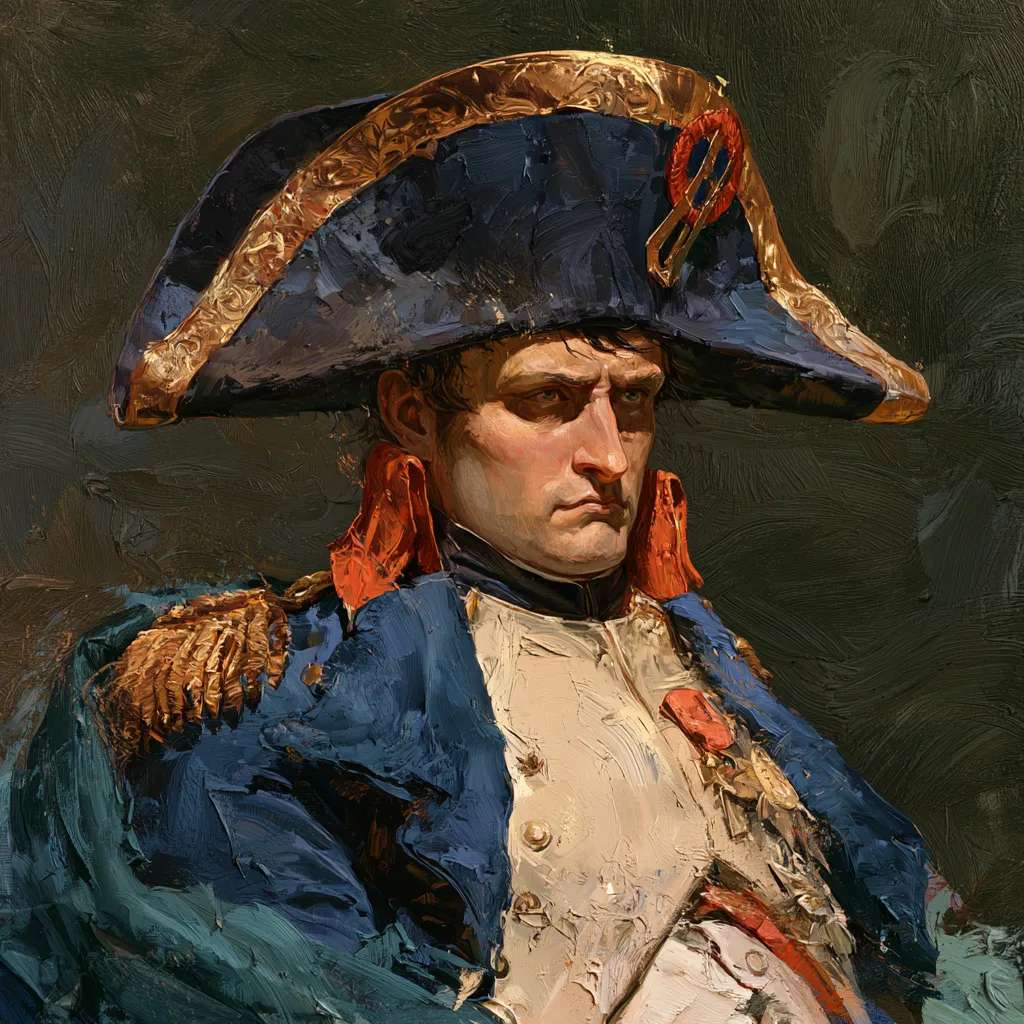
Who was Napoleon Bonaparte?
Napoleon Bonaparte (15 August 1769 - 5 May 1821) was a French military commander and statesman who rose to power during the French Revolution and became Emperor of the French in 1804. He led French armies through decisive victories including Austerlitz, reshaping European politics, before his defeat at Waterloo in 1815. Exiled to Saint Helena, he died at Longwood House. His lasting legacy includes the Napoleonic Code and sweeping legal reforms across Europe.
French military and political leader who rose to prominence during the French Revolution. He later became Emperor of France and reshaped European politics through his conquests.
Don't stop at the facts — continue Napoleon Bonaparte's story in free narrated chapters on Chunks.
Or get it straight away:
 Download on iOS
 Download on Android
Quick facts
- Born
- 15 August 1769
- Birthplace
- Ajaccio
- Died
- 5 May 1821
- Place of death
- Longwood House
- Nationality
- France
- Occupation
- Politician, art collector, emperor
Napoleon Bonaparte: key facts
- Napoleon Bonaparte was born on 15 August 1769 in Ajaccio, Corsica, to a family of Italian origin.
- He graduated from the École militaire in Paris in 1785, becoming the first Corsican to do so, and was commissioned a second lieutenant in the artillery.
- Napoleon crowned himself Emperor of the French at Notre Dame de Paris on 2 December 1804 after the Senate proclaimed him emperor in May of that year.
- His decisive victory at the Battle of Austerlitz on 2 December 1805 led to the dissolution of the Holy Roman Empire.
- In 1803 Napoleon sold the Louisiana territory to the United States for 15 million dollars.
- After his defeat at the Battle of Waterloo in June 1815, he was exiled to the remote island of Saint Helena in the South Atlantic.
- Napoleon died on 5 May 1821 at Longwood House on Saint Helena, aged 51, from what a 2021 study concluded was stomach cancer.
A Corsican Family in the Service of France
Napoleon was born on 15 August 1769 in Ajaccio, Corsica, one year after the island had been ceded to France by the Republic of Genoa. His family, the Buonapartes, were of Italian origin, descended from a minor Tuscan noble line that had settled on Corsica in the sixteenth century. His father, Carlo Maria Buonaparte, had initially backed Corsican independence but switched allegiance to France after the movement's defeat, becoming a client of the French governor and securing a royal scholarship for his son to attend military school on the mainland. Napoleon's mother, Maria Letizia Ramolino, ran the household with strict discipline, and Napoleon later credited her with shaping his character.
In 1779, at age nine, Napoleon left Corsica for France to improve his French, since his native languages were Corsican and Italian. He never fully lost his accent and remained a weak speller of French throughout his life. At military school in Brienne-le-Château he was mocked by classmates for his origins and appearance, which pushed him toward solitude, heavy reading, and an outspoken Corsican nationalism modeled on the exiled independence leader Pasquale Paoli.
He continued his training at the École militaire in Paris, focusing on artillery, and excelled in mathematics, history, and geography while struggling with French and German. His father's death in 1785 forced him to compress a two-year course into one year. He graduated the same year, examined in part by the scientist Pierre-Simon Laplace, becoming the first Corsican to complete the school's program, and was commissioned as a second lieutenant in the French artillery.
Revolutionary Turmoil and the Road to Command
When the French Revolution broke out in 1789, Napoleon was serving in the French army but spent long stretches on leave in Corsica, where he became entangled in a three-way conflict between royalists, revolutionaries, and Corsican nationalists loyal to Paoli. He sided with pro-French Corsican Republicans, rose to captain, and eventually clashed openly with Paoli's forces. After Corsican volunteers seized control of the island in 1793 and condemned Napoleon and his family, the Buonapartes fled to the French mainland.
His breakthrough came at the siege of Toulon in late 1793, where, as artillery commander for republican forces trying to retake the port from allied occupiers, he engineered the capture of a hill fort that let republican guns dominate the harbor and force an evacuation. The victory brought him to the attention of influential Jacobins and earned him a promotion to brigadier general at just 24. His fortunes dipped after the fall of Maximilien Robespierre in 1794, when his Jacobin ties made him briefly suspect and led to a short arrest.
Napoleon's decisive moment came on 5 October 1795, when royalist rebels threatened the National Convention in Paris. Paul Barras placed him in charge of the convention's defense, and Napoleon used artillery, brought up by a young cavalry officer named Joachim Murat, to fire on the rebels with canister rounds, killing several hundred to over a thousand. The episode, later remembered as the whiff of grapeshot, secured the Directory's gratitude and led to his appointment as commander of the Army of Italy in 1796. Around this time he married Joséphine de Beauharnais and began styling himself Napoleon Bonaparte rather than the Italian Napoleone di Buonaparte.
Conquering Italy and Egypt
Taking command of the Army of Italy in 1796, Napoleon knocked Piedmont out of the war within two weeks and then turned on Austrian forces, winning a string of battles including Castiglione, Bassano, Arcole, and Rivoli. His advance into Habsburg territory pushed to within about 100 kilometers of Vienna, forcing Austria to accept peace terms that gave France control of northern Italy and the Low Countries. He also ended over a thousand years of Venetian independence and authorized the looting of art and treasure, extracting tens of millions of French pounds and hundreds of artworks from Italy during the campaign.
In 1798 Napoleon led an expedition to Egypt, aiming to damage British trade routes to India, bringing along more than a hundred and sixty scientists whose discoveries included the Rosetta Stone. He defeated Egypt's Mamluk rulers at the Battle of the Pyramids, but the French fleet was destroyed by Admiral Horatio Nelson at the Battle of the Nile, cutting off his army from France. A subsequent campaign into Ottoman Syria included the brutal capture of Jaffa, where Napoleon ordered thousands of prisoners executed, and ended in failure at Acre, with heavy losses from combat and disease during the retreat to Egypt.
Learning that France faced military setbacks in Europe, Napoleon abandoned his army in Egypt in August 1799 and sailed home without official orders. Despite this desertion, he returned to a hero's welcome, as the Directory government was bankrupt and deeply unpopular. In November 1799 he and several allies staged the Coup of 18 Brumaire, dissolving the Directory and installing Napoleon as First Consul, effectively placing him at the head of the French state.
Emperor of the French and Domination of Europe
As First Consul, Napoleon centralized administration, introduced heavy censorship, and secured a landmark peace with Austria after victories at Marengo in 1800 and Hohenlinden. He also signed the Concordat of 1801 with the Pope, restoring Catholicism's standing in France while keeping the church under state control. In 1802 a plebiscite made him consul for life, and in December 1804 he crowned himself Emperor of the French at Notre Dame, with Pope Pius VII present, symbolically placing the crown on his own head rather than accepting it from the pontiff.
Renewed war with Britain and other powers led to some of Napoleon's greatest triumphs, notably the 1805 Battle of Austerlitz, where he lured Russian and Austrian forces off high ground and encircled them, a victory he considered his finest. The defeat led to the dissolution of the Holy Roman Empire. He went on to crush Prussia at Jena-Auerstedt in 1806 and defeat Russia at Friedland in 1807, after which he met Tsar Alexander I at Tilsit and imposed harsh terms on Prussia while creating new satellite states carved from its territory.
Napoleon's attempt to enforce a trade blockade against Britain drew him into Spain, where he installed his brother Joseph as king in 1808, triggering the prolonged and costly Peninsular War against Spanish, Portuguese, and British forces. Austria's renewed challenge in 1809 ended in French victory at Wagram, after which Napoleon divorced Joséphine, who had not produced an heir, and married the Austrian princess Marie Louise, who bore him a son in 1811. By this point he controlled roughly forty percent of Europe's population directly or through satellite kingdoms.
Collapse in Russia and Final Defeat
In 1812 Napoleon invaded Russia with a multinational army of around 450,000 men, hoping to force a decisive battle. The Russians retreated and burned resources as they went, and after a bloody but inconclusive fight at Borodino, Napoleon occupied Moscow, only to find it set ablaze. With no peace offer coming and winter closing in, he ordered a retreat that turned catastrophic, as cold, starvation, disease, and Russian attacks destroyed most of his army; only a fraction of the invading force made it back across the border.
Prussia, Austria, Russia, Sweden, and eventually Britain formed a coalition against the weakened French empire. Despite early victories in 1813, Napoleon suffered a crushing defeat at the Battle of Leipzig in October, the largest battle of the Napoleonic Wars. Coalition forces invaded France in 1814 and captured Paris, and Napoleon abdicated in April, was exiled to the Mediterranean island of Elba, and saw the Bourbon monarchy restored under Louis XVIII.
Napoleon escaped Elba in February 1815 with about a thousand men, marched on Paris, and returned to power in what became known as the Hundred Days. He raised a new army and invaded Belgium, but was decisively beaten by Wellington and Blücher at the Battle of Waterloo on 18 June 1815. He abdicated a second time and surrendered to the British, who exiled him to the remote South Atlantic island of Saint Helena, keeping him under guard at Longwood House for the rest of his life.
Legal Reforms, Exile, and Death
Beyond his battles, Napoleon reshaped French institutions in ways that outlasted his rule. His Napoleonic Code, issued in 1804, unified French law around principles of equality before the law, secure property rights, and religious toleration, though it curtailed the legal rights of women and children. He founded the Legion of Honour, established the Banque de France, reorganized secondary and higher education through lycées and the Imperial University, and abolished many remnants of feudalism across the territories he controlled, while also reinstating slavery in French colonies and restricting the rights of Black people and mixed-race people in France.
On Saint Helena, Napoleon lived under close British guard at the damp and unhealthy Longwood House, insisting on maintaining the formal trappings of imperial life even in captivity. He spent his final years dictating memoirs, complaining about his treatment, and watching his health decline. In 1821 he was confined to bed, and on 5 May he died at age 51. Later medical analysis, including a 2021 study, concluded that stomach cancer was the cause, the same disease that had killed his father, rather than the arsenic poisoning some had once suspected.
Napoleon's remains stayed on Saint Helena until 1840, when the British allowed France to bring them home for a state funeral in Paris attended by hundreds of thousands, after which he was eventually entombed at Les Invalides. His legacy remains deeply contested: admired as a brilliant military commander and reformer whose legal code and administrative innovations spread across Europe and the Americas, yet condemned for the vast human cost of his wars, his authoritarian suppression of dissent, and his reversal of civil rights for women, colonial subjects, and enslaved people.
Napoleon Bonaparte: timeline
- 1769Born in Ajaccio, Corsica, to Carlo Buonaparte and Maria Letizia Ramolino.
- 1785Graduated from the École militaire in Paris and was commissioned as a second lieutenant in the artillery.
- 1793Led the artillery assault that recaptured the port of Toulon from allied forces, earning promotion to brigadier general.
- 1795Used cannon fire to crush a royalist uprising against the National Convention in Paris, gaining the patronage of the Directory.
- 1796Married Joséphine de Beauharnais in a civil ceremony shortly before taking command of the Army of Italy.
- 1798-99Led a military expedition to Egypt and Syria, winning land battles but losing his fleet to the British at the Battle of the Nile.
- 1799Seized power in the Coup of 18 Brumaire, overthrowing the Directory and becoming First Consul.
- 1804Crowned himself Emperor of the French at Notre Dame de Paris.
- 1805Destroyed the Third Coalition's armies at the Battle of Austerlitz.
- 1810Married Archduchess Marie Louise of Austria after annulling his marriage to Joséphine.
- 1812Invaded Russia with a massive multinational army, occupied Moscow, then suffered catastrophic losses during the winter retreat.
- 1814Abdicated after coalition forces captured Paris and was exiled to the island of Elba.
- 1815Escaped Elba, briefly retook power during the Hundred Days, and was decisively defeated at the Battle of Waterloo.
- 1821Died in exile at Longwood House on Saint Helena, likely of stomach cancer.
Listen: stories featuring Napoleon Bonaparte
Narrated chapters from the Chunks Microlearning app. Read a preview here, or listen to the full story in the app.
Frequently asked questions about Napoleon Bonaparte
What role did Napoleon play in the French Revolution's aftermath?
Napoleon Bonaparte rose to power in the chaos following the French Revolution, eventually seizing control of the French government. He later crowned himself Emperor of France in 1804.
How did Napoleon change Europe?
Napoleon's military campaigns reshaped the political map of Europe through conquest and the spread of legal reforms. His Napoleonic Code influenced legal systems across many nations.
How did Napoleon's rule end?
Napoleon was defeated at the Battle of Waterloo in 1815 after returning from exile. He was then exiled again to the remote island of Saint Helena, where he died in 1821.
Continue Napoleon Bonaparte's story
You've read the summary — hear the full story as narrated 5-minute chapters on Chunks, alongside 200+ figures and events from history, philosophy and science. Free to start on iOS and Android.