

Who was Marie Curie?
Marie Curie (7 November 1867 – 4 July 1934) was a Polish-French physicist and chemist who discovered the elements polonium and radium and coined the term radioactivity. She was the first woman to win a Nobel Prize, receiving the Physics Prize in 1903 and the Chemistry Prize in 1911, making her the only person ever to win Nobel Prizes in two different sciences.
Polish-French physicist and chemist who discovered radium and polonium, becoming the first woman to win a Nobel Prize and the only person to win Nobel Prizes in two different sciences. Her groundbreaking research on radioactivity laid the foundation for modern atomic physics.
Don't stop at the facts — continue Marie Curie's story in free narrated chapters on Chunks.
 Download on iOS
 Download on Android
Quick facts
- Born
- 7 November 1867
- Birthplace
- Warsaw
- Died
- 4 July 1934
- Place of death
- Sancellemoz
- Nationality
- Second Polish Republic, France
- Occupation
- Physicist, chemist, university teacher
Marie Curie: key facts
- Marie Curie was born Maria Salomea Skłodowska on 7 November 1867 in Warsaw, then part of the Russian Empire, and later became a naturalised French citizen while never abandoning her Polish identity.
- Curie won the 1903 Nobel Prize in Physics alongside her husband Pierre Curie and Henri Becquerel for research into radioactivity, a term she herself coined.
- She won the 1911 Nobel Prize in Chemistry for the discovery of polonium and radium and the isolation of radium, making her the first person ever to win Nobel Prizes in two different scientific fields.
- Curie named the first element she and Pierre discovered polonium after her native country Poland, which at the time remained partitioned among Russia, Austria, and Prussia.
- In 1906, following Pierre Curie's death in a Paris street accident, Marie became the first woman to hold a professorship at the University of Paris.
- During World War I, Curie developed mobile radiography units known as petites Curies and directed the installation of 20 such vehicles to bring X-ray services to battlefield surgeons, with an estimated one million wounded soldiers treated.
- Curie died on 4 July 1934 at the Sancellemoz sanatorium in Passy, Haute-Savoie, from aplastic anaemia caused by decades of exposure to radiation during her scientific work and wartime radiological service.
A Polish Childhood Under Russian Rule
Maria Salomea Skłodowska was born on 7 November 1867 in Warsaw, then part of the Russian Empire, the youngest of five children in a family of teachers. Her father Władysław taught mathematics and physics and, after Russian authorities stripped laboratory instruction from Polish schools, brought the equipment home and taught his children to use it. That detail matters: her scientific formation began at the kitchen level, under occupation, before she ever set foot in a university.
The family paid a heavy price for Polish patriotism. Property and money had been lost through involvement in national uprisings, and the household struggled financially throughout Maria's childhood. Her mother died of tuberculosis when Maria was ten; an older sister had already died of typhus. These losses pushed Maria away from the Catholicism of her upbringing toward agnosticism. She attended a clandestine institution called the Flying University, which admitted women students at a time when regular universities in Russian-controlled Poland did not. To fund her elder sister Bronisława's medical studies in Paris, Maria worked for years as a governess in the countryside, expecting equivalent support in return — an arrangement the two sisters honored.
From a Garret in Paris to the Discovery of Two Elements
Maria arrived in Paris in late 1891, enrolled at the University of Paris, and lived on almost nothing, sometimes forgetting to eat while absorbed in her studies. By 1893 she had a degree in physics, and she earned a second degree in 1894. That same year she met Pierre Curie, an instructor at the city's industrial physics and chemistry school. They were introduced because she needed laboratory space; their shared obsession with science drew them into a partnership that became a marriage on 26 July 1895.
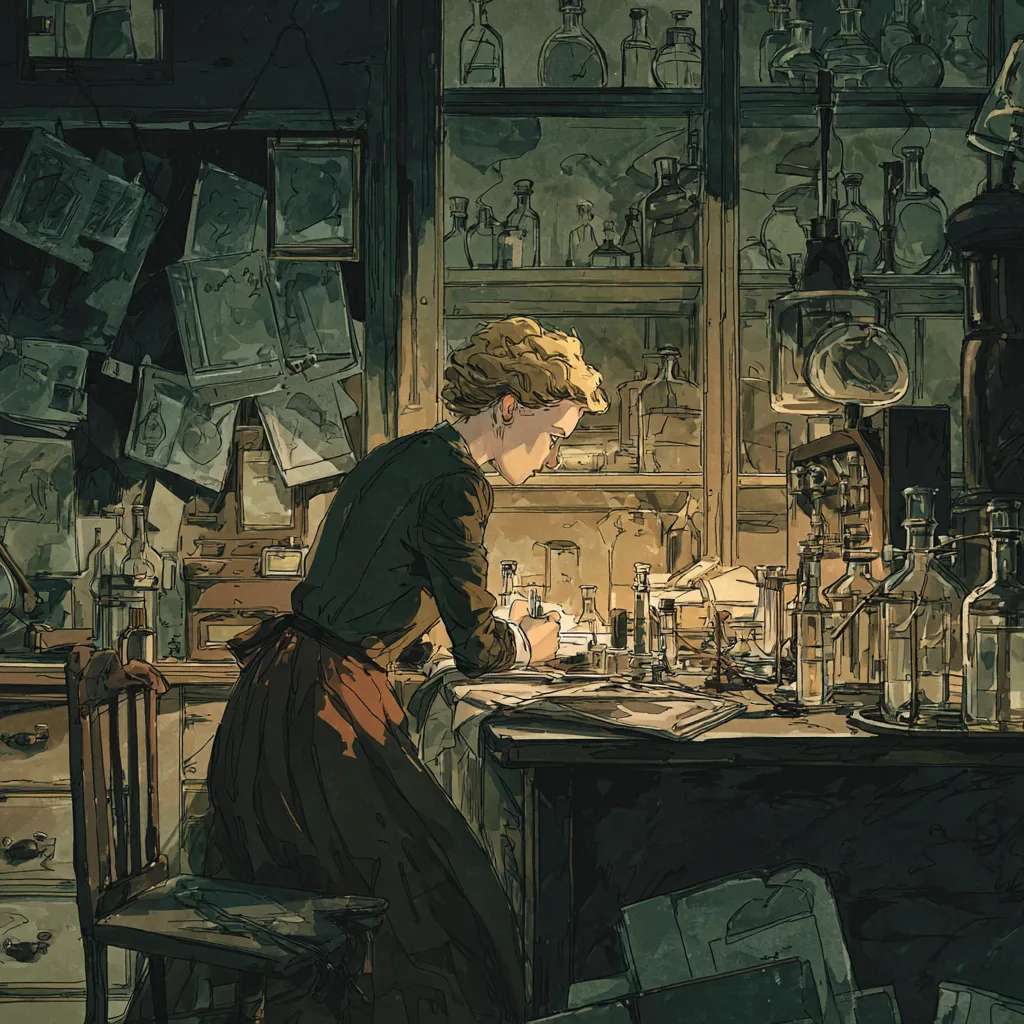
Working in a converted shed next to Pierre's institution — a former dissecting room that was neither properly ventilated nor waterproof — the Curies investigated uranium minerals. Marie had observed that pitchblende was four times more radioactive than uranium alone and concluded it must contain an unknown, highly active element. The reasoning was hers; Pierre eventually abandoned his own crystal research to join the effort. In July 1898 they jointly announced polonium, named for her occupied homeland. In December 1898 they announced radium. The word 'radioactivity' was also coined in the course of this work.
Isolating these elements in verifiable quantities required processing enormous amounts of ore. From one tonne of pitchblende, a tenth of a gram of radium chloride was finally separated in 1902. Pure radium metal was isolated in 1910. Polonium, with a half-life of only 138 days, was never successfully isolated. The Curies did not patent the isolation process, deliberately leaving it open for other researchers to use without restriction.
Two Nobel Prizes and the Obstacles Between Them
In December 1903 the Royal Swedish Academy of Sciences awarded the Nobel Prize in Physics jointly to Marie Curie, Pierre Curie, and Henri Becquerel. Marie Curie was the first woman to win a Nobel Prize. Critically, the committee had initially planned to honor only Pierre and Becquerel; a Swedish mathematician on the committee, Magnus Gösta Mittag-Leffler, alerted Pierre to the omission, and after Pierre objected, Marie's name was added. The prize money allowed the couple to hire their first laboratory assistant.
Pierre died on 19 April 1906, struck by a horse-drawn vehicle on the Rue Dauphine in Paris, his skull fractured instantly. The University of Paris offered his chair to Marie, and she accepted it, becoming the first woman to hold a professorship there. She continued research and in 1910 succeeded in defining an international standard for radioactive emissions, eventually named the curie after her and Pierre. In 1911 the French Academy of Sciences refused her membership by one or two votes. That same year a press scandal erupted over her relationship with physicist Paul Langevin; the tabloid coverage was openly xenophobic and antisemitic, misrepresenting her as a foreign home-wrecker despite her decades of contribution to French science.
The Royal Swedish Academy, overriding the controversy, awarded Curie the 1911 Nobel Prize in Chemistry for the discovery of polonium and radium and the isolation and study of radium. She became the first person to win two Nobel Prizes, and remains one of only two individuals to receive prizes in two different scientific fields. When the Nobel committee chair attempted to discourage her attendance over her personal life, she replied that the prize had been awarded for her scientific discoveries and that her private life was a separate matter. She attended the ceremony.
Mobile X-Ray Units and the First World War
When war began in 1914, Curie recognized that rapid surgical intervention could save soldiers who would otherwise lose limbs or die, and that surgeons near the front had no access to radiological equipment. She taught herself the necessary anatomy, radiology, and automotive mechanics, then assembled mobile X-ray vehicles that became known informally as petites Curies, or Little Curies. She became director of the Red Cross Radiology Service and established France's first military radiology centre before the end of 1914.
In the first year alone she oversaw the installation of twenty mobile radiological vehicles and two hundred radiological units at field hospitals. Her seventeen-year-old daughter Irène assisted her in the early period, and Curie later trained other women as radiological aides. In 1915 she produced hollow needles filled with radon gas — drawn from her own gram of radium — for sterilising infected tissue. Estimates place the number of soldiers treated by her X-ray units at over one million. Despite all of this, the French government never formally recognized her wartime contribution.
Building Scientific Institutions and the Final Years
After the war Curie focused on building lasting infrastructure for science. She had founded the Curie Institute in Paris in 1920 and the Curie Institute in Warsaw in 1932, the latter with her sister Bronisława as director. The Paris institute, developed jointly with the Pasteur Institute and the University of Paris, eventually became one of the world's leading radioactivity research laboratories. Under Curie's direction it produced four further Nobel Prize winners, including her daughter Irène Joliot-Curie and Irène's husband Frédéric.
Curie made two fundraising tours of the United States, in 1921 and 1929, to secure radium and funding for research she could not obtain from French public sources. She sat on the League of Nations' International Committee on Intellectual Cooperation from 1922 until 1934, working alongside Albert Einstein and others on international scientific coordination. In 1930 she was elected to the International Atomic Weights Committee.
She visited Poland for the last time in early 1934. On 4 July 1934 she died at the Sancellemoz sanatorium in Passy, Haute-Savoie, France, of aplastic anaemia attributed to decades of radiation exposure. She had carried radioactive isotopes in her pockets, stored them in her desk, and operated unshielded X-ray equipment in field hospitals — all before the biological dangers of ionising radiation were understood. In 1995 her remains, along with Pierre's, were transferred to the Paris Panthéon, sealed in lead because of residual radioactivity. She was the first woman interred there on the basis of her own achievements.
Marie Curie: timeline
- 1867Born Maria Salomea Skłodowska in Warsaw, Congress Poland, the youngest of five children in a family of teachers.
- 1891Left Warsaw for Paris, enrolling at the University of Paris to study physics, chemistry, and mathematics.
- 1893Awarded a degree in physics from the University of Paris, then began work in an industrial laboratory while continuing her studies.
- 1895Married physicist Pierre Curie in Sceaux, beginning a partnership that would reshape modern science.
- 1898Jointly announced the discovery of two new elements, polonium and radium, and coined the term radioactivity to describe the phenomenon she was investigating.
- 1903Became the first woman to win a Nobel Prize, sharing the Physics prize with Pierre Curie and Henri Becquerel for research into radioactivity.
- 1906Appointed professor at the University of Paris after Pierre's death in a road accident, becoming the first woman to hold such a position there.
- 1911Won the Nobel Prize in Chemistry for the discovery of polonium and radium and the isolation of radium, becoming the only person to win Nobel Prizes in two different sciences.
- 1914–1918Developed mobile radiography units known as petites Curies and directed their deployment to field hospitals, helping treat over a million wounded soldiers.
- 1920Founded the Curie Institute in Paris, which became a major centre for medical and radioactivity research.
- 1934Died aged 66 at the Sancellemoz sanatorium in Passy, France, of aplastic anaemia caused by decades of radiation exposure.
Listen: stories featuring Marie Curie
Narrated chapters from the Chunks Microlearning app. Read a preview here, or listen to the full story in the app.
Continue Marie Curie's story
You've read the summary — hear the full story as narrated 5-minute chapters on Chunks, alongside 200+ figures and events from history, philosophy and science. Free to start on iOS and Android.