
Maria Skłodowska, born in 1867 in Warsaw under Russian rule, was raised in a family that cherished education despite constant hardship. Political oppression limited opportunities, especially for women like Maria. Schools for girls were basic, and universities were entirely closed off. But Maria hungered for knowledge, secretly attending the clandestine 'Flying University,' where students met in private homes to avoid police attention. Despite her brilliance, her path in Poland was blocked by both societal norms and imperial barriers. Driven by dreams of science, Maria made a fateful decision: at age 24, she left behind her war-torn homeland. Arriving in Paris in 1891, she adopted the French name 'Marie' and enrolled at the Sorbonne. Life in Paris was harsh; her tiny attic room was always cold, and she often fainted from hunger while studying. Yet she persevered, excelling in physics and mathematics, laying the foundation for her revolutionary future.
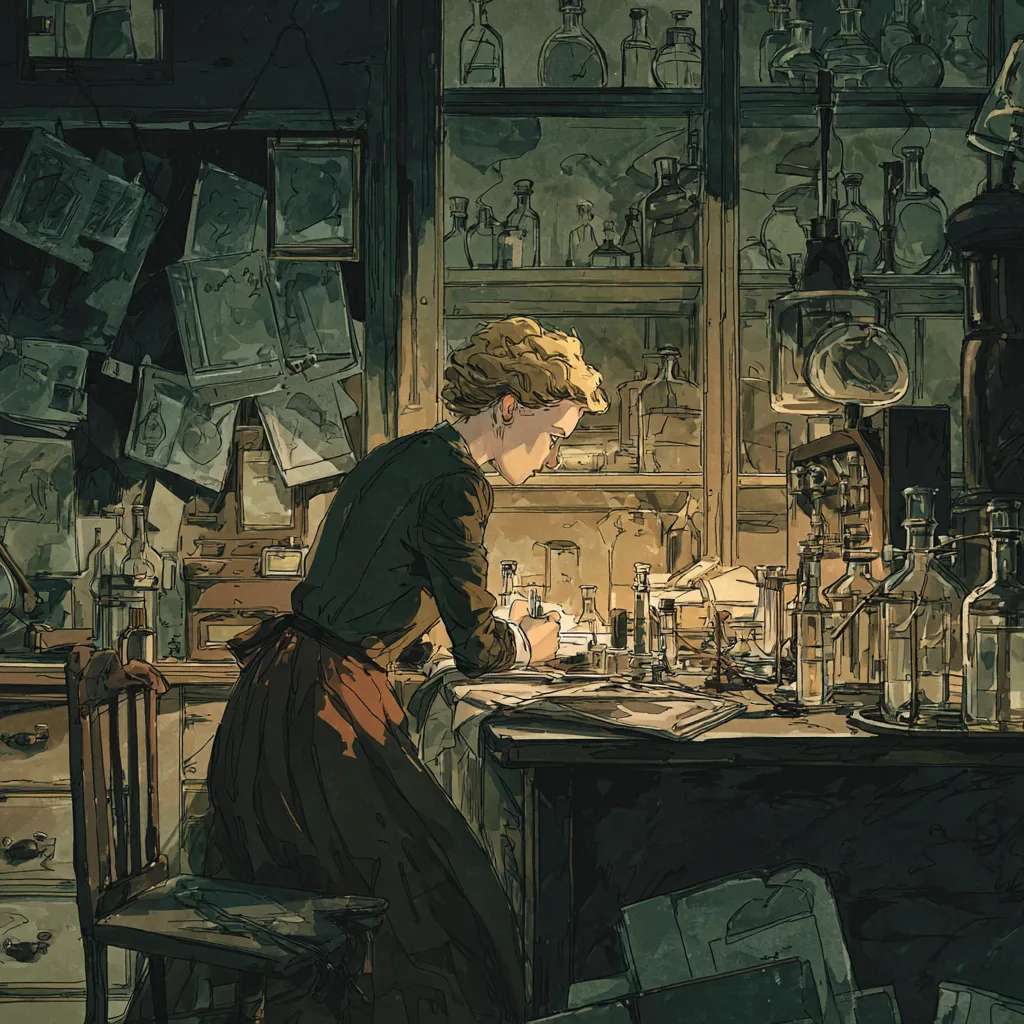
Marie Curie and the Discovery of Radioactivity
How Marie Curie changed science with her quest to understand radioactivity.
A Girl Called Maria
Frequently Asked Questions
What was Marie Curie's original name and where was she born?
Marie Curie was born Maria Sklodowska in Warsaw, Poland, in 1867. She later moved to Paris to study at the Sorbonne, where she eventually met her future husband Pierre Curie. The name change from Maria to Marie occurred when she adopted the French version of her name while living in France.
How many Nobel Prizes did Marie Curie win and in which fields?
Marie Curie won two Nobel Prizes in different scientific fields. She received the Nobel Prize in Physics in 1903, shared with her husband Pierre Curie and Henri Becquerel, for their work on radioactivity. In 1911, she won the Nobel Prize in Chemistry for discovering the elements radium and polonium.
What new elements did Marie Curie discover during her research on radioactivity?
Marie Curie discovered two new radioactive elements: polonium and radium. She named polonium after her native country Poland, and radium for its intense radioactive properties. These discoveries came from her painstaking work processing tons of pitchblende ore to isolate these previously unknown elements.
Learn more
To continue the story, download the Chunks Microlearning app
 Download on iOS
 Download on Android