
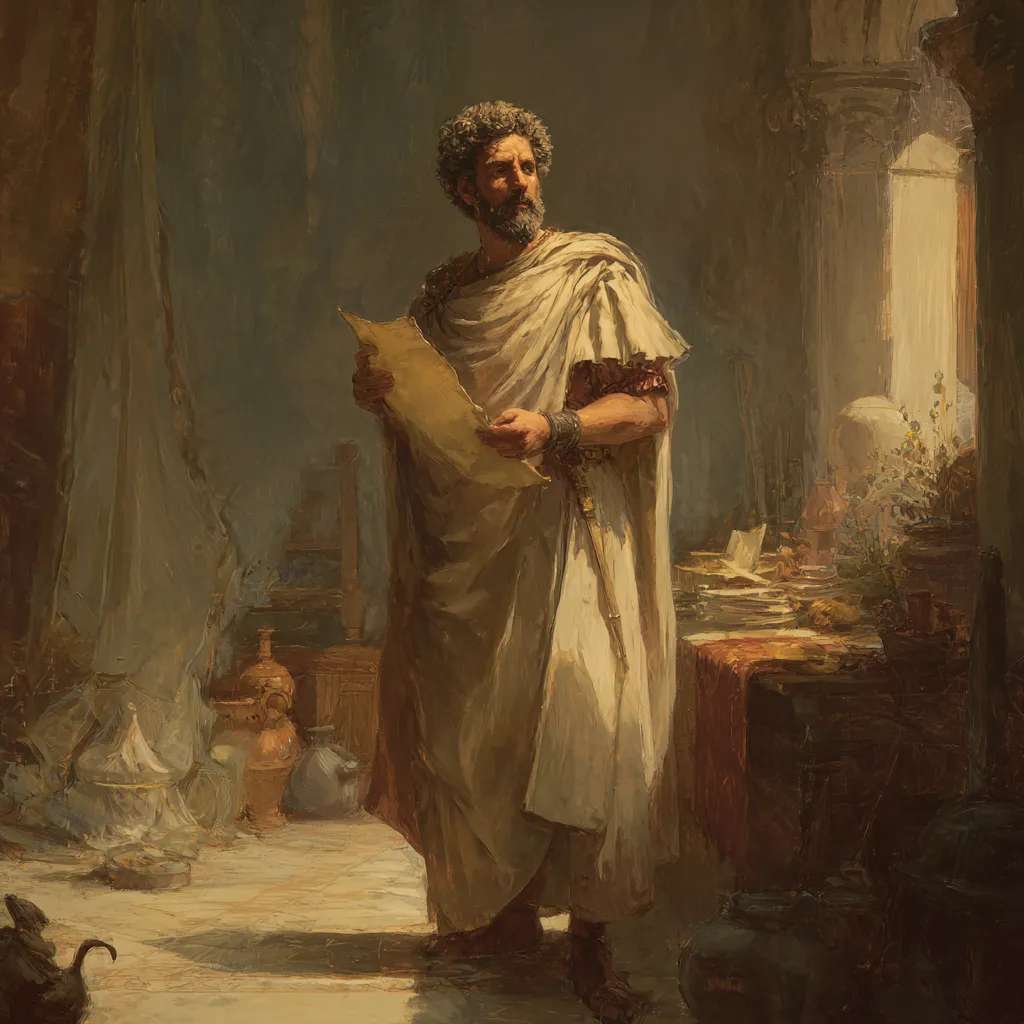
Who was Marcus Aurelius?
Marcus Aurelius (26 April 121 – 17 March 180) was a Roman emperor and Stoic philosopher who ruled from 161 to 180 CE. The last of the Five Good Emperors, he governed during the Antonine Plague and constant border conflicts, yet wrote his private philosophical journal Meditations in Greek, which remains a foundational text of Stoic thought.
Roman Emperor from 161-180 CE and one of the most famous Stoic philosophers, known for his personal writings in 'Meditations.' He exemplified the philosopher-king ideal while leading the Roman Empire through challenging times.
Don't stop at the facts — continue Marcus Aurelius's story in free narrated chapters on Chunks.
 Download on iOS
 Download on Android
Quick facts
- Born
- 26 April 121
- Birthplace
- Rome
- Died
- 17 March 180
- Place of death
- Vindobona
- Nationality
- Ancient Rome
- Occupation
- Politician, philosopher, writer
Marcus Aurelius: key facts
- Marcus Aurelius was born in Rome on 26 April 121 and died on 17 March 180, either at Vindobona in Pannonia Superior or near Sirmium in Pannonia Inferior.
- As the last of the Five Good Emperors, Marcus Aurelius was also the final emperor of the Pax Romana, the period of relative peace that had lasted from 27 BC to 180 AD.
- Marcus Aurelius wrote his Meditations in Greek as a private journal of self-guidance while on military campaign between 170 and 180; the work is now considered one of the most important sources for ancient Stoic philosophy.
- The Antonine Plague, which broke out in 165 or 166 and is believed to have been smallpox, killed an estimated five to ten million people during Marcus Aurelius's reign.
- Marcus Aurelius insisted that his adoptive brother Lucius Verus be granted equal imperial powers at his accession in 161, making it the first time Rome was ruled by two co-emperors.
- Marcus Aurelius defeated the Marcomanni, Quadi, and Iazyges in the Marcomannic Wars, and his victories were commemorated by a column with spiral carved reliefs that still stands in Rome.
- He served as Roman consul three times — in 140, 145, and 161 — and was already experienced in imperial administration before taking sole leadership of the empire.
From Aristocratic Boyhood to Heir of the Empire
Marcus Aurelius was born in Rome on 26 April 121 to Marcus Annius Verus, a praetor, and Domitia Lucilla, a wealthy Roman patrician whose inheritance included large brickworks on the outskirts of Rome and a villa on the Caelian Hill. His father died when he was around three years old, and he was raised primarily by his paternal grandfather, Marcus Annius Verus II, who had legal authority over the household. Marcus credited his grandfather with teaching him good character and the avoidance of bad temper.
His education followed the pattern of the aristocratic elite: tutors at home rather than public schools, with an emphasis on Greek and Latin. A painting master named Diognetus proved especially formative, introducing Marcus to the philosophic way of life. By April 132, at Diognetus's urging, Marcus had adopted the dress and habits of a philosopher, studying in a rough Greek cloak and sleeping on the ground until his mother persuaded him otherwise. The teacher who would most permanently shape his thinking, however, was Quintus Junius Rusticus, a Stoic whose influence eventually pulled Marcus away from the rhetorical training that dominated elite Roman education.
The decisive turn in Marcus's life came in 138. Hadrian's first chosen heir, Aelius Caesar, died in January of that year. Hadrian then selected Antoninus Pius as his successor, but on the condition that Antoninus in turn adopt both Marcus and Lucius, the son of Aelius. Hadrian died later that year, and Antoninus became emperor. Marcus, now formally the heir apparent, moved into the imperial palace despite his reluctance, took on the name Marcus Aelius Aurelius Verus Caesar, and began the long preparation for rule.
Training for Power Under Antoninus Pius
The years between Marcus's adoption and his accession were shaped by two parallel tracks: formal preparation for imperial duties and a deepening commitment to Stoic philosophy. He served as consul in 140, with Antoninus as his colleague, and again in 145. As quaestor he read imperial letters to the senate on the emperor's behalf and handled secretarial work, though he complained to his tutor Marcus Cornelius Fronto of being overwhelmed by correspondence. Fronto, considered second only to Cicero among Latin stylists of the age, maintained an intimate correspondence with Marcus across many years, and a significant portion of those letters survives.
In April 145, Marcus married Faustina, the daughter of Antoninus Pius, a match that had been planned since 138. Faustina would bear him at least fourteen children over the following decades, though many did not survive childhood. Twin sons born in 149 died within the year; a daughter, Domitia Faustina, born in 147, died in 151. Marcus wrote to Fronto about the anxious early days of one sick infant with notable directness, describing symptoms and expressing relief at small signs of recovery.
Antoninus ruled for over two decades, and as the emperor aged Marcus took on increasing administrative responsibilities. When the praetorian prefect Marcus Gavius Maximus died in 156 or 157, Marcus assumed that role, which was as much secretarial as military. By 160, Marcus and Lucius were jointly designated consuls for the following year. Antoninus died on 7 March 161 at his ancestral estate at Lorium, reportedly uttering the word 'equanimity' as his final instruction to the night-watch tribune.
Ruling an Empire Under Constant Strain
When Marcus acceded to the throne in 161, he refused to accept power unless his adoptive brother Lucius received equal status as co-emperor. The Senate granted Lucius the title Augustus, making it the first time Rome was governed by two emperors simultaneously. In practice, Marcus held more authority: he had been consul one more time than Lucius, had shared in Antoninus's administration, and was the sole pontifex maximus. Almost immediately, the empire faced military crises. The Parthian king Vologases IV invaded Armenia, a Roman client state, and a Roman legion sent to respond was trapped and destroyed at Elegeia.
Lucius was sent east to oversee the Parthian war in person, spending much of the campaign at Antioch while his generals conducted operations in the field. By 165, Roman forces had pushed deep into Mesopotamia, sacking Seleucia and burning the royal palace at Ctesiphon. The victory was real but came with a catastrophic consequence: the Antonine Plague, which broke out in 165 or 166 and spread through the empire, killing between five and ten million people. Lucius Verus may have died from the plague in 169 while returning to Rome.
From 166 onward, Germanic and other peoples launched sustained incursions across the Danube frontier. The Marcomanni, Quadi, and Iazyges all posed serious threats, and Marcus spent much of his later reign conducting campaigns in person along the northern border. He and Lucius had already set out on a new military expedition in 168 before Lucius's death removed him as co-ruler. Marcus continued these wars, eventually defeating the Marcomanni and Quadi in what became known as the Marcomannic Wars. He died on 17 March 180, either at Vindobona or near Sirmium, at the age of 58, while still on campaign.
Meditations: A Private Philosophy Written During Wartime
Between 170 and 180, while conducting military campaigns along the northern frontier, Marcus composed the work now known as Meditations, written in Greek entirely for his own guidance rather than for any public audience. The original title, if there ever was one, is unknown; the name Meditations was applied later. The book contains almost no specific references to the events of his reign and very few dateable passages. It draws heavily on Stoic teaching, particularly the emphasis on duty, self-discipline, and the acceptance of circumstances beyond one's control.
The work survived through the scholarly traditions of the Eastern Church and was first quoted by name in the tenth century by Arethas of Caesarea. It was first published in print in 1558 in Zurich, from a manuscript that was reportedly lost shortly afterward. The oldest surviving complete manuscript is held in the Vatican library and dates to the fourteenth century. Among those who admired it in later centuries were Frederick the Great, John Stuart Mill, and Goethe. In the twenty-first century it has continued to reach wide readerships, with sales of one hundred thousand copies recorded in 2019 alone.
Marcus acquired the reputation of a philosopher-king during his own lifetime. The historian Herodian wrote that he alone among emperors demonstrated his philosophical commitments not through words or doctrines but through the character of his actual conduct. His tutor Fronto had warned him early against philosophy, considering it a distraction from the rhetorical training proper to a Roman statesman, but Marcus persisted. The equestrian statue of him that still stands in the Capitoline Museums in Rome, cast in bronze around 175, shows his hand extended in a gesture of clemency — an image that aligns with the priorities expressed throughout the pages of Meditations.
Succession, Legacy, and the Question of Commodus
Marcus was succeeded by his biological son Commodus, whom he had named as Caesar in 166 and with whom he had jointly ruled since 177. The decision to pass power to a biological son rather than an adopted successor was historically unusual; in the preceding century, each emperor had chosen his heir by adoption rather than by birth. Historians ancient and modern have criticized the succession, noting Commodus's erratic behaviour. Cassius Dio, who lived through the transition, described it as a descent 'from a kingdom of gold to one of iron and rust.' The historian Michael Grant argued that bypassing Commodus in favour of someone else would almost certainly have triggered a civil war.
The physical monuments to Marcus's reign remain visible in Rome. An equestrian bronze statue, crafted around 175 and standing over eleven feet tall, now resides in the Capitoline Museums. A victory column, established either in his final years or shortly after his death and completed in 193, commemorates his campaigns against the Sarmatians and Germanic tribes; a spiral of carved reliefs winds around its shaft depicting scenes from those wars. The statue of Marcus that once topped the column disappeared during the Middle Ages and was replaced with a statue of Saint Paul in 1589.
The Antonine Plague, the near-constant warfare, and the burden of administering a vast empire defined Marcus's reign in ways he could not fully control. What he could control, at least in part, was his own response to those pressures, and the Meditations stand as the record of that effort. Cassius Dio noted that from his earliest days as a counsellor to Antoninus to his final days as emperor, Marcus remained fundamentally the same person and did not change in the least — a consistency that contemporaries and later readers alike found remarkable in a man who held absolute power for nearly two decades.
Marcus Aurelius: timeline
- 121Born in Rome to the praetor Marcus Annius Verus and Domitia Calvilla, and raised on the Caelian Hill after his father died when he was three years old.
- 138Emperor Hadrian selected Antoninus Pius as his successor on condition that Antoninus adopt Marcus, making Marcus heir to the Roman throne.
- 140Served as Roman consul for the first time alongside Antoninus Pius, beginning his formal role in imperial administration.
- 145Married Faustina, daughter of Antoninus Pius, beginning a 30-year marriage that produced at least 14 children.
- 161Became Roman Emperor following the death of Antoninus Pius, and insisted that his adoptive brother Lucius Verus share power, marking the first time Rome was ruled by two co-emperors.
- 165-166The Antonine Plague broke out across the Roman Empire, ultimately killing an estimated five to ten million people and severely straining imperial resources.
- 169Co-emperor Lucius Verus died, likely from the Antonine Plague, leaving Marcus as sole ruler of the Empire.
- 170-180Wrote his Meditations in Greek while on military campaign, creating one of the most celebrated works of Stoic philosophy as a private guide for self-improvement.
- 176Defeated the Marcomanni, Quadi, and Iazyges in the Marcomannic Wars, later commemorated by a victory column erected in Rome.
- 180Died at age 58 at Vindobona and was immediately deified; he was succeeded by his son Commodus, ending the era later called the Pax Romana.
Listen: stories featuring Marcus Aurelius
Narrated chapters from the Chunks Microlearning app. Read a preview here, or listen to the full story in the app.
Continue Marcus Aurelius's story
You've read the summary — hear the full story as narrated 5-minute chapters on Chunks, alongside 200+ figures and events from history, philosophy and science. Free to start on iOS and Android.