
Who was Malcolm McLaren?
Hear Malcolm McLaren's story
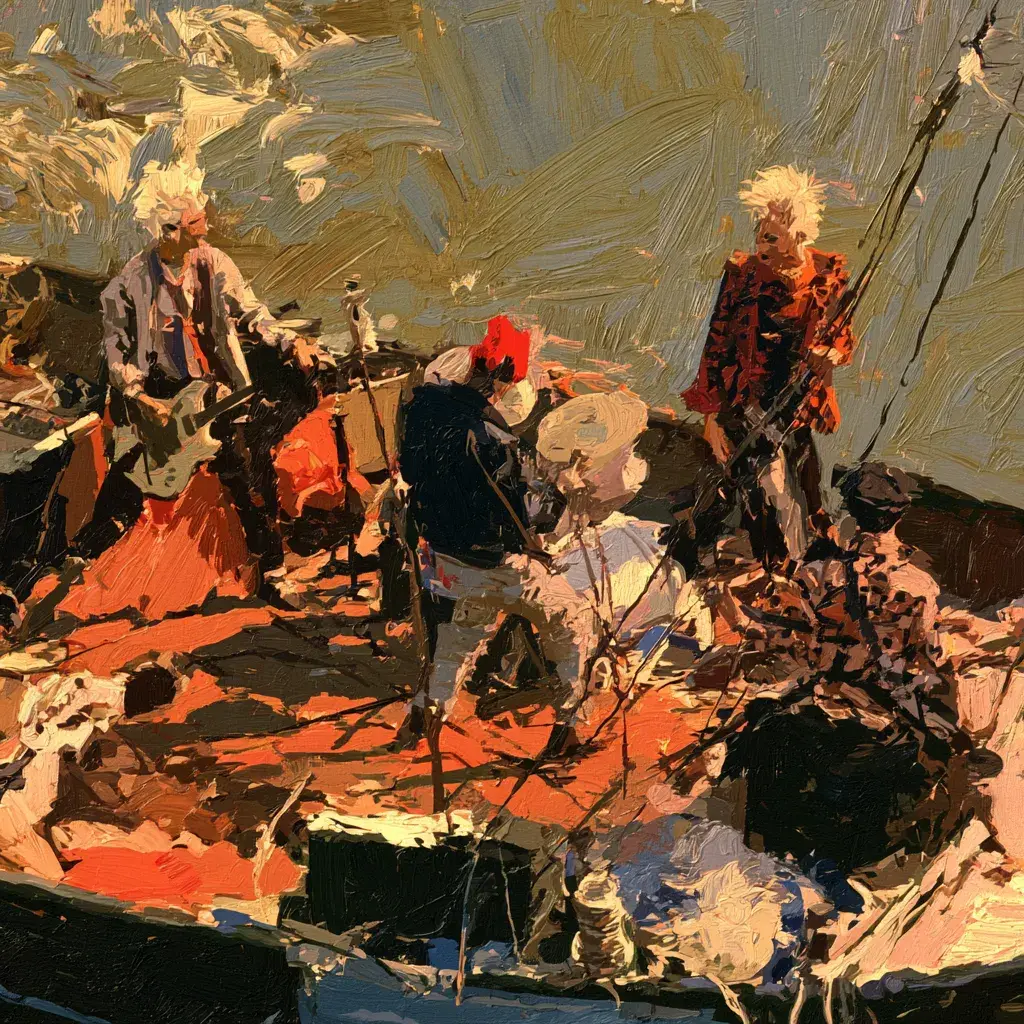
Chapter 1 of Punk's Jubilee Boat: The Sex Pistols on the Thames · the full story is in the app
Malcolm McLaren (22 January 1946 - 8 April 2010) was an English fashion designer, entrepreneur, and music manager who shaped the early punk scene. He ran the Chelsea boutique Sex with Vivienne Westwood, managed the Sex Pistols, and orchestrated the publicity-generating Thames boat stunt during the 1977 Jubilee. He later pursued a solo music career, producing the hit album Duck Rock, and worked in film and visual art.
English manager and provocateur behind the Sex Pistols and their Jubilee boat stunt.
Don't stop at the facts — continue Malcolm McLaren's story in free narrated chapters on Chunks.
See how Chunks works → Download on iOS
 Download on Android
Quick facts
- Born
- 22 January 1946
- Birthplace
- Stoke Newington
- Died
- 8 April 2010
- Place of death
- Bellinzona
- Nationality
- United Kingdom
- Occupation
- Singer, screenwriter, songwriter
Malcolm McLaren: key facts
- Malcolm McLaren was born on 22 January 1946 in Stoke Newington, England.
- McLaren ran the Chelsea boutique Sex with girlfriend Vivienne Westwood from 1974 to 1976, a shop that helped shape early punk fashion.
- As manager of the Sex Pistols, McLaren recruited John Lydon, whom he renamed Johnny Rotten, as the band's frontman.
- McLaren organized a 1977 boat trip on the Thames for the Sex Pistols to perform outside the Houses of Parliament during the Queen's Silver Jubilee, resulting in his arrest.
- His 1983 solo album Duck Rock was certified silver in the UK and produced the top-ten singles Buffalo Gals and Double Dutch.
- McLaren managed Adam and the Ants and later Bow Wow Wow after members split from Adam Ant's band in 1979.
- McLaren died of peritoneal mesothelioma on 8 April 2010 in a hospital in Bellinzona, Switzerland.
An Upbringing in North London and Years Drifting Through Art Schools
Malcolm Robert Andrew McLaren was born on 22 January 1946 in Stoke Newington, London, to Peter McLaren, a Scottish-born engineer serving with the Royal Engineers, and Emily Isaacs, daughter of tailor Mick Isaacs and the independently wealthy Rose Corré Isaacs. His father left the family home, and McLaren was raised instead by his grandmother. Accounts from those who knew him later, including biographers Judy and Fred Vermorel, suggest his was not an easy or affectionate childhood; even his own mother was said to have little warmth for him.
He left Orange Hill school at sixteen with only three O-levels and worked a succession of short-lived jobs before drifting into art education. Over the following seven years he passed through St Martin's School of Art, a foundation course at Harrow School of Art, the South East Essex School of Art in Walthamstow, and Goldsmiths. It was during this period that he became immersed in underground art movements and left-wing activism, interests that would later surface in his approach to music management and fashion.
Let It Rock, Sex, and the New York Dolls
In October 1971 McLaren took over part of a shop at 430 King's Road in Chelsea, initially trading in rock and roll records, refurbished radiograms and vintage clothing under the name In the Back of Paradise Garage. With art-school friend Patrick Casey he expanded the space and renamed it Let It Rock, drawing a following among teddy boys. His girlfriend, designer Vivienne Westwood, began customising and remaking original garments for the shop, and their work appeared in productions such as The Rocky Horror Show. The shop was renamed again in 1973 as Too Fast To Live Too Young To Die, selling leather clothing inspired by 1950s style, and the pair also produced costumes for Ken Russell's film Mahler.
A 1973 trip to New York for the National Boutique Fair brought McLaren and Westwood into contact with the New York Dolls, whom they began dressing and later joined on tour in Britain and France. In January 1975 the pair designed red patent leather stage outfits for the band and introduced a Soviet hammer-and-sickle motif intended to provoke attention in the United States. The tactic failed to revive the group's fortunes, and guitarist Johnny Thunders later blamed McLaren directly for the band's breakup, a charge McLaren rejected, pointing instead to drug problems within the band. He returned to Britain in May 1975, renaming his shop Sex later that year to reflect a turn toward fetish-inspired fashion.
Building the Sex Pistols
McLaren had already been advising two customers of his shop, Paul Cook and Steve Jones, on forming a band, and he proposed that shop assistant Glen Matlock join them as bassist in a group he called QT Jones and his Sex Pistols. In 1975 he removed original frontman Wally Nightingale because he did not match the image McLaren wanted. Associate Bernie Rhodes is credited with spotting John Lydon, a customer known for green hair and a defaced Pink Floyd T-shirt, as a replacement singer. McLaren renamed him Johnny Rotten and shortened the band's name to Sex Pistols, saying he wanted the name to suggest sexy young assassins.
In 1977, shortly after Sid Vicious replaced Matlock, the band released God Save the Queen during the week of the Queen's Silver Jubilee, a deliberately provocative anti-monarchy single. McLaren organised a boat trip on the Thames for the band to perform outside the Houses of Parliament, which was raided by police; his own arrest that day delivered exactly the publicity he had sought. The band's sole studio album, Never Mind the Bollocks, Here's the Sex Pistols, appeared in October 1977, and their last UK show preceded a US tour in January 1978. Band members accused McLaren of financial mismanagement, and the dispute escalated into a 1979 lawsuit brought by Lydon, Jones, Cook and Sid Vicious's estate against McLaren's company Glitterbest. In 1986 the High Court sided with the band, awarding them the group's name, its recordings, associated film material, and its income.
Managing Adam Ant, Bow Wow Wow, and a Solo Turn into Pop Music
After the Sex Pistols, McLaren managed Adam Ant following the release of Ant's debut album, then took over as manager of Bow Wow Wow when three members split from Adam's backing band. He and Westwood designed the new group's stage clothing, and McLaren courted further controversy by proposing a magazine called Chicken intended to celebrate sex between people under the legal age of consent.
McLaren's own recording career began with 1983's Duck Rock, made with producer Trevor Horn and New York hip-hop DJs the World's Famous Supreme Team, blending African and American influences and helping introduce hip-hop to a broader audience. It produced the UK top-ten hits Buffalo Gals and Double Dutch and was certified silver. He later worked with producer Stephen Hague on the operatic single Madame Butterfly, and released the funk and disco album Waltz Darling in 1989, whose single Deep in Vogue helped popularise voguing and ball culture, reaching the top of the US dance chart months before Madonna's Vogue. Several of McLaren's recordings, including tracks built from South African mbaqanga songs by groups such as the Boyoyo Boys and the Mahotella Queens, were later the subject of a lawsuit over unpaid royalties, which McLaren settled out of court after a judge froze his royalty payments.
Film Work, a Mayoral Bid, and Final Years
From the mid-1980s McLaren shifted toward film and theatre production, developing projects including a Fashion Beast script commissioned from comic writer Alan Moore and working briefly as a production executive for CBS Theatrical Films before joining Steven Spielberg's Amblin Entertainment as an ideas consultant. In the 1990s he produced and appeared in the Channel 4 documentary The Ghosts of Oxford Street and later served as producer on the 2006 film Fast Food Nation, adapted from Eric Schlosser's book.
In 1999 McLaren floated the idea of standing as an independent candidate for Mayor of London, publishing a manifesto in the New Statesman and securing campaign funding arranged by music entrepreneur Alan McGee through Sony Music. His campaign manager later said the late entry of Ken Livingstone into the race effectively ended McLaren's chances.
McLaren spent his later years based in Paris and New York, continuing work in visual art, radio documentaries, and television, including an ultimately abandoned stint on I'm a Celebrity... Get Me Out of Here! and an appearance on Big Brother: Celebrity Hijack. He was diagnosed with peritoneal mesothelioma in October 2009 and died of the disease on 8 April 2010 in a hospital in Bellinzona, Switzerland. He was buried at Highgate Cemetery in north London, his coffin marked with the slogan Too Fast To Live Too Young To Die, to the accompaniment of Sid Vicious's version of My Way.
Malcolm McLaren: timeline
- 1946Born in Stoke Newington, England, to Peter McLaren and Emily Isaacs.
- 1971Took over part of a shop at 430 King's Road in Chelsea, opening it as Let It Rock, selling records and vintage clothing.
- 1973Travelled to New York with Vivienne Westwood, beginning an association supplying stage wear to the New York Dolls.
- 1974Renamed the King's Road boutique Sex, shifting its focus toward fetish fashion and provocation.
- 1975Returned to Britain after the New York Dolls broke up, and began shaping a new band around Sex shop regulars, recruiting John Lydon as frontman under the name Johnny Rotten.
- 1977Released the Sex Pistols single 'God Save the Queen' during the Queen's Silver Jubilee and was arrested after a publicity-seeking boat trip past the Houses of Parliament.
- 1977Oversaw release of the Sex Pistols album Never Mind the Bollocks, Here's the Sex Pistols.
- 1979Began managing Adam and the Ants, and shortly after formed Bow Wow Wow from departing members of that band.
- 1983Released his debut solo album Duck Rock, blending hip-hop and global influences and producing hit singles 'Buffalo Gals' and 'Double Dutch'.
- 1989Released the funk and disco album Waltz Darling, helping bring voguing and ball culture to wider attention through the single 'Deep in Vogue'.
- 2000Launched and later withdrew from an independent campaign to become the first elected Mayor of London.
- 2010Died of peritoneal mesothelioma in a hospital in Bellinzona, Switzerland.
Listen: stories featuring Malcolm McLaren
Narrated chapters from the Chunks Microlearning app. Read a preview here, or listen to the full story in the app.
Continue Malcolm McLaren's story
You've read the summary — hear the full story as narrated 5-minute chapters on Chunks, alongside 200+ figures and events from history, philosophy and science. Free to start on iOS and Android.