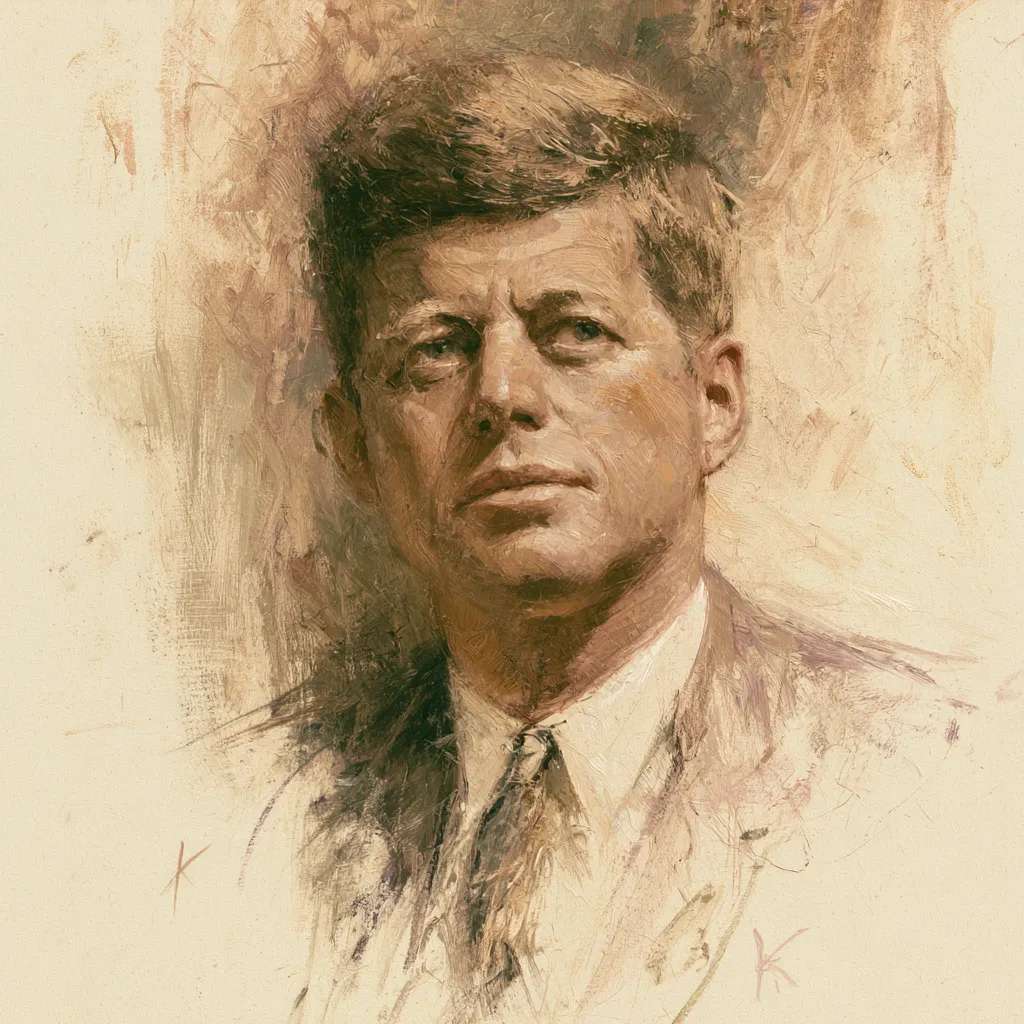
Who was John F. Kennedy?
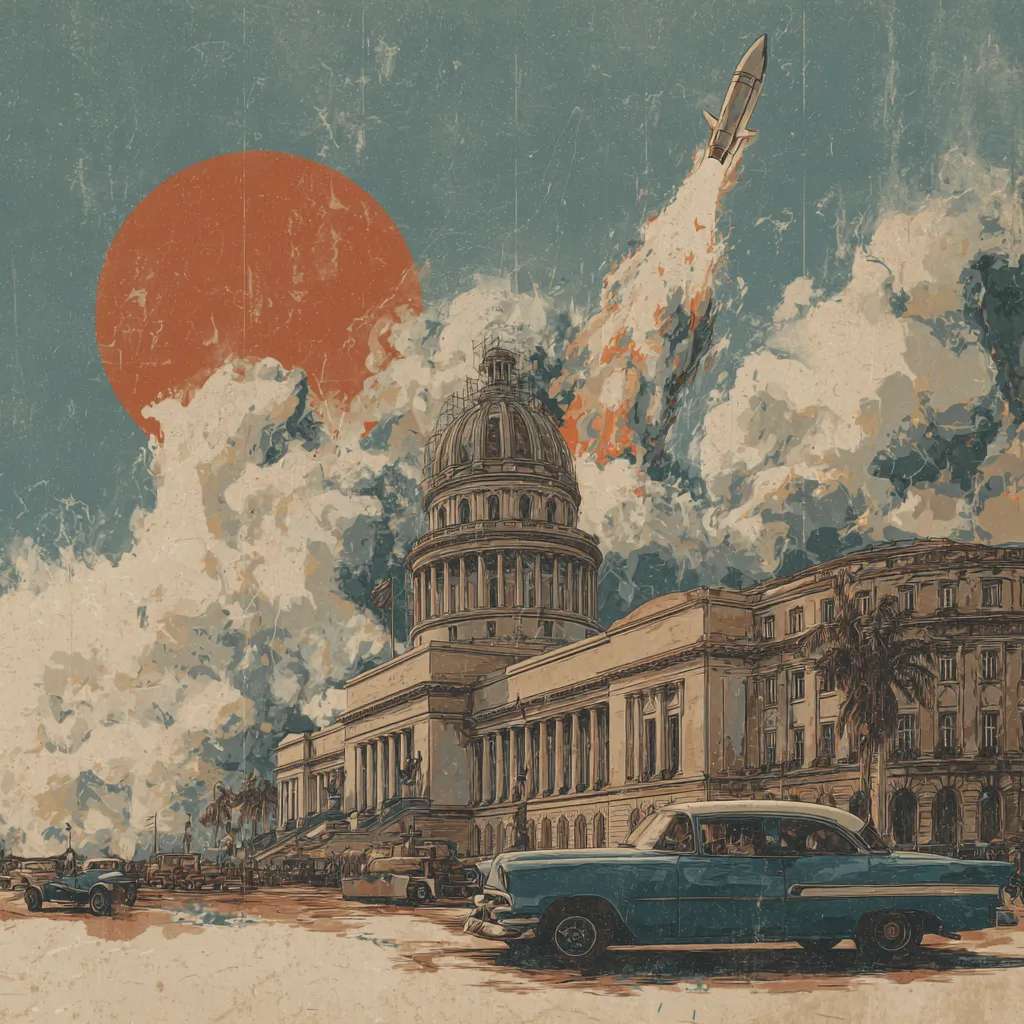
John F. Kennedy (May 29, 1917 – November 22, 1963) was the 35th president of the United States, the youngest person elected to the office and the first Catholic president. He is best known for steering the United States through the Cuban Missile Crisis of 1962, when Soviet missile sites discovered in Cuba brought the world to the brink of nuclear war, resolved through naval blockade and secret diplomacy.
35th President of the United States who navigated the Cuban Missile Crisis in 1962, preventing nuclear war through careful diplomacy. His leadership during this tense standoff helped define Cold War politics and nuclear deterrence strategies.
Don't stop at the facts — continue John F. Kennedy's story in free narrated chapters on Chunks.
Or get it straight away:
 Download on iOS
 Download on Android
Quick facts
- Born
- 29 May 1917
- Birthplace
- Brookline
- Died
- 22 November 1963
- Place of death
- Parkland Memorial Hospital
- Nationality
- United States
- Occupation
- Politician, journalist, statesperson
John F. Kennedy: key facts
- John F. Kennedy was born on May 29, 1917, in Brookline, Massachusetts, and served as the 35th President of the United States from January 1961 until his assassination on November 22, 1963.
- Kennedy was the youngest person ever elected to the presidency, winning the 1960 election at age 43, narrowly defeating Republican incumbent Vice President Richard Nixon.
- During the Cuban Missile Crisis in October 1962, Kennedy formed a secret advisory group called EXCOMM and chose a naval blockade over an air strike after U.S. spy planes discovered Soviet missile sites being built in Cuba.
- The crisis was resolved on October 28, 1962, when Khrushchev agreed to dismantle the Cuban missile sites in exchange for a U.S. public pledge never to invade Cuba and a private agreement to remove Jupiter missiles from Turkey and Italy.
- Kennedy signed the Limited Nuclear Test Ban Treaty on October 7, 1963, prohibiting atomic weapons testing in the atmosphere, underwater, and on the ground, with the United States, United Kingdom, and Soviet Union as the initial signatories.
- Kennedy commanded PT-109 in the Pacific during World War II, and after the vessel was rammed and sunk by a Japanese destroyer in August 1943, he towed an injured crewman to safety and earned the Navy and Marine Corps Medal.
- While serving as a U.S. Senator from Massachusetts, Kennedy published Profiles in Courage in 1956, a book about senators who risked their careers for their principles, which won the Pulitzer Prize for Biography in 1957.
From Brookline to the White House: Kennedy's Rise Through Politics
John Fitzgerald Kennedy was born on May 29, 1917, in Brookline, Massachusetts, into one of the most politically connected Irish-American families in the country. His maternal grandfather had been a congressman and twice mayor of Boston, while his paternal grandfather was a ward boss in the Massachusetts state legislature. His father, Joseph P. Kennedy Sr., amassed a considerable private fortune and established trust funds for each of his nine children, pushing them hard toward political ambition. Kennedy graduated from Harvard University in 1940 with a degree in government, and his senior thesis — an analysis of Britain's failure to prepare for war — was published as a bestselling book titled Why England Slept.
After serving in the U.S. Navy during World War II, Kennedy won a seat in the U.S. House of Representatives in 1946, representing a working-class Boston district. He moved to the Senate in 1953, defeating incumbent Henry Cabot Lodge Jr. While in the Senate he published Profiles in Courage, a study of senators who had risked their careers for principle, which won the Pulitzer Prize for Biography in 1957. In January 1960, Kennedy announced his candidacy for the presidency, winning the Democratic nomination and defeating Republican Richard Nixon in one of the closest elections of the twentieth century, carrying 303 Electoral College votes to Nixon's 219.
A Soldier's Record: PT-109 and the Making of a War Hero
Kennedy joined the U.S. Naval Reserve in September 1941 and was commissioned as an ensign the following month. After training at the Motor Torpedo Boat Squadrons Training Center in Rhode Island, he took command of PT-109 in April 1943, based on Tulagi Island in the Solomon Islands. On the night of August 1 to 2, 1943, a Japanese destroyer named Amagiri rammed and cut PT-109 in half, killing two crew members. Despite re-injuring his back in the collision, Kennedy towed a badly burned crew member named Patrick McMahon to a nearby island by clenching a life jacket strap between his teeth.
Kennedy and his surviving crew spent seven days navigating the coral islands before a rescue was arranged, aided by Kennedy carving his location onto a coconut shell and sending it with a local islander. The episode received widespread press attention and was later chronicled by journalist John Hersey in The New Yorker. Kennedy was awarded the Navy and Marine Corps Medal for his courage and leadership, along with a Purple Heart for the injuries he sustained. His back problems, which had plagued him before the war, worsened significantly as a result and would cause him severe pain throughout the rest of his life.
Thirteen Days: The Cuban Missile Crisis and the Brink of Nuclear War
On October 14, 1962, CIA U-2 spy planes photographed Soviet construction of intermediate-range ballistic missile sites inside Cuba. Kennedy was shown the photographs on October 16 and immediately recognized the threat: Soviet missiles positioned approximately 90 miles from the Florida coast represented a direct nuclear danger to the United States. Rather than convene a public meeting of the National Security Council, Kennedy formed a secret advisory group of key officials, later known as EXCOMM, which met over the following twelve days to work through the available options.
More than a third of EXCOMM members initially favored an unannounced air assault on the missile sites, but Kennedy settled on a naval blockade — officially termed a quarantine — of Cuba. On October 22, he announced the blockade on national television. Soviet ships approaching the quarantine line stopped or reversed course. Through a combination of direct correspondence with Soviet Premier Nikita Khrushchev and a secret back-channel message delivered by Robert Kennedy to Soviet Ambassador Anatoly Dobrynin, a resolution was reached on October 28. The Soviets agreed to dismantle the missile sites, while the United States publicly pledged not to invade Cuba and privately agreed to remove its Jupiter missiles from Turkey and Italy.
The crisis came close to unraveling on multiple occasions. A Soviet missile shot down a U.S. U-2 reconnaissance aircraft over Cuba during the standoff, killing pilot Rudolf Anderson, and Kennedy chose to hold back from retaliating. A hotline between Moscow and Washington was established in the aftermath to prevent future misunderstandings. Kennedy's approval rating rose from 66 to 77 percent following the resolution, and negotiations for a nuclear test ban treaty gained new momentum almost immediately.
Civil Rights and the Limits of the New Frontier
Kennedy entered office promising a broad domestic agenda he called the New Frontier, which included federal aid to education, health insurance for the elderly, and economic assistance to struggling regions. In practice, his narrow electoral margin, weak connections with senior members of Congress, and his administration's heavy focus on foreign affairs slowed much of this legislation. He did win passage of a bill raising the federal minimum wage, the Area Redevelopment Act directing funds to impoverished regions including Appalachia, and the Housing Act of 1961. His proposed health insurance program for the elderly failed to pass either chamber.
On civil rights, Kennedy moved cautiously in his first two years, reluctant to antagonize conservative Southern Democrats whose votes he needed on other legislation. His administration sent federal marshals rather than troops to protect the Freedom Riders in 1961, and it was not until June 11, 1963, after he personally intervened to allow two Black students to enroll at the University of Alabama over Governor George Wallace's physical obstruction, that Kennedy delivered a nationally televised address calling for sweeping civil rights legislation. The proposals he outlined that night formed the core of the Civil Rights Act, which President Lyndon B. Johnson signed into law on July 2, 1964, more than seven months after Kennedy's assassination.
Dallas, November 22, 1963
Kennedy was in Texas on a political trip aimed at easing tensions within the state's Democratic Party when his motorcade passed through Dealey Plaza in Dallas at 12:30 p.m. on November 22, 1963. He was struck by two bullets — one in the back that exited through his throat, and one to the head. He was rushed to Parkland Memorial Hospital, where he was pronounced dead thirty minutes after the shooting, at 1:00 p.m. He was 46 years old. Vice President Lyndon B. Johnson was sworn in as president aboard Air Force One that afternoon.
Lee Harvey Oswald was arrested for the assassination but was shot and killed two days later by Jack Ruby before any trial could take place. The Warren Commission, established by President Johnson and chaired by Chief Justice Earl Warren, concluded that Oswald had acted alone. The FBI reached the same conclusion. A separate investigation by the House Select Committee on Assassinations in 1979 suggested Kennedy was probably killed as a result of a conspiracy, though it could not identify any additional gunmen. Subsequent FBI and National Academy of Sciences reviews found no reliable acoustic evidence to support the conclusion of a second shooter, and conspiracy theories about the assassination have persisted to the present day.
John F. Kennedy: timeline
- 1917Born in Brookline, Massachusetts, to Joseph P. Kennedy Sr. and Rose Kennedy, into a prominent Irish-American political family.
- 1940Graduated cum laude from Harvard University with a degree in government, having written a bestselling thesis published as Why England Slept.
- 1943Commanded PT-109 in the Pacific; after a Japanese destroyer rammed and sank the boat, he towed an injured crewman to safety and helped rescue the surviving crew over seven days.
- 1947Began representing a working-class Boston district in the U.S. House of Representatives, the first step in his national political career.
- 1953Took his seat as junior senator from Massachusetts after narrowly defeating Republican incumbent Henry Cabot Lodge Jr. in the 1952 election.
- 1957Won the Pulitzer Prize for Biography for Profiles in Courage, a book about U.S. senators who risked their careers for their convictions.
- 1961Inaugurated as the 35th President of the United States, the youngest person ever elected to the office and the first Catholic president.
- 1961Authorized the CIA-backed Bay of Pigs invasion of Cuba, which failed within two days and forced Kennedy to negotiate the release of over a thousand captured exiles.
- 1962Imposed a naval blockade on Cuba after U-2 spy planes revealed Soviet missile sites there, steering the world back from the brink of nuclear war through secret diplomacy with Khrushchev.
- 1963Signed the Limited Nuclear Test Ban Treaty, prohibiting atomic testing in the atmosphere, underwater, and on the ground.
- 1963Assassinated in Dallas while riding in a presidential motorcade through Dealey Plaza; pronounced dead at Parkland Hospital at 1:00 p.m.
Listen: stories featuring John F. Kennedy
Narrated chapters from the Chunks Microlearning app. Read a preview here, or listen to the full story in the app.
Continue John F. Kennedy's story
You've read the summary — hear the full story as narrated 5-minute chapters on Chunks, alongside 200+ figures and events from history, philosophy and science. Free to start on iOS and Android.