
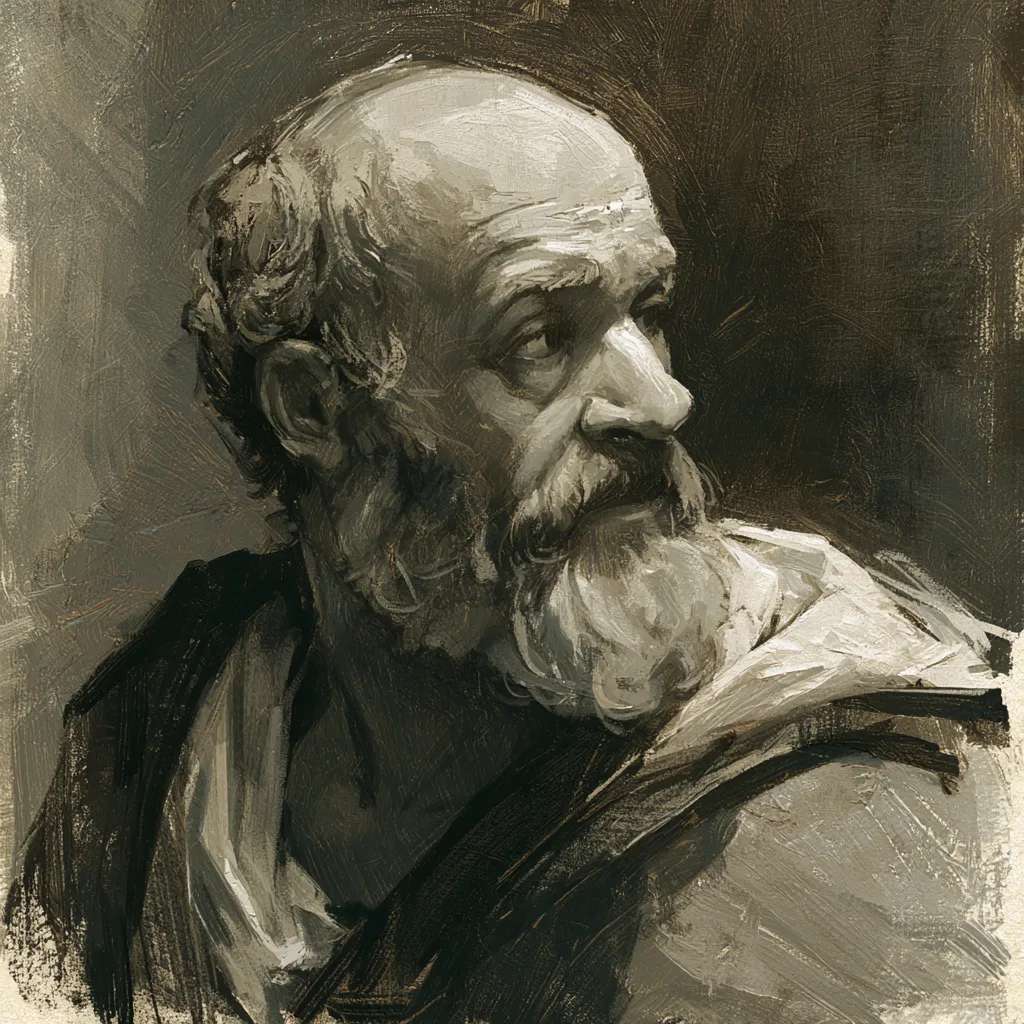
Who was Hippocrates?
Hippocrates of Kos (c. 460–c. 370 BC) was an ancient Greek physician and philosopher widely called the Father of Medicine. He separated medicine from religion and superstition, arguing that disease arose from natural causes such as environment and diet. His school introduced clinical observation and prognosis as core practices, and his name is attached to the Hippocratic Oath still referenced in medical ethics today.
Ancient Greek physician known as the 'Father of Medicine' who established medicine as a profession distinct from philosophy and religion, creating the Hippocratic Oath.
Don't stop at the facts — continue Hippocrates's story in free narrated chapters on Chunks.
Or get it straight away:
 Download on iOS
 Download on Android
Quick facts
- Born
- 460 BC
- Birthplace
- Kos
- Died
- 370 BC
- Place of death
- Larissa
- Occupation
- Physician, philosopher
Hippocrates: key facts
- Hippocrates was born around 460 BC on the Greek island of Kos and died around 370 BC, probably in Larissa, at an age variously recorded as 83, 85, or 90.
- Traditionally called the 'Father of Medicine', Hippocrates is credited with separating medicine from religion and superstition by arguing that disease results from environmental factors, diet, and living habits rather than divine punishment.
- Hippocrates introduced the concept of prognosis and systematic clinical observation, teaching physicians to record symptoms such as complexion, pulse, fever, and excretions in clear, objective case histories.
- He is credited with the first description of clubbing of the fingers, a diagnostic sign now linked to chronic lung disease, lung cancer, and cyanotic heart disease, which is why the condition is still called Hippocratic fingers.
- The Hippocratic Corpus, a collection of around seventy early medical works written in Ionic Greek, was assembled under his name, though modern scholars believe it was produced by multiple authors, possibly as many as nineteen.
- The Hippocratic Oath, attributed to Hippocrates in antiquity, may have been written after his death, but it remains the foundational document of medical ethics and is still the basis for oaths taken by modern medical graduates.
- Hippocrates trained at the asklepieion of Kos, studied under the Thracian physician Herodicus of Selymbria, and traveled as far as Thessaly, Thrace, and the Sea of Marmara to teach and practice medicine.
A Physician Born on Kos, Around 460 BC
Hippocrates was born around 460 BC on the Greek island of Kos. His father, Heraclides, was himself a physician, and his mother, Praxitela, came from a family with its own distinguished lineage. According to ancient accounts, Hippocrates learned medicine from both his father and his grandfather, Hippocrates I, making him the product of a deeply medical household. He was also said to have studied other subjects with thinkers including Democritus and Gorgias, suggesting an education that stretched well beyond clinical practice.
He was almost certainly trained at the asklepieion of Kos, a sanctuary and center of healing, and took instruction from the Thracian physician Herodicus of Selymbria. Plato, writing in the fourth century BC, referred to him as 'Hippocrates the Asclepiad,' a term linking him to the tradition of Asklepius, the god of medicine. Hippocrates traveled widely during his lifetime, practicing and teaching as far afield as Thessaly, Thrace, and the Sea of Marmara. He died, probably in the city of Larissa, at an advanced age, with ancient sources variously placing his death at 83, 85, or 90 years old.
Separating Medicine from Gods and Philosophers
The most consequential shift Hippocrates brought to ancient Greek medicine was insisting that disease had natural causes rather than divine ones. Before his school rose to prominence, illness was widely understood as punishment sent by the gods, and its treatment fell within the territory of priests and philosophers as much as healers. Hippocrates argued that disease arose from environmental conditions, diet, and living habits. There is not a single mystical explanation for illness anywhere in the entire body of work associated with his school.
Greek medicine at the time was divided between two competing schools. The Knidian school placed heavy emphasis on diagnosis, trying to identify and name specific diseases. This approach was limited partly because dissection of human bodies was forbidden, leaving physicians with a poor understanding of anatomy. The Hippocratic, or Koan, school took a different path, prioritizing patient care and prognosis over precise diagnosis. By observing patients carefully over time and recording what happened, Hippocratic physicians were able to build up a body of practical knowledge that the Knidian approach, for all its diagnostic ambition, could not match.
Hippocrates was acknowledged by followers of Pythagoras for drawing philosophy and medicine into closer alliance, yet one of his central achievements was ensuring that medicine ultimately stood apart as its own discipline with its own methods and standards. This separation gave medicine the coherence it needed to develop as a profession rather than remaining an adjunct to religious ritual or abstract philosophical debate.
The Theory of Crises, Humours, and the Healing Power of Nature
Central to Hippocratic medicine was the concept of the crisis, a decisive turning point in the course of a disease at which the patient would either begin to recover or decline toward death. Hippocratic physicians believed these crises tended to occur on predictable days after the onset of illness, which they called critical days. If a crisis arrived on a day that did not match the expected pattern, a relapse was thought likely to follow. This framework gave physicians a way of thinking about disease progression over time rather than treating each symptom in isolation.
The broader theoretical foundation was humoral theory, the idea that the body contained four humours that needed to remain in balance for health to be maintained. While this theory has since been entirely discredited, it gave Hippocratic medicine an internally consistent logic. The approach to treatment that followed from it was notably gentle: the doctrine held that the body possessed its own power to heal itself, and that the physician's role was to support that natural process rather than to override it. Rest, cleanliness, and careful attention to diet were the primary tools, with drugs used only when necessary.
In practice this meant Hippocratic therapy was far kinder to patients than many competing approaches. Wounds were cleaned with pure water or wine, and the general preference was for 'dry' treatment. Fasting was sometimes prescribed, and a mixture of honey and vinegar was among the general remedies recommended. For straightforward mechanical injuries such as broken bones, the passive approach worked well; devices like the Hippocratic bench applied traction to relieve pressure on injured areas and assist recovery.
Clinical Observation, Prognosis, and Specific Medical Discoveries
One of the most durable practical contributions of the Hippocratic school was its commitment to systematic observation and documentation. Physicians were expected to record symptoms, findings, and treatments in clear, objective terms so that the records could be used by others. Hippocrates himself noted symptoms including complexion, pulse, fever, pain, movement, and excretions. He is said to have measured a patient's pulse during case-taking, and he extended his observations beyond the individual patient to include family history and the surrounding environment.
Several specific clinical discoveries are credited to Hippocrates. He gave the first recorded description of clubbing of the fingers, a physical sign now known to indicate chronic lung disease, lung cancer, or cyanotic heart disease, which is why the condition is still sometimes called Hippocratic fingers. He described what became known as the Hippocratic face, the characteristic appearance produced by prolonged illness or the approach of death. He provided detailed accounts of thoracic empyema, suppuration inside the chest cavity, and his surgical techniques for draining it, including the use of lead pipes, remained influential long after his lifetime.
Hippocrates also began classifying diseases using categories that became standard medical vocabulary: acute, chronic, endemic, and epidemic. He introduced terms including exacerbation, relapse, resolution, crisis, paroxysm, peak, and convalescence. His work on the rectum and hemorrhoids introduced early forms of treatments, including ligation and the use of a hot iron, that bear resemblance to methods still in use. The Hippocratic Corpus also contains the earliest recorded reference to the use of a rectal speculum, making it a foundational text in the history of endoscopy.
The Hippocratic Corpus, the Oath, and a Complicated Legacy
The collection of texts associated with Hippocrates, known as the Hippocratic Corpus, contains around seventy works written in Ionic Greek. These include textbooks, lectures, research notes, and philosophical essays covering an enormous range of medical subjects. They were not all written by one person: the variety of subjects, writing styles, and apparent dates of composition makes that impossible. One scholar counted at least nineteen distinct authors. The works were gathered in Alexandria and came to bear Hippocrates's name most likely because of his fame, with librarians attributing all medical writings to the most celebrated physician of the tradition.
Among these texts is the Hippocratic Oath, the document that has shaped medical ethics for centuries. Ancient sources attributed it to Hippocrates himself, though modern scholarship suggests it may have been written after his death. In its original form it is rarely used today, but it served as the foundation for later oaths and codes of medical conduct, and derivatives of it are still taken by medical graduates entering practice around the world.
Hippocrates died, probably in Larissa, around 370 BC. His reputation after death became so immense that his teachings were treated as fixed and authoritative rather than as a starting point for further investigation. The practice of recording detailed clinical case histories, one of the school's most valuable contributions, largely died out in the centuries after him. Later physicians, most notably Galen, who lived from AD 129 to AD 200, worked within the Hippocratic tradition but made only partial advances. It was not until the European Renaissance, and more fully in the nineteenth century, that physicians such as Thomas Sydenham and William Osler systematically revived Hippocratic methods of rigorous clinical observation.
Hippocrates: timeline
- c. 460 BCBorn on the Greek island of Kos, son of the physician Heraclides and Praxitela, daughter of Tizane.
- c. 460–430s BCTrained in medicine through his father and grandfather Hippocrates I, and likely at the asklepieion of Kos, also taking lessons from the Thracian physician Herodicus of Selymbria.
- c. 440–400 BCTraveled and practiced medicine across Thessaly, Thrace, and the Sea of Marmara region, teaching students including his two sons Thessalus and Draco and his son-in-law Polybus.
- c. 420–400 BCLed the Hippocratic school of medicine in separating medicine from religion and philosophy, establishing that diseases arise from natural causes such as environment, diet, and living habits.
- c. 370 BCDied, probably in Larissa, at an age reported variously as 83, 85, or 90, though some ancient accounts claimed he lived well over 100 years.
Listen: stories featuring Hippocrates
Narrated chapters from the Chunks Microlearning app. Read a preview here, or listen to the full story in the app.

Continue Hippocrates's story
You've read the summary — hear the full story as narrated 5-minute chapters on Chunks, alongside 200+ figures and events from history, philosophy and science. Free to start on iOS and Android.