
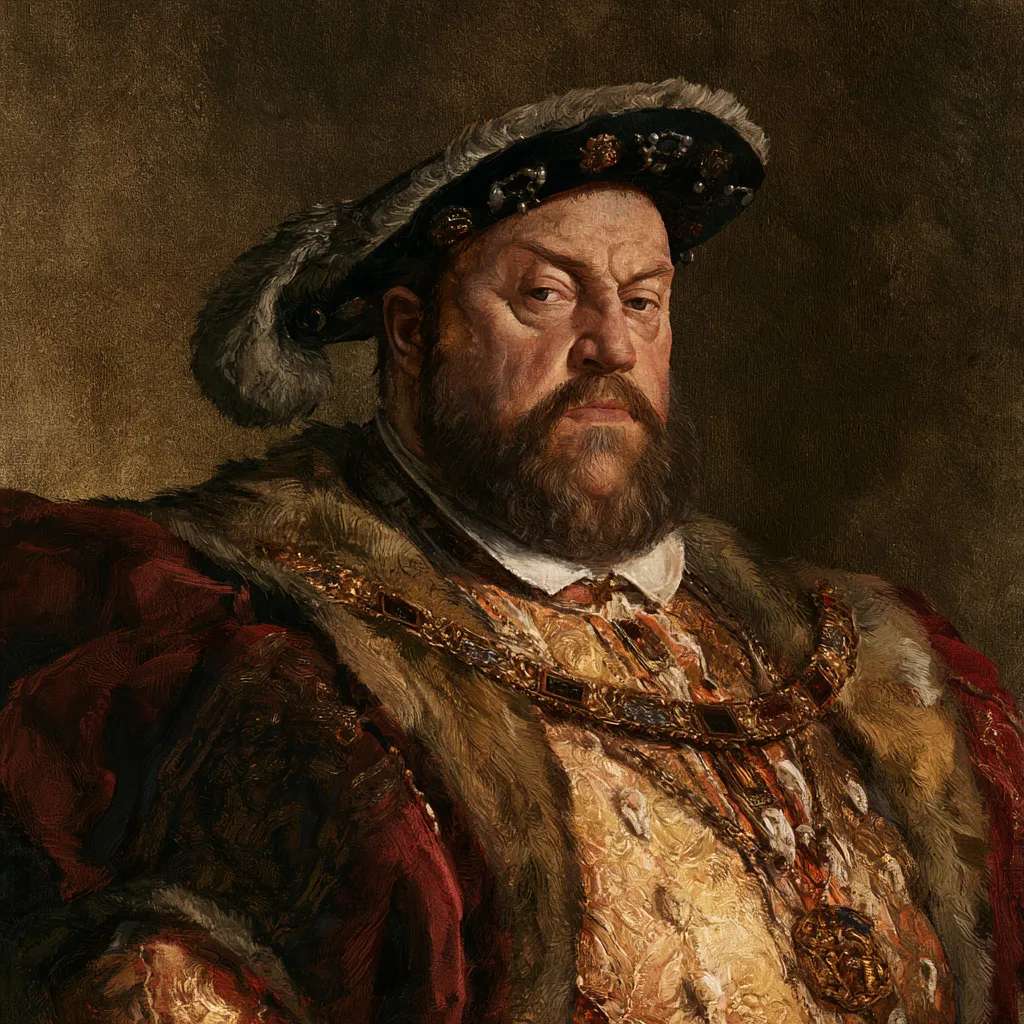
Who was Henry VIII?
Henry VIII (28 June 1491 - 28 January 1547) was King of England and Ireland from 1509 until his death, born at the Palace of Placentia and known for his six marriages and his break with the Catholic Church. Seeking an annulment from Catherine of Aragon, he established the Church of England under royal supremacy, dissolved the monasteries, and later married Anne Boleyn, Jane Seymour, Anne of Cleves, Catherine Howard, and Catherine Parr. He died at the Palace of Whitehall, succeeded by his son Edward VI.
Henry VIII was King of England from 1509 to 1547, famous for his six marriages and for breaking from the Catholic Church to found the Church of England. His reign reshaped English religion, politics, and monarchy.
Don't stop at the facts — continue Henry VIII's story in free narrated chapters on Chunks.
Or get it straight away:
 Download on iOS
 Download on Android
Quick facts
- Born
- 28 June 1491
- Birthplace
- Palace of Placentia
- Died
- 28 January 1547
- Place of death
- Palace of Whitehall
- Nationality
- Kingdom of England
- Occupation
- Monarch, composer
Henry VIII: key facts
- Henry VIII was born on 28 June 1491 at the Palace of Placentia in Greenwich, the second son of Henry VII and Elizabeth of York.
- He became King of England and Ireland in April 1509 at age 17, after his elder brother Arthur, Prince of Wales, died in 1502.
- Henry married his brother's widow, Catherine of Aragon, in 1509, then sought an annulment when she failed to produce a surviving male heir.
- After Pope Clement VII delayed ruling on the annulment, Henry married Anne Boleyn in secret in 1532 and Archbishop Thomas Cranmer voided the Catherine marriage in May 1533.
- The Act of Supremacy 1534 made Henry Supreme Head of the Church of England, triggering his excommunication by the Pope and the English Reformation.
- Anne Boleyn was executed for treason in 1536, after which Henry married Jane Seymour, who died in 1537 shortly after giving birth to Henry's son and heir, Edward.
- Henry went on to marry Anne of Cleves, Catherine Howard, and finally Catherine Parr, and he died on 28 January 1547 at the Palace of Whitehall.
- Beyond politics, Henry was a composer and author, best known for the song 'Pastime with Good Company'.
A Second Son Never Meant to Rule
Henry was born on 28 June 1491 at the Palace of Placentia in Greenwich, the third child and second son of Henry VII and Elizabeth of York. Because his elder brother Arthur was heir to the throne, young Henry was not raised with kingship in mind. Instead he was given a string of ceremonial titles as a small child, including Constable of Dover Castle, Lord Warden of the Cinque Ports, and Duke of York, appointments his father used partly to keep control of profitable offices within the family.
Henry received an excellent education, becoming fluent in Latin and French and picking up some Italian, and by all accounts showed talent in music and scholarship from a young age. He was kept largely out of public view and given few responsibilities, since he was not expected to inherit the crown. Everything changed in 1502, when Arthur died at fifteen, just months after marrying Catherine of Aragon, daughter of the Spanish monarchs Ferdinand II and Isabella I. Ten-year-old Henry suddenly became heir apparent, taking on the titles of Duke of Cornwall and Prince of Wales.
Henry VII, wary of losing the Spanish alliance, arranged for his surviving son to marry Catherine, his brother's widow, and the two were betrothed in 1503. The match required a special dispensation because canon law treated marriage to a brother's widow as a barrier, and there was legal wrangling over whether Catherine's first marriage had ever been consummated. The plan stalled for years amid politics and Henry's own reluctance, and it was only after his father's death in 1509 that the 17-year-old king agreed to go ahead, marrying Catherine within weeks of taking the throne.
The Great Matter and the Break with Rome
Catherine bore Henry a string of stillbirths and infant deaths, with only one child, Mary, surviving into adulthood. By the mid-1520s, with no legitimate son and Catherine past forty, Henry became convinced his marriage was cursed in the eyes of God, citing a passage in Leviticus that he believed forbade marrying a brother's widow. He had also become infatuated with Anne Boleyn, a woman in the queen's household who refused to become his mistress as her sister Mary Boleyn reportedly had been. Henry decided the only path forward was to have his marriage to Catherine annulled so he could marry Anne.
Henry appealed to Pope Clement VII for the annulment, but Catherine's nephew was the powerful Holy Roman Emperor Charles V, and the pope, under pressure from Charles, delayed rather than ruled. Cardinal Thomas Wolsey, Henry's chief minister for over a decade, was blamed for the failure to secure a quick decision and was stripped of power, dying before he could face a treason trial. Henry secretly married the now-pregnant Anne in 1532, and in May 1533 Thomas Cranmer, the new Archbishop of Canterbury, declared the marriage to Catherine null and void. The pope responded by rejecting the ruling and eventually excommunicating Henry.
Rather than back down, Henry had Parliament pass the Act of Supremacy in 1534, naming the English monarch Supreme Head of the Church of England and severing ties with Rome. Thomas More and Bishop John Fisher, who refused to accept the king's new religious authority, were executed for treason in 1535. Henry then ordered the dissolution of England's monasteries and convents between 1536 and 1542, seizing their land and wealth, destroying shrines and relics, and dispersing their libraries. The changes provoked serious unrest, most notably the Pilgrimage of Grace, a large 1536 uprising in northern England that Henry crushed after luring its leaders with a false promise of pardon.
Six Marriages
Anne Boleyn gave Henry a daughter, the future Elizabeth I, but no son, and her sharp temper and political enemies at court hastened her downfall. In 1536 she was arrested on charges of adultery and treason and beheaded at the Tower of London, and her marriage to Henry was annulled just before her execution. Within days Henry married Jane Seymour, who in 1537 finally gave him a son, Edward, but died shortly afterward from complications of the birth.
Seeking a political alliance, Henry next married Anne of Cleves in 1540 based on a flattering portrait, but he was reportedly repelled by her in person and the marriage was never consummated. It was quickly annulled, and Anne was given a generous settlement and the title the King's Sister. Henry then married the teenage Catherine Howard the same year, but she was executed in 1542 after evidence emerged of affairs both before and during her marriage to the king.
Henry's sixth and final wife was Catherine Parr, a widow he married in 1543. She helped reconcile Henry with his daughters Mary and Elizabeth, and Parliament's Third Succession Act that year restored both women to the line of succession behind Edward. Catherine Parr outlived Henry, making her his only wife besides Catherine of Aragon and Anne of Cleves to survive the marriage.
War, Money, and the Business of Ruling
Henry pursued an aggressive foreign policy aimed at recovering English claims in France, invading in 1513 and winning a minor victory at the Battle of the Spurs, while an English army defeated and killed the Scottish king James IV at Flodden the same year. In 1520 Henry staged the lavish Field of the Cloth of Gold meeting with Francis I of France, hoping for lasting peace, but rivalry with France and shifting alliances with the Holy Roman Emperor Charles V kept England drawn into continental wars for much of his reign, including a costly second invasion of France in 1544 that captured Boulogne.
Henry inherited a full treasury and a well-run economy from his frugal father, but his wars, building projects, and mismanagement drained it steadily. The dissolution of the monasteries brought a huge windfall of land and wealth to the crown, and later debasement of the currency under his minister Thomas Cromwell brought short-term profit but serious long-term inflation. By the end of his reign England again faced financial strain despite the monastic wealth it had absorbed.
Government under Henry relied heavily on powerful ministers, first Cardinal Wolsey and later Thomas Cromwell, who built up much of the machinery of Tudor administration, including a reformed Privy Council. Cromwell also fell from favour, executed in 1540 the same day Henry married Catherine Howard, after enemies at court turned the king against him. Henry is also credited with expanding England's navy substantially and building a chain of coastal defences against invasion after his break with Rome left the country diplomatically isolated.
Decline, Death, and an Unsettled Succession
A jousting accident in January 1536 left Henry with a leg wound that never properly healed, festering for the rest of his life and limiting the physical activity he had once thrived on. In his later years he grew severely obese, reportedly reaching a waist measurement of 54 inches, and suffered painful boils and possibly gout, needing mechanical devices to help him move. Contemporaries increasingly described him as suspicious, short-tempered, and tyrannical, a marked contrast to the athletic, charismatic young king of his early reign.
Henry died on 28 January 1547 at the Palace of Whitehall, on what would have been his father's ninetieth birthday. He was buried at St George's Chapel, Windsor Castle, beside Jane Seymour, in a tomb that was never finished as originally planned. His only surviving son, Edward, became king at age nine as Edward VI, ruled by a council of regents rather than directly.
Henry's will set out that if Edward died without heirs, the throne would pass to Mary, then to Elizabeth, and finally to the descendants of his younger sister Mary, deliberately excluding the Scottish descendants of his other sister, Margaret Tudor. In the end all three of his children, Edward VI, Mary I, and Elizabeth I, would each reign in turn, though the exclusion of the Scottish line broke down decades later when Margaret's great-grandson James VI of Scotland inherited the English throne as well.
Henry VIII: timeline
- 1491Born at the Palace of Placentia in Greenwich, second son of Henry VII and Elizabeth of York.
- 1502Became heir to the throne after his elder brother Arthur, Prince of Wales, died at age 15.
- 1509Became King of England on the death of his father, Henry VII.
- 1509Married Catherine of Aragon, his late brother's widow, in Greenwich.
- 1513Led an English invasion of France, winning the Battle of the Spurs, while England defeated Scotland at Flodden in his absence.
- 1521Published a defence of Catholic sacraments and was granted the title Defender of the Faith by Pope Leo X.
- 1527Sought an annulment of his marriage to Catherine of Aragon from Pope Clement VII after growing convinced their union was unlawful.
- 1533Had his marriage to Catherine of Aragon declared null by Archbishop Thomas Cranmer, having secretly married Anne Boleyn shortly before.
- 1534Secured passage of the Act of Supremacy, making the English monarch Supreme Head of the Church of England after breaking with Rome.
- 1536Had Anne Boleyn executed on charges of treason after their marriage was annulled; married Jane Seymour ten days later.
- 1537Gained a male heir, Prince Edward, when Jane Seymour gave birth to him; she died twelve days later.
- 1540Married and then annulled his marriage to Anne of Cleves, then married Catherine Howard, who was executed in 1542 for adultery.
- 1543Married his sixth and final wife, Catherine Parr, who helped reconcile him with his daughters Mary and Elizabeth.
- 1547Died at the Palace of Whitehall, succeeded by his young son Edward VI.
Listen: stories featuring Henry VIII
Narrated chapters from the Chunks Microlearning app. Read a preview here, or listen to the full story in the app.
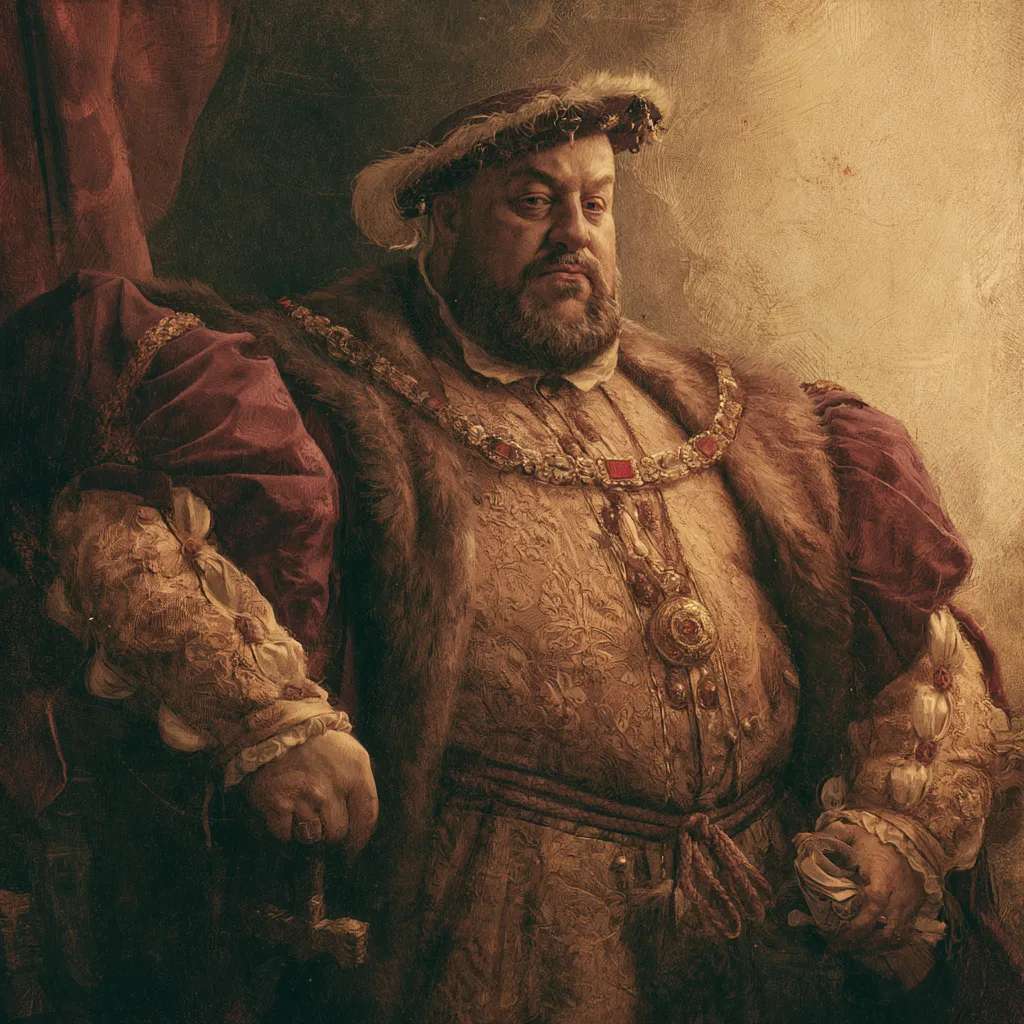
Frequently asked questions about Henry VIII
Who was Henry VIII?
Henry VIII was King of England from 1509 until his death in 1547. He is best remembered for his six marriages and for founding the Church of England after breaking away from the Roman Catholic Church.
Why did Henry VIII create the Church of England?
Henry VIII broke from the Roman Catholic Church because the Pope refused to annul his marriage to Catherine of Aragon, who had not produced a male heir. He established the Church of England with himself as its head, allowing him to divorce and remarry.
How many wives did Henry VIII have?
Henry VIII had six wives during his reign. Two of his marriages ended in annulment, two of his wives were executed, one died naturally, and one outlived him.
Continue Henry VIII's story
You've read the summary — hear the full story as narrated 5-minute chapters on Chunks, alongside 200+ figures and events from history, philosophy and science. Free to start on iOS and Android.