
Who was Hanaya Yohei?
Hear Hanaya Yohei's story
Chapter 1 of Hanaya Yohei and the Invention of Nigiri Sushi · the full story is in the app
Hanaya Yohei (1799-1858) was a Japanese chef and restaurateur credited with inventing nigirizushi, the hand-pressed style of sushi that became the basis for Edo-style Edomaezushi. In 1810 he opened a sushi restaurant in Honjo, Edo, and in the early Bunsei era he began serving sliced, soy-sauce-marinated or lightly cooked fish atop vinegared rice balls, a technique that shaped the sushi eaten worldwide today.
Edo-era Japanese chef credited with inventing nigiri sushi in the 1820s.
Don't stop at the facts — continue Hanaya Yohei's story in free narrated chapters on Chunks.
See how Chunks works → Download on iOS
 Download on Android
Quick facts
- Born
- 1799
- Birthplace
- Echizen Province
- Died
- 1858
- Nationality
- Japan
- Occupation
- Cook
Hanaya Yohei: key facts
- Hanaya Yohei was a Japanese cook born in 1799 in Echizen Province.
- In 1810 he opened a sushi restaurant called Hanaya in Honjo, Edo, now part of modern Tokyo.
- During the early Bunsei era, roughly 1818 to 1830, he created nigirizushi, a style distinct from the earlier oshizushi.
- Because refrigeration did not exist, he preserved fish for sushi by lightly cooking it or marinating it in soy sauce or vinegar.
- He marinated the lean red meat of tuna in soy sauce rather than using the fatty belly, which spoiled too quickly to be popular at the time.
- His nigirizushi consisted of sliced fish served atop vinegared rice balls that were larger than typical sushi servings today.
- Hanaya Yohei died in 1858 at the age of 59.
From Echizen Province to Edo
Hanaya Yohei was born in 1799 in Echizen Province, a region on the Sea of Japan coast of what is now Fukui Prefecture. Little is recorded of his early years, but like many ambitious cooks of his generation he eventually made his way to Edo, the shogunal capital and by far the largest city in Japan at the time, where opportunities in the food trade were expanding rapidly alongside the city's population.
In 1810 he opened his own establishment, a sushi restaurant simply called Hanaya, in the Honjo district of Edo, an area on the east bank of the Sumida River that corresponds to present-day Honjo, Tokyo. This was still early in his career, well before the innovation for which he would become famous, and at this stage his shop would have served the kinds of sushi already familiar to Edo residents.
Inventing Nigirizushi
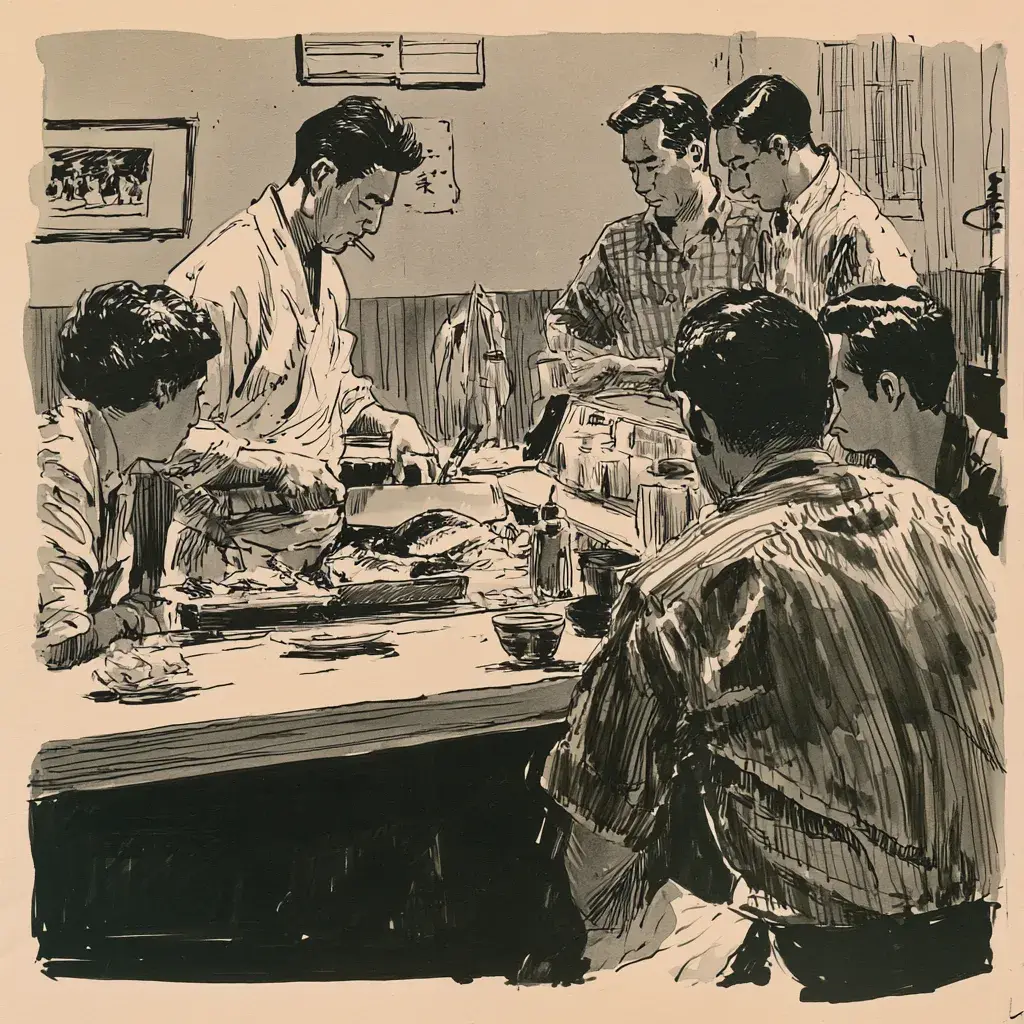
Sometime in the early Bunsei era, spanning roughly 1818 to 1830, Hanaya developed a new style of sushi that departed from the oshizushi then in common use. Oshizushi was pressed sushi, made by compacting rice and fish together, often over time and with some force, into a block that was then sliced. Hanaya's innovation, nigirizushi, instead involved shaping a ball of vinegared rice by hand and topping it with a piece of fish, producing a far quicker and more immediate style of preparation.
This new form of sushi is now recognized as the direct ancestor of Edomaezushi, the Tokyo-style nigiri sushi that eventually became the dominant sushi tradition recognized worldwide. Hanaya is credited not only as the originator of this regional style but, more broadly, as the figure most responsible for the basic form of modern sushi as it is known today.
Working Without Refrigeration
The sushi Hanaya served bore little resemblance to the raw-fish dishes most people associate with sushi now. His ingredients were fish caught fresh from the nearby waters of Tokyo Bay, and in an age before refrigeration, food safety was a serious practical concern even in a coastal city with ready access to seafood. Certain ingredients that are staples of sushi today, such as salmon roe, were entirely absent from his repertoire because there was no reliable way to keep them from spoiling.
To manage this risk, Hanaya either lightly cooked the fish or marinated it, using soy sauce or vinegar as preserving agents. Fatty cuts, such as the belly meat of tuna, spoiled especially quickly and were for this reason unpopular and avoided. Hanaya instead worked with the leaner red meat of the tuna, marinating it in soy sauce before slicing it and placing it atop a rice ball considerably larger than what would be considered standard today.
From Street Stalls to Restaurants
Hanaya's approach represented a real break from established Japanese eating habits, and it took time to become normalized. In its early period, sushi making of this kind was often just a part-time trade rather than a dedicated profession. Gradually, inexpensive sushi stalls known as yatai began to appear around Edo, offering this style of sushi to a broad public as a quick, affordable food rather than a formal meal.
These street stalls eventually drew official disapproval and were outlawed by the government, a move that pushed the sushi trade toward a different model. In the stalls' place, dedicated sushi restaurants, known as ryotei, became the standard setting in which this cuisine was prepared and sold, shifting sushi from a casual street food toward something closer to the restaurant tradition recognizable today.
Death and Lasting Influence
Hanaya Yohei died in 1858 at the age of fifty-nine. By the time of his death, the style of sushi he had pioneered decades earlier was already reshaping how sushi was made and eaten in Edo.
His legacy rests on the basic technique he introduced: hand-shaped vinegared rice topped with a prepared piece of fish, assembled quickly rather than pressed over time. That format, refined through the practical necessities of preserving fish without refrigeration, became the template for Edomaezushi and, ultimately, for the nigiri sushi served around the world today.
Hanaya Yohei: timeline
- 1799Born in Echizen Province, Japan.
- 1810Opened a sushi restaurant called Hanaya in Honjo, Edo.
- 1818-30During the early Bunsei era, developed nigirizushi, a new style distinct from the existing pressed sushi (oshizushi).
- 1818-30Used fish freshly caught from nearby Tokyo Bay, favoring ingredients safe to eat without refrigeration.
- 1818-30To prevent spoilage, lightly cooked or marinated fish in soy sauce or vinegar before serving.
- 1818-30Marinated lean red tuna meat in soy sauce, since the fattier belly meat spoiled too quickly to be popular.
- 1818-30Served sliced marinated fish atop large vinegared rice balls, producing sushi quite unlike today's raw-fish image.
- 1818-30His innovations departed from established Japanese eating customs, initially practiced only part-time by chefs.
- 1818-30Inexpensive sushi stands known as yatai gradually emerged, popularizing this new style of sushi among common people.
- 1858Died at the age of 59.
Listen: stories featuring Hanaya Yohei
Narrated chapters from the Chunks Microlearning app. Read a preview here, or listen to the full story in the app.
Continue Hanaya Yohei's story
You've read the summary — hear the full story as narrated 5-minute chapters on Chunks, alongside 200+ figures and events from history, philosophy and science. Free to start on iOS and Android.