
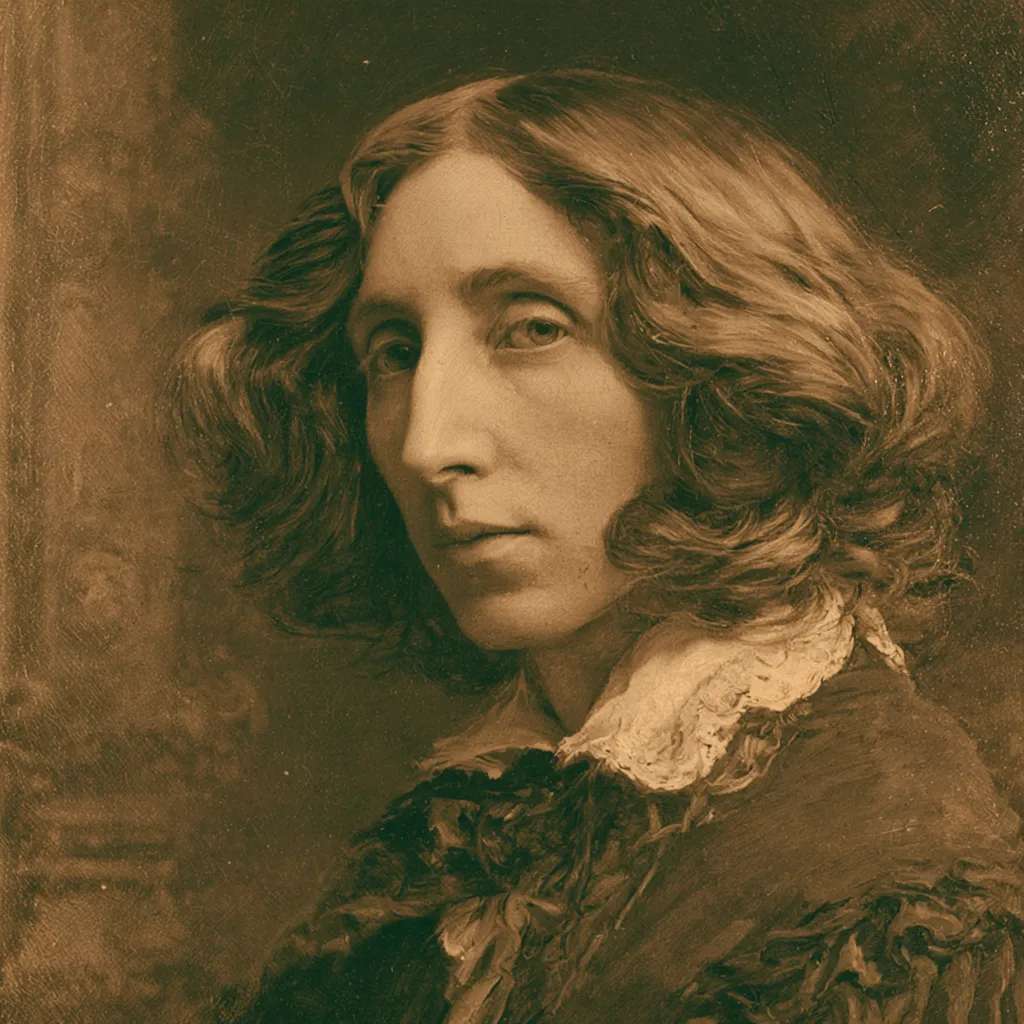
Who was George Eliot?
George Eliot (22 November 1819 – 22 December 1880) was the pen name of English novelist Mary Ann Evans, one of the leading writers of the Victorian era. She adopted a male pseudonym to be taken seriously and escape the stereotype of light women's fiction. Her seven novels, including Middlemarch and Silas Marner, are celebrated for their realism, psychological insight, and vivid depiction of English rural life.
Pen name of Mary Ann Evans, a pioneering Victorian novelist who wrote masterpieces like 'Middlemarch' and 'Silas Marner.' She used a male pseudonym to ensure her work was taken seriously in a male-dominated literary world.
Don't stop at the facts — continue George Eliot's story in free narrated chapters on Chunks.
Or get it straight away:
 Download on iOS
 Download on Android
Quick facts
- Born
- 22 November 1819
- Birthplace
- Nuneaton
- Died
- 22 December 1880
- Place of death
- London
- Nationality
- United Kingdom of Great Britain and Ireland
- Occupation
- Novelist, translator, philosopher
George Eliot: key facts
- Mary Ann Evans, born on 22 November 1819 in Nuneaton, Warwickshire, adopted the pen name George Eliot partly to escape the stereotype of women's writing being limited to lighthearted romances and to have her fiction judged on its own merits.
- George Eliot wrote seven novels, including Adam Bede (1859), The Mill on the Floss (1860), Silas Marner (1861), and Middlemarch (1871–1872), which Virginia Woolf described as one of the few English novels written for grown-up people.
- Before turning to fiction, Evans worked as assistant editor of the Westminster Review from 1851 and produced English translations of David Strauss's The Life of Jesus (1846) and Ludwig Feuerbach's The Essence of Christianity (1854).
- Evans lived openly with the married philosopher and critic George Henry Lewes from 1854 until his death on 30 November 1878, referring to him as her husband at a time when such an arrangement was considered scandalous.
- In May 1880, eighteen months after Lewes's death, Evans married John Walter Cross, a Scottish commission agent twenty years her junior, and took the name Mary Ann Cross.
- George Eliot died on 22 December 1880 in London at the age of sixty-one from a combination of a throat infection and kidney disease, and was buried in Highgate Cemetery beside George Henry Lewes.
- In a 2015 poll of writers from outside the UK, Middlemarch was voted the greatest British novel by a landslide.
From Warwickshire Farm to Victorian Literary Powerhouse
Mary Ann Evans was born on 22 November 1819 at South Farm on the Arbury Hall estate near Nuneaton, Warwickshire. Her father, Robert Evans, managed the estate, and the position gave the family access to the estate's substantial library — an unusual advantage that shaped the voracious reading habits Evans developed from childhood. Because she was not considered physically attractive and therefore not expected to marry well, her father invested in a more rigorous education than most girls of her time received, sending her to a succession of boarding schools between the ages of five and sixteen.
After her mother died in 1836, Evans returned home to keep house for her father. When her brother Isaac married in 1841 and took over the family home, Evans and her father moved to Foleshill, near Coventry. That move proved decisive. Through the wealthy ribbon manufacturer Charles Bray and his wife Cara, Evans entered a circle of radical, free-thinking intellectuals whose guests included Robert Owen, Herbert Spencer, and Harriet Martineau. Exposure to writers such as David Strauss and Ludwig Feuerbach, who questioned the literal truth of Biblical texts, deepened the religious doubts she had been quietly nursing for some time.
Translator, Editor, and the Making of a Public Intellectual
Evans's first major literary project was an English translation of David Strauss's Das Leben Jesu kritisch bearbeitet, published in 1846 as The Life of Jesus, Critically Examined. The book had already caused a sensation in Germany by arguing that New Testament miracles were mythological rather than historical, and the English translation produced a similar reaction — the Earl of Shaftesbury denounced it as the most pestilential book ever published. She later translated Ludwig Feuerbach's The Essence of Christianity in 1854 and completed a translation of Baruch Spinoza's Ethics in 1856, though the latter was not published in her lifetime.
After her father's death in 1849, Evans spent time in Geneva before settling in London in 1850, where she took up lodgings with the radical publisher John Chapman. She became assistant editor of the Westminster Review in 1851, and though Chapman held the official title, Evans did the bulk of the editorial and intellectual work. Her essays and reviews for the journal ranged across religion, society, and contemporary fiction, earning a reputation for writing that was both learned and clear-eyed. She also attended mathematics classes at what would later become Bedford College, London.
The Decision to Write Fiction Under a Man's Name
By the mid-1850s Evans had resolved to write novels, setting out her thinking in a 1856 Westminster Review essay titled 'Silly Novels by Lady Novelists', which attacked the trivial plots that dominated fiction written by women at the time. She adopted the pen name George Eliot — George taken from the forename of her partner George Henry Lewes, and Eliot chosen, as she explained to her biographer J. W. Cross, because it was a good mouth-filling, easily pronounced word. While female authors did publish under their own names during this period, Evans wanted her fiction judged on its merits rather than filtered through assumptions about women's writing, and she also wished to keep her private life from public scrutiny.
The first story published under the name George Eliot, 'The Sad Fortunes of the Reverend Amos Barton', appeared in Blackwood's Magazine in 1857 and was widely assumed to have been written by a country parson. The collected Scenes of Clerical Life followed in 1858 to strong reviews. Adam Bede, her first full novel, arrived in 1859 and was an immediate success, provoking such intense public curiosity about its author that Evans was eventually compelled to acknowledge the pseudonym as her own. The novel's reputation reached Queen Victoria, who was so impressed that she commissioned the artist Edward Henry Corbould to paint scenes from it.
Middlemarch and the Novels That Defined Victorian Realism
Over the following fifteen years Evans produced the body of work that secured her place in English literature. The Mill on the Floss appeared in 1860, followed by Silas Marner in 1861, the historical novel Romola set in fifteenth-century Florence in 1863, Felix Holt, the Radical in 1866, and Middlemarch in 1871 to 1872. Her final novel, Daniel Deronda, was published in 1876. The novels are distinguished by precise psychological observation, a deep sense of place rooted in the English countryside, and a commitment to the kind of realism she had praised in European fiction as a critic.
Middlemarch attracted the most enduring critical admiration. Virginia Woolf described it as one of the few English novels written for grown-up people, and both Martin Amis and Julian Barnes have called it the greatest novel in the English language. In a 2007 poll of authors conducted by Time, Middlemarch was voted the tenth greatest literary work ever written, and in 2015 writers from outside the United Kingdom voted it the greatest British novel by a wide margin. The novel centres on the lives of several inhabitants of a small English town on the eve of the Reform Bill of 1832, and is particularly noted for the sophistication of its character portraits.
Life with Lewes, a Late Marriage, and Death at Sixty-One
The philosopher and critic George Henry Lewes met Evans in 1851, and by 1854 the two had decided to live together openly. Lewes was legally married to Agnes Jervis and remained so, but Evans referred to him as her husband and eventually changed her name to Mary Ann Evans Lewes. The relationship defied the social conventions of the time and drew considerable disapproval, though acceptance came gradually — the couple were introduced to Princess Louise, daughter of Queen Victoria, in 1877. Lewes died on 30 November 1878, and Evans spent months editing his final manuscript for publication.
In May 1880, eighteen months after Lewes's death, Evans married her longtime friend John Walter Cross, a Scottish commission agent twenty years her junior, and took the name Mary Ann Cross. Her brother Isaac, who had broken off relations with her when she began living with Lewes, sent his congratulations. During the honeymoon in Venice, Cross jumped from their hotel balcony into the Grand Canal in what appeared to be a suicide attempt; he survived and the couple returned to England. Evans fell ill with a throat infection shortly after, and this, combined with a kidney disease she had carried for years, brought about her death on 22 December 1880, when she was sixty-one. Because she had rejected the Christian faith and lived outside the bounds of conventional marriage, she was buried not in Westminster Abbey but in Highgate Cemetery, beside George Henry Lewes.
George Eliot: timeline
- 1819Born Mary Ann Evans at South Farm on the Arbury Hall estate near Nuneaton, Warwickshire, the third child of estate manager Robert Evans.
- 1836Her mother Christiana died, and Evans returned home to act as housekeeper for her father, continuing her self-education through access to the Arbury Hall library.
- 1841After her brother Isaac married and took over the family home, Evans moved with her father to Foleshill near Coventry, where she entered the radical intellectual circle of Charles and Cara Bray.
- 1846Published her first major literary work, an English translation of David Strauss's Das Leben Jesu as The Life of Jesus, Critically Examined, causing a sensation in England.
- 1854Began living openly with the married philosopher and critic George Henry Lewes, travelling with him to Weimar and Berlin and considering herself his wife, in defiance of Victorian social convention.
- 1859Published Adam Bede, her first full novel, to immediate popular and critical success, prompting her to publicly acknowledge the pen name George Eliot as her own.
- 1871–1872Published Middlemarch, later described by Virginia Woolf as one of the few English novels written for grown-up people and voted by writers the greatest British novel.
- 1876Published Daniel Deronda, her final novel, after which she and Lewes retired to Witley, Surrey.
- 1878George Henry Lewes died on 30 November, leaving Eliot devastated; she spent the following months editing his final work, Life and Mind, for publication.
- 1880Married her longtime friend and financial adviser John Walter Cross, a Scottish commission agent twenty years her junior, taking the name Mary Ann Cross.
- 1880Died in Chelsea, London, at the age of sixty-one from a throat infection combined with kidney disease, and was buried beside Lewes in Highgate Cemetery.
Listen: stories featuring George Eliot
Narrated chapters from the Chunks Microlearning app. Read a preview here, or listen to the full story in the app.
Continue George Eliot's story
You've read the summary — hear the full story as narrated 5-minute chapters on Chunks, alongside 200+ figures and events from history, philosophy and science. Free to start on iOS and Android.